



October 2026: Navigating Bangladesh’s Shifting Tobacco Market
As one of the world’s top 10 cigarette markets by volume, Bangladesh occupies a central position in the global tobacco landscape. Dominated heavily by British American Tobacco (BAT) Bangladesh, the market serves as a primary source of indirect tax revenue for the government. Following sharp excise tax increases on traditional cigarettes introduced in 2025, the national budget for the 2026–27 fiscal year has shifted attention toward alternative nicotine categories. However, the new budget also highlights a distinct regulatory dichotomy: while electronic cigarettes (e-cigarettes/vapes) remain strictly prohibited with no fiscal mention, other alternative nicotine formats like pouches and heated tobacco products (HTPs) have been formally introduced into the tax net.
Bangladesh’s nicotine landscape is anchored by a vast conventional cigarette market. Consistently ranking among the top volume consumers globally, the sector operates under a multi-tiered ad-valorem taxation structure. The industry experienced significant structural headwinds after the government enacted steep excise duty hikes and retail price adjustments across all cigarette tiers in 2025. The 2025 excise measures placed noticeable volume and profit pressure on market leader BAT Bangladesh and other manufacturers as higher tax burdens trickled down to retail prices. The high reliance on cigarette duties underscores the state’s ongoing need for fiscal yield, balancing health objectives with the revenue generated by a major consumer market. Having tightened fiscal terms on conventional cigarettes, policymakers addressed novel and emerging nicotine formats in the 2026-27 budget.
In stark contrast to other emerging categories, e-cigarettes and vaping devices are completely omitted from the FY2026-27 budget schedule. This fiscal silence directly reflects the country’s existing regulatory prohibition: building on earlier import restrictions and public health directives, Bangladesh maintains a strict ban on the import, sale, and commercial distribution of vaping products. By leaving vapes out of the budget schedule altogether, the National Board of Revenue (NBR) avoids assigning them a duty structure – preventing any implicit tax-based recognition or legal authorization of vaping devices. While vapes remain explicitly barred, the budget takes a completely different path for other non-combustible nicotine products.
Unlike e-cigarettes, the FY2026-27 budget explicitly brings nicotine pouches and Heated Tobacco Products (HTPs) into the formal fiscal structure. Nicotine pouches with a maximum retail price (MRP) of up to Tk 500 per 10 grams are assigned a 40% supplementary duty. To deter unmonitored local filling, bulk imports of raw nicotine granules face a 350% supplementary duty. HTPs are subjected to a 67% supplementary duty based on a benchmark MRP of Tk 210 per 10 sticks.
The introduction of explicit tax tiers for pouches and HTPs – alongside the complete prohibition of vapes – creates two distinct operational environments:
| Category | Policy Approach | Fiscal Status (2026-27 Budget) | Market Status |
| Traditional Cigarettes | High Excise / Rate Hikes | Multi-tier ad-valorem excise | Dominant; ongoing volume pressure post-2025 tax hikes |
| E-Cigarettes | Complete Prohibition | Unmentioned / Untaxed | Banned from import, manufacture, and formal sale |
| Nicotine Pouches | Formal Tax Integration | 40% SD (Retail) / 350% SD (Bulk imports) | Recognized under formal tax schedule |
| Heated Tobacco (HTPs) | Formal Tax Integration | 67% SD (MRP Tk 210/10 sticks) | Recognized under formal tax schedule |
Proponents of this split policy argue that banning vapes while taxing pouches and HTPs allows the state to curb high-risk youth vaping trends while creating traceable, taxable avenues for other reduced-risk formats. Conversely, market analysts note that tax integration may outpace comprehensive statutory framework updates governing the retail marketing and public consumption of alternative categories. As Bangladesh navigates the 2026-27 fiscal year, the market landscape is defined by tight enforcement on conventional cigarettes, a firm legal wall against e-cigarettes, and a new tax framework for emerging oral and heated alternatives.
June 2026: Bangladesh Brings Nicotine Pouches and Heated Tobacco Products Into National Tax Framework
Bangladesh has, for the first time, formally brought nicotine pouches and heated tobacco products (HTPs) into its national tax framework. Under the proposed fiscal year 2026-27 budget, Minister of Finance introduced new tariff classifications for nicotine granules and nicotine pouches and proposed a 350% supplementary duty on these products. The measures form part of a broader package aimed at increasing taxes on tobacco and nicotine products.
The proposal comes months after the interim government approved amendments to tobacco control legislation intended to tighten restrictions on emerging nicotine products. Public health advocates have argued that placing nicotine pouches within a formal tax framework could be interpreted as official recognition of the products as legitimate commercial goods. They contend that the move departs from earlier proposals that sought stricter controls on emerging nicotine products and may be difficult to reconcile with Bangladesh’s commitments under the WHO Framework Convention on Tobacco Control (FCTC). Previously, the Government had reiterated its long-term objective of achieving a tobacco-free Bangladesh by 2040.
The debate has intensified following approval for Philip Morris International (PMI) to establish a nicotine pouch manufacturing facility in Narayanganj. The project, approved by the Bangladesh Economic Zones Authority (BEZA), involves an initial investment of USD 5.8 million and is designed to produce more than 500 million nicotine pouches (25 million cans) annually. The project is intended primarily for the domestic market and remains subject to additional regulatory clearances, including environmental approvals.
The factory approval has faced opposition from anti-tobacco groups, which argue that it conflicts with Bangladesh’s tobacco-control objectives and could increase the availability of emerging nicotine products. Supporters of the project, however, note that nicotine pouches are not currently prohibited under Bangladeshi law and therefore remain a legal product category.
May 2026: BAT Bangladesh Profit Falls 34% as Cigarette Volumes Drop 14% in Q1 2026
British American Tobacco (BAT) Bangladesh reported a sharp deterioration in first-quarter 2026 results, with cigarette sales volumes declining 14% year-on-year from 10.74 billion sticks to 9.23 billion sticks. The weaker cigarette demand was driven primarily by persistent inflation, reduced disposable income, and higher tobacco taxes.
Gross revenue fell 9% to Tk87.25 billion, while the share of Supplementary Duty and VAT in gross revenue increased from 80.6% to 83.7%. As a result, net revenue declined 23% to Tk14.33 billion. Operating expenses increased 41% year-on-year, further weighing on profitability.
Net profit dropped 34% to Tk2.095 billion, while earnings per share declined from Tk5.89 to Tk3.88. BAT Bangladesh additionally reported negative operating cash flow, citing weaker sales collections and higher interest payments linked to increased reliance on short-term borrowing for working capital needs.
With its head office in Dhaka, BAT Bangladesh manufactures and markets brands including Benson & Hedges, John Player Gold Leaf, Capstan, Star, Royals, Lucky Strike, Luckies, Derby, Pilot, and Hollywood. The company operates a cigarette factory in Savar, a green leaf threshing plant in Kushtia, a green leaf redrying plant in Manikganj, and multiple leaf and sales offices across Bangladesh.
December 2025: Bangladesh Tightens Tobacco Laws with New Anti-Tobacco Ordinance
Bangladesh’s Advisory Council has approved the Smoking and Tobacco Products Usage (Control) (Amendment) Ordinance, 2025, a major overhaul of the country’s tobacco control framework aimed at reducing tobacco use and related harms. The ordinance expands the legal definition of tobacco products to include e-cigarettes, electronic nicotine delivery systems (ENDS), heated tobacco products, and nicotine pouches, and imposes comprehensive bans on their production, marketing, and use. It also prohibits smoking and the use of all tobacco products in all public places and public transport, tightens regulations by expanding the definitions of these spaces, and subjects designated smoking areas to government direction. All forms of tobacco advertising, promotion and sponsorship – including online and point-of-sale displays – are outlawed, and health warnings on packaging must now cover 75 % of the surface. Public health advocates have welcomed the ordinance as a vital step toward curbing tobacco-related illnesses and deaths in Bangladesh, where tobacco remains a leading cause of premature mortality.
October 2025: BAT Bangladesh reports 23% profit decline in Q3 2025
British American Tobacco (BAT) Bangladesh reported 18% revenue and 23% profit decline in Q3 2025 amid significant sales volume decline. Moreover, higher excise duty and additional costs due to the closure of Dhaka factory weighed on the profitability. In the first nine months of 2025, domestic sales declined 20% to ৳52.31 billion while tobacco leaf exports increased 78% to ৳3.70 billion. Total sales declined 17% to ৳57.55 billion (US$470 million). The profit declined 46% to ৳7.2 billion (US$59 million). BAT Bangladesh had shut down its Dhaka factory in July 2025 following a court order, relocating operations to a new site in Ashulia. The Company incurred one-off exit costs amounting to ৳2.12 billion which weighed on the profit for the period.
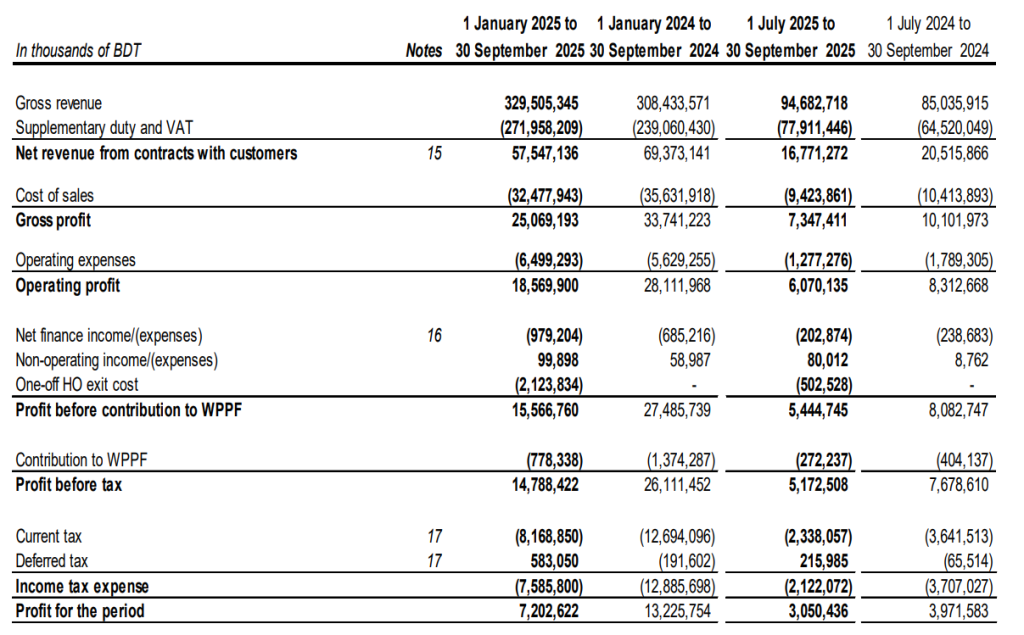
BAT markets Benson & Hedges, John Player Gold Leaf, Lucky Strike, Capstan, Star, Royals, Derby, Pilot, Flag and Hollywood cigarettes in Bangladesh. In the first nine months of 2025, BAT Bangladesh paid ৳272 billion (US$2.22 billion) in supplementary duty & VAT – almost 14% more than the same period in 2024 despite a significant decline in sales volume.
June 2025: BAT Bangladesh will shut down the Mohakhali, Dhaka factory and relocate its HQ
British American Tobacco (BAT), Bangladesh’s largest cigarette manufacturer, will shut down operations at the Mohakhali, Dhaka factory from July 1, 2025 following the Supreme Court’s rejection of its appeal to extend the land lease agreement. The Company will also relocate its head office to Ashulia, is a suburban area near Dhaka.
BAT Bangladesh has been leasing the factory premises from the Dhaka Cantonment Board since 1964. Each lease term spans 30 years, with the option to renew for a total duration of up to 90 years. The Board declined to extend the lease which led BAT Bangladesh to initiate legal proceedings for the enforcement of contractual rights. Both the High Court and the Appellate Division dismissed BAT Bangladesh’s case.
BAT Bangladesh has three factories located at Mohakhali (Dhaka), Savar and Manikganj, and a green leaf trash plant in Kushtia. The Company made ৳432 billion ($3.5 billion) gross revenue, ৳99.4 billion ($810 million) net revenue (after supplementary duty and VAT) and ৳17.5 billion ($140 million) profit in 2024.

