


Release date: February 8, 2023 (before the opening bell)
BAT already released an Interim Business Update (IBU) on December 6, 2023. Recall: Our “BAT: Interim Business Update” write-up. Thereby, for the FY23 Results release, focus will be on: (1) numerical details of the business update; (2) any deviations & changes versus the IBU; (3) any new disclosures.
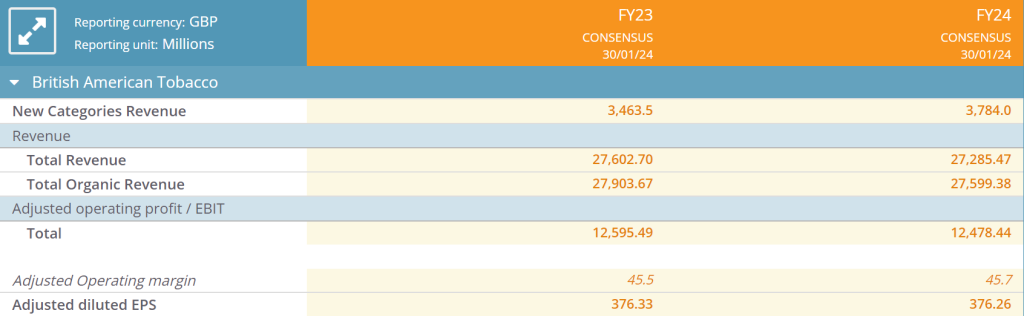
Sell-side analyst expectations
Revenue: £27.9Bn in FY23 (-1.1% decline in FY24)
Operating profit: £12.6Bn in FY23 (-0.9% decline in FY24)
EPS: £3.76 in FY23 (flat in FY24)
Latest FY23 Guidance
At the IBU, BAT reaffirmed the FY23 guidance: organic revenue growth in the low end of 3-5% and mid-single digit EPS growth.
What to watch out for?
Market will carefully watch 6 key points at the BAT’s Interim Update:
1. US cigarette volume decline
In H1 2023, BAT generated 53.5% of its operating profit in the US and more than 90% of BAT’s US revenue is associated to the traditional products (cigarettes & smokeless) – which are under massive volume pressure. In H1 2023, BAT reported 12.4% and 17.2% volume decline in cigarettes and traditional smokeless, respectively.
At the IBU, BAT Management underlined that
– macro-economic pressures and the continued proliferation of illicit disposable vapes are impacting combustibles industry volume in H2 2023 in the US with recent signs of premium segment pressure
– although the US volume share is down -10bps (YTD Oct’23 vs. FY22), commercial plans continue to show early signs of share recovery with +50bps improvement between January and October driven by Newport, Natural American Spirit and Lucky Strike.
Although BAT’s overall volume share continued to decline in Q4 2023, the latest NielsenIQ data confirm that
– BAT’s volume share loss in Q4 is less steep than the previous quarters
– BAT’s Q4 volume performance is slightly better than Altria’s (i.e. share gain in the premium segment category?)
– BAT may have gained (marginal) volume share in the first two weeks of 2024.
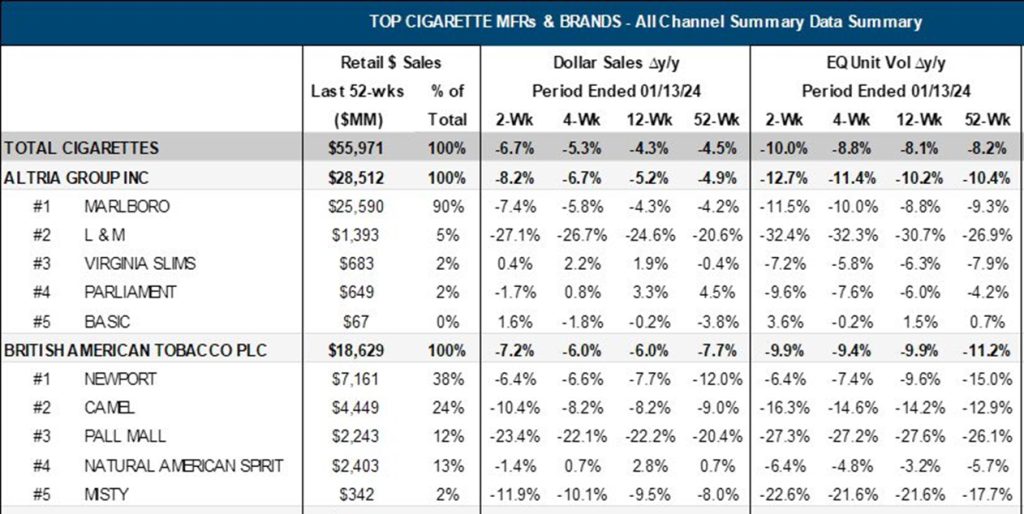
In summary, although the overall market shows no signs of moderation in volume decline, BAT seems to have improved its position in the US Market. However, Altria is reporting one week ahead of BAT and Altria’s results (if disappointing across the board) could trigger a selling pressure in BAT shares.
2. New Category Performance
At the IBU, BAT Management stated that
– New Category contribution is expected to broadly break-even in 2023 (two years ahead of the original 2025 target)
– Vuse extended its global leadership position in e-vapor (in tracked channels & closed systems only) while Velo is the distant nicotine pouch category leader in Europe with 67% volume share in key markets (yet, almost wiped out of the key US market)
– glo continues to disappoint in the heated tobacco category with deceleration in organic volume and revenue growth in H2 2023.
The latest NielsenIQ data indicates that the volume decline in the tracked (legal) US e-cigarette market is worsening. BAT lacks competitiveness in the key US nicotine pouch market until the PMTA for the Europe-leading Velo 2.0 platform is approved by the US FDA. Finally, glo Hyper Air (the latest & greatest glo) is unlikely to be a game changer in the heated tobacco category. All in all, risks are still skewed to the downside in term of new category performance.
3. Finance costs
In H1 2023, BAT’s net finance costs were up +12.7% to £921Mn (+10.7% on adj. constant currency basis), mainly due to the higher interest expense. The average cost of debt has increased to 4.3% from 4.0% in FY22. In FY23, BAT expects its net finance cost to reach £1.9Bn.
Market would assess whether (or not) the financial benefit of reduced debt is washed out by the increasing interest rates.
4. Deleveraging & Share Buybacks
In February 2023, BAT shocked the markets by pausing its share repurchase program. Market expects BAT to re-initiate the program when its leverage (Net Debt/Adj. EBITDA ratio) is reduced sufficiently (from 2.89x at the end of 2022) close to the middle of the 2-3x range. Recall: our “Share Buybacks” write-up.
At the IBU, BAT stated that adj. Net Debt / EBITDA leverage will be ~2.7x at the end of 2023. Re-initiation of the share buyback program is the most important expectation of many market players. However, a small-sized program (£1Bn) is the maximum BAT can afford for the time being (if ever). Would a modest program be effective in supporting the BAT share price? Should BAT Management avoid caving into the short-term market pressure and focus on debt reduction? These are valid questions that are up for discussion.
5. Balance sheet flexibility
At the IBU, BAT stated that they continue to evaluate all opportunities to enhance balance sheet flexibility, including disposals and the exit of non-strategic markets. Any further disclosures on the revived corporate strategy could help build confidence on the new BAT Management’s ability to think out of the box.
6. FY24 guidance
FY24 expectations are already lowered to “no growth” by the sell-side (- see the Table above). However, at the IBU, BAT guided a low-single digit revenue and operating profit growth in FY24 (at constant rates). Accordingly, the guidance risk is skewed to the upside (i.e. guidance could beat “expectations”).
Price action: The next 10 days will feature both Altria’s and BAT’s FY23 Earnings releases. BAT marked its latest 52-week low at $28.35 (£22.33) following the Interim Business Update (December 6, 2023). If BAT could escape a new 52-week low in the next 10 days, market confidence on bottom formation (marking the end of the 2-year decline trend) could increase significantly.

