


Top-line1
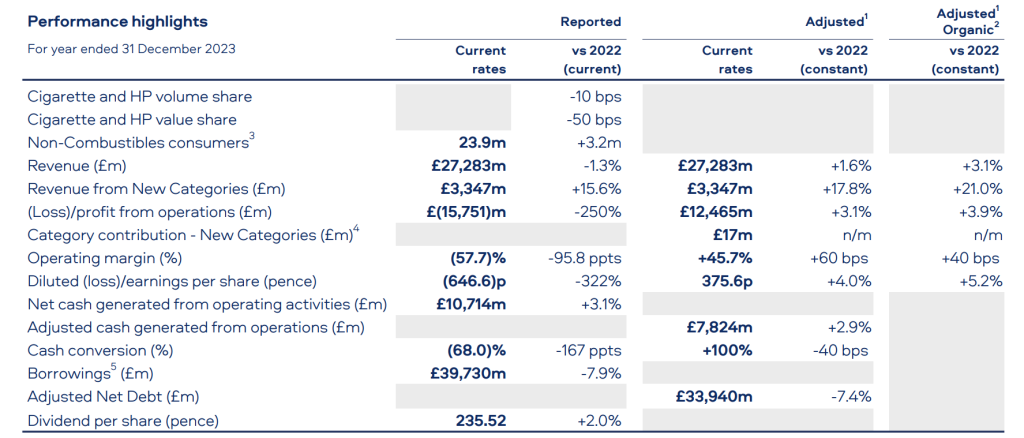
– Revenue: £27.28Bn (vs. £27.9Bn expected)
– Reported Revenue: down -1.3%, largely due to the sale of Russian business as well as the impact of lower cigarette volume (mainly in the US) and a translational FX headwind of 2.9% (due to the relative strength of £, particularly against the US$, JPY, Pakistani rupee and Bangladeshi taka)
– Organic Revenue: up +3.1% (New Categories up +21%)
– New Categories Revenue: 12.2% of total
– Combustibles Revenue: up +0.6% with price/mix improvement of +6.1% offset by lower volume and geographic mix mainly due to macro-economic pressures in the US (impacting the premium segment) and despite the strong performance in AME and APMEA
– Cigarette volume: down -5.3% on organic basis (down -8.2% reported), mainly driven by the US cigarette volume decline of 11.4%. Global industry volume is down by -3.5%
– £27.6Bn non-cash impairment charge mainly related to the acquired US combustibles brands
Bottom-line
– Adj. Operating Profit: £12.47Bn (vs. £12.6Bn exp.)
– Adj. Operating Margin: 45.7% (vs. 45.5% exp.)
– Contribution from New Categories: £17Mn (break-even achieved two years ahead of original target)
– Adj. EPS: £3.76 (vs. £3.76 exp.)
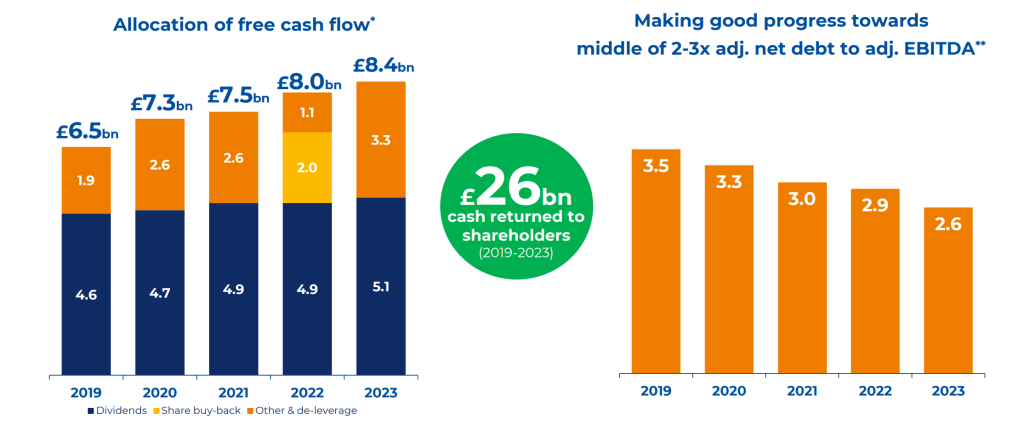
– Adjusted net debt / adjusted EBITDA down to 2.6x
– Dividend increase: +2% to £2.355
FY24 Guidance
– Global tobacco industry volume: down ~3% mainly due to the US and Indonesia
– Low-single digit organic revenue operating profit growth ( including ~2% transactional FX headwind)
– Continue to progress towards “£5Bn New Category revenue in 2025” ambition (from £3.35Bn in FY23)
– Performance to be H2-weighted given planned investment phasing and slow recovery in the US
– Translational FX headwind of 3% on FY24 operating profit growth
– Operating cash flow conversion in excess of 90%
– Further progress towards the middle of 2-3x adj. net debt/adjusted EBITDA corridor
– Progressively build back to deliver 3-5% revenue and mid-single digit operating profit growth by 2026
– ~£40 billion free cash flow before dividends over the next five years. Committed to a progressive dividend. Once the leverage target (middle of 2-3x) is reached, share buybacks will restart (“further opportunity to return excess cash to shareholders”)
Key Highlights – the US Market:
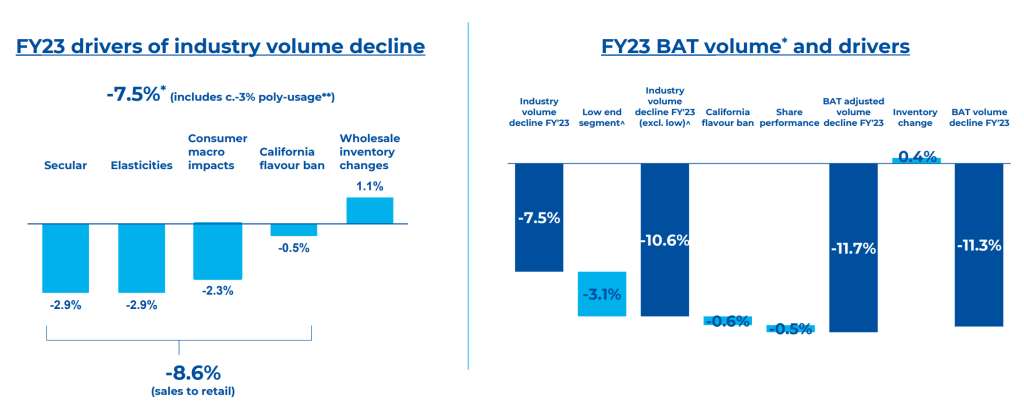
– Combustible: volume -11.3%, revenue -6.4%
– Combustible volume loss (-11.3%) explained as: Market decline (-7.5%) + Non-participation in the low-end segment growth (-3.1%) + Share loss (-0.5%; downtrading driving a greater proportional effect on BAT’s premium skewed portfolio) + California menthol ban (-0.6%) + Inventory movement (+0.4%)
– Increased use of alternative nicotine products, driven by the growth of illicit disposable vapes
– Combustibles share: volume share down -10 bps; value share down -60 bps (although volume share returned to sequential growth during 2023)
– Commercial plans delivering early signs of portfolio stabilization with volume share up +40 bps since January 2023 (driven by Newport and the continued strength of Natural American Spirit and Lucky Strike)
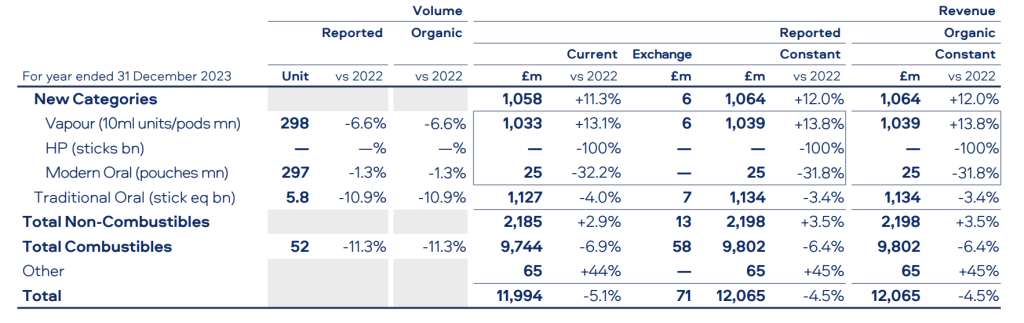
– Vapour (Vuse): volume -6.6% (due to the growth of illicit disposable vapes – now estimated to be more than 60% of the total market), revenue +13.8% (substantial net price increases)
– Revenue: -4.5%, Operating profit: +0.4% => Operating margin up +280bps to 56.9%
Key Highlights – New Categories (NGP):
– Break-even achieved. This is a very important achievement as – excluding the distant category leader, PMI – there is no other major tobacco company that comes close to break-even in NGPs (the next one: Japan Tobacco in 2028)
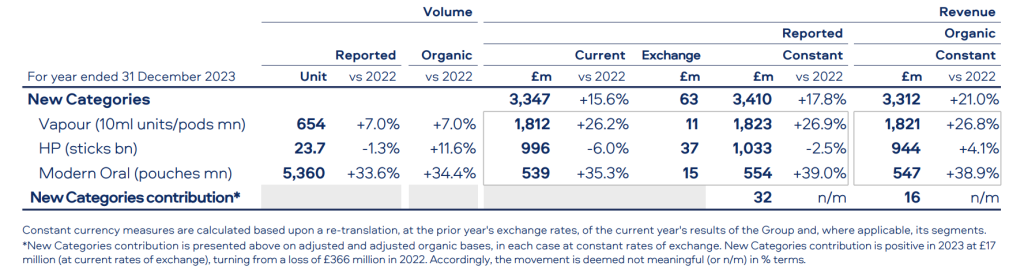
– Revenue: +21% (e-cigarette +26.8%; heated tobacco +4.1%; modern oral +38.9%)
– Vapour (Vuse): +7% volume growth coupled with strong pricing. 11.5Mn consumers in total (up +1.5Mn in 2023). Vuse value share up +30 bps, reaching 36.1% in key vapour markets (a self-defined subset of the overall e-cigarette market). Disposable vapes continue to accelerate total category growth. Vuse GO now available in 59 markets. Vuse extended leadership in value share by +470 bps to 45.6% in the US (tracked channels only). Four of the five key vapour markets profitable – driven by pricing, increased scale and marketing effectiveness
– Heated tobacco (glo): Volume up +11.6% and revenue up +4.1% (excluding the sale of Russian business). Global category volume growth slowed down to 13% due to the growth of disposable vapes and despite the elevated investment (i.e. competitive activity). glo volume share in key markets declined -110 bps to 18.2%. glo Hyper Air now launched in 23 markets. veo is now available in 11 markets. Hyper pro launched in Italy and Poland with further geographic roll-outs planned in 2024
– Modern oral (Velo): 3.3Mn users in total (+26%). US Market in a standstill (awaiting the outcome of PMTA submission for new Velo product). Overall volume up +34.4% despite the US (volume down -1.3%). Outside the US, clear volume share leadership maintained, with Mini pouches and Max ranges driving strong growth. Strong growth in new markets: Pakistan and Kenya
Regional Highlights:
– AME Region: Revenue +13.0% (excluding the sale of Russian business)
– APMEA Region: Revenue +5.5% (driven by higher combustibles volume in Bangladesh and combustibles pricing in Pakistan). Lower revenue in Heated Products (down -7.3%), driven by the price repositioning in the highly competitive Japanese market and the final step in the five-year excise harmonization plan in Japan.
Other Business Highlights:
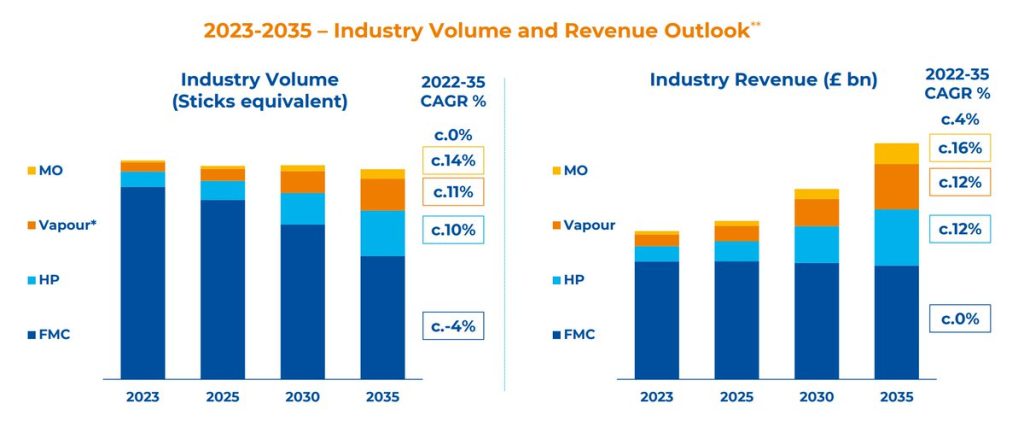
– Long-term Nicotine Industry growth (2022-35): flat overall industry volume (decline in combustibles fully washed out by the NGP growth, +4% CAGR in revenue
– ITC stake sale: Actively working on completing the regulatory process required to monetize some of ITC shareholding (in a pursuit to release & reallocate some capital to enhance balance sheet flexibility). Need to keep a minimum of 25% stake in order to maintain the veto rights; this means that ~4% stake reduction (~$2.5Bn in market value) is foreseen
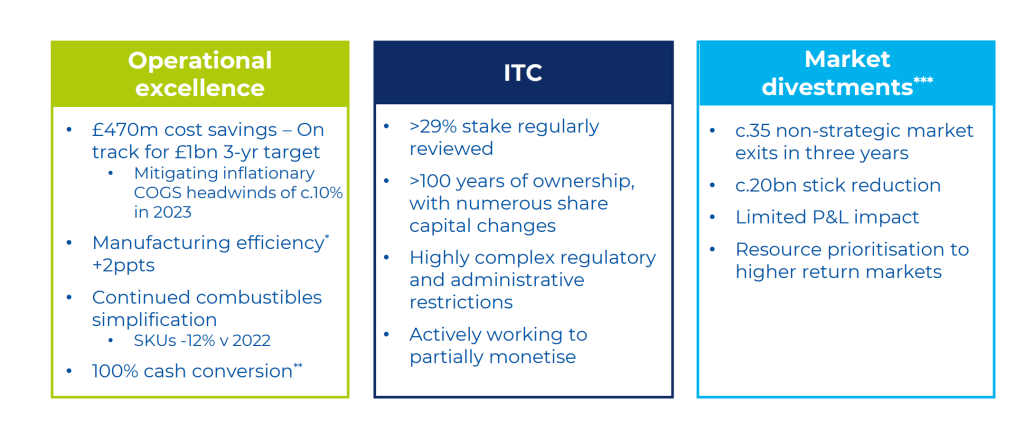
– 35 non-strategic markets (with 20Bn sticks volume in total) to be exited in three years
– In Dec 2023, BAT submitted MRTP application to the US FDA for the Glo Hyper device (- BAT still believes that vaping has much more potential than heated tobacco in the US, but took a precautionary action in case the category’s growth surprises)
– Average debt maturity: 10.5 years. Fixed debt profile of ~95% and close currency matching. Medium-term rating target remains Baa1/BBB+/BBB+, with a current rating of Baa2 (positive outlook), BBB+ (negative outlook), BBB (positive outlook), from Moody’s, S&P and Fitch, respectively
– Borrowings & Net Debt: Borrowings are £39.7Bn at the end of 2023 (i.e. down -7.9% from £43.1Bn at the end of 2022, partly due to the FX movements). Net debt is £34.6Bn at the end of 2023 (i.e. down -11.8% from £39.3Bn at the end of 2022)

– FY24 gross capital expenditure: £550Mn, mainly related to the operational infrastructure, including the expansion of New Categories portfolio
– ESG: 2023 MSCI rating upgraded to A (from BBB in 2022). Achieved targets for water withdrawn and waste
Summary:
Overall, the key issues persist: cigarette volume decline in the US, under-performance in heated tobacco and competitive environment becoming more challenging in e-cigarettes. However, all these issues are already well-known and priced in. Recall: BAT: H1 2023 Results
Yet, today is likely to be the day Market remembers that BAT is a powerful cash cow: pays £5+Bn in dividends and reduces £4+Bn debt in one year. Market will also like that
– ITC stake sale is explored to enhance balance sheet flexibility (release & reallocate capital)
– adj. net debt / EBITDA is down to 2.6x (pre-announcement expectation: 2.7x)
– BAT is sticking to the low-single digit revenue and operating profit growth guidance (Recall: FY24 expectations were already lowered to “no growth” ahead to the FY23 Results release and, in our BAT – FY23 Results: Preview write-up, we underlined that FY24 guidance is likely to beat expectations)
– global nicotine industry volume is not declining (while the industry turnover is growing by +4% per annum on the long-run)
We repeat our final thought from the BAT – FY23 Results: Preview: if BAT escapes a new 52-week low in this earnings period, market confidence on bottom formation (marking the end of the 2-year decline trend) will increase significantly.
References:

