


ITC is the tobacco market leader in India, world’s most populous country, and is the fourth largest publicly-traded tobacco company in the world by market cap. ITC is also the seventh largest Indian company by market cap – a list led by giants like Reliance Industries, TATA and HDFC.
Brief History: Who is BAT in ITC?
“Imperial Tobacco Company of India” is established as a British American Tobacco (BAT) subsidiary in Calcutta in 1910. In 1954, ITC was converted into a public limited company as a first step towards Indian ownership. In parallel to the increasing Indian ownership, the company was renamed as “India Tobacco Company” in 1970 (-morphed into “I.T.C. Limited” in 1974 and “ITC Limited” in 2001). BAT is still ITC’s largest shareholder with 29.2% stake. Indian state-run/controlled companies own 28.5% of the company.
Relationship with BAT
BAT repeatedly wanted to increase its stake in ITC in the past – to hit the “Indianisation” wall each time. BAT’s ambition eventually backfired when India banned foreign investment in cigarette manufacturing in 2010. Moreover, the relationship between BAT and ITC remained tarnished since the infamous “BAT-ITC Tussle” of mid-90s (- which eventually led BAT to publicly demand the resignation of ITC Chairman). Most recently (July 2023), BAT’s CEO disclosed that he was made aware about the ITC Board’s decision to spin-off the hotel business a day before the public announcement.
Business
Having relied on the tobacco business since 1910, ITC has been in pursuit of diversifying its business and reducing its reliance on tobacco since 2000s. Admittedly, with great success: the weight of tobacco in total ITC revenue is now down to 37% (from almost two thirds a decade ago). However, tobacco, as a high-margin business, is still the core profit generator for the company (76% weight in overall operating results).
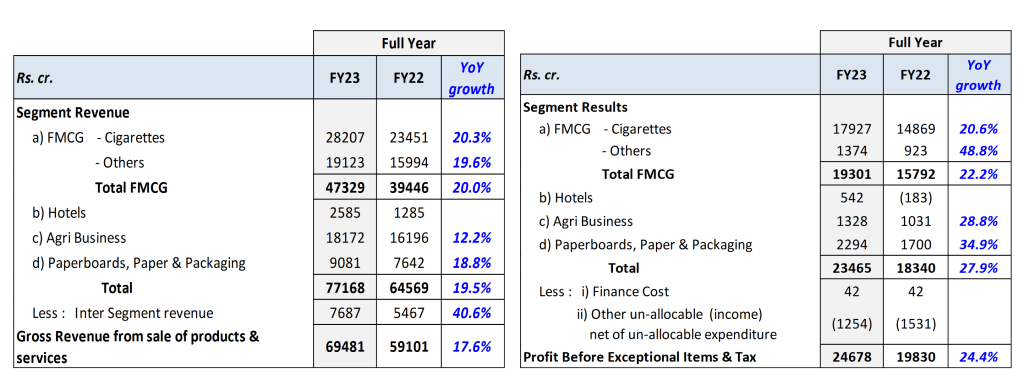
ITC’s growth in the consumer goods business (“FMCG Others”: snacks, biscuits, noodles, dairy, beverages, personal care products ) has been especially remarkable: the segment delivered a two-hundredfold (200x) revenue increase over the past two decades and ITC now holds a leadership position in multiple consumer goods sub-categories. Agri-business (wheat/spice/dairy sourcing for branded packaged food companies and tobacco leaf exports) is also an growing revenue source for ITC. Moreover, as a higher-value strategic sourcing support opportunity, ITC is developing a manufacturing facility at Mysuru to export nicotine & nicotine derivative products to the US/EU.
BAT’s stake
At the time of writing, the market cap difference between BAT and ITC is down to mere US$2Bn. BAT’s 29.2% stake in ITC is now worth US$19.6Bn (at face value, equivalent to 28% of BAT’s total market cap or $8.3 per BAT share). Two companies are obviously trading at two totally different P/E multiples: ITC at 27x whereas BAT at 6.4x. Market – rightly or wrongly – values ITC for “growth & prosperity” and BAT for “decay & extinction”.
Market heavily discounts BAT’s stake in ITC – on the presumption that even if BAT extracts economic value from its ITC ownership, ITC stake means little when it comes to the strategic imperatives.
– BAT’s share of ITC’s post-tax results was £514Mn in 2022 – when exposed to BAT’s “depressed” valuation multiples, the value of the stake is nowhere close to ~US$20Bn
– It is almost impossible for BAT to exit its stake without taking a major loss as it would be very difficult to find a local buyer that can pay US$20Bn (FDI rules prohibit the entry of foreign investor to the Indian tobacco market)
– BAT has little to say in ITC’s strategic direction and cannot leverage ITC’s strength to grow in the massive Indian market with NGP/RRPs. All NGPs/RRPs are banned in India (- although India could be a mega nicotine pouch market as the total smokeless tobacco consumption in India is bigger than the rest of the world combined).
– “Indianisation” is ongoing. India still wants BAT out and will continue to make life difficult for BAT (presumably, through share dilution).
When asked about the ITC stake, BAT CEO mentioned that the BAT Board is regularly assessing the ITC stake and there are immense legal and regulatory hurdles in India. To our ears, he said it is not straight-forward to monetize or build on the ITC stake. Thereby, the BAT-ITC saga is set to continue.
Our Selection of “Good Reads”

