


September 2026: Canada Rejects Calls to Ease Nicotine Pouch Rules Despite Industry Pressure
Federal Health Minister Marjorie Michel has pushed back against growing industry lobbying, confirming that the government has no intentions of loosening strict regulations governing nicotine pouches. The announcement comes in response to mounting campaigns from convenience retailers and tobacco-affiliated groups, urging the federal government to permit broader retail sales. Proponents of wider access have argued that opening up sales in convenience stores and gas stations would help combat the illicit market.
However, Michel firmly dismissed those proposals. Under current Health Canada rules, authorized nicotine pouches are strictly regulated as smoking-cessation aids and are restricted to behind-the-counter sales at pharmacies. Only a single brand, Zonnic owned by British American Tobacco (BAT), has secured federal approval for sale under those conditions, with strict caps on nicotine strength (4 mg) and flavor options to limit youth appeal.
While public health and tobacco control organizations acknowledge that unauthorized, grey-market products continue to breach retail channels, they argue that relaxing restrictions is the wrong solution. Instead, advocacy groups are pressing health authorities to crack down harder on illicit online and physical vendors, warning that easier access risks reversing progress against youth nicotine addiction.
September 2026: Canada Reevaluates Pharmacy-Only Rule for Nicotine Pouches as Convenience Store Industry and Provinces Push for Retail Access
Canada’s federal government is reportedly considering easing sales restrictions on nicotine pouches, potentially allowing authorized products to return to convenience store shelves and gas stations across the country. According to media reports, senior federal officials indicate that Ottawa is open to revisiting its 2024 policy framework following mounting pressure from provincial leaders, convenience store operators, and harm-reduction advocates. While discussions are underway, government sources note that no official decision has been made and the policy shift is not currently considered a top federal priority.
The debate centers on where authorized nicotine replacement therapy products can be legally sold. In August 2024, Health Canada introduced rules restricting nicotine pouches to behind-the-counter pharmacy sales under pharmacist supervision, citing concerns over youth access and appeal. The regulations also capped nicotine content at 4 milligrams per pouch, restricted flavors strictly to mint and menthol, and banned youth-oriented packaging. Before these restrictions took effect, Imperial Tobacco Canada’s Zonnic – the sole nicotine pouch brand authorized under Health Canada’s Natural Health Products framework – was widely available in convenience stores and gas stations before being forced exclusively into pharmacy channels.
Pressure to reconsider the pharmacy-only rule has built steadily across political and corporate sectors. Alberta Premier publicly called on the federal government to ease restrictions, questioning why authorized 4 mg nicotine pouches face tighter sales limits than traditional cigarettes. Ontario health officials have also raised the issue with federal counterparts, while major convenience store operators have actively lobbied senior federal officials. Advocates and retailers argue that convenience stores already possess robust age-verification systems and that widening access helps adult smokers access lower-risk alternatives.
A potential shift in retail placement would not represent a broader deregulation of Canada’s nicotine market. Health Canada continues an aggressive enforcement campaign against unauthorized, high-dose imports, such as illicit 6 mg to 35 mg pouches, that bypass federal safety standards entirely. If Ottawa moves forward with easing the restrictions, the policy change would strictly re-open convenience store distribution for legally licensed, low-dose nicotine replacement products while maintaining strict enforcement against illegal high-strength imports.
April 2026: As Part of 2035 Smoke Reduction Goal, Canada Considers ‘Smoke-Free Generation’ Ban Inspired by UK
Canada’s federal government is examining the introduction of a generational tobacco ban that would permanently prohibit the sale of tobacco products to anyone born after 2008. The proposal, still under consideration, reflects a more structural approach to tobacco control, aimed at preventing future uptake rather than further restricting current users. The initiative aligns with Canada’s broader public health objective of reducing tobacco use to below 5% by 2035. According to the 2024 Canadian Community Health Survey, 11% of Canadians aged 18 and over currently report smoking, suggesting that significant progress would still be required to meet that target.
At the same time, nicotine consumption patterns continue to evolve. Data from Statistics Canada indicates that vaping remains relatively prevalent among younger adults, with around one in ten Canadians aged 20 to 24 reporting daily use, compared to roughly one in fifty among those aged 25 and older. This highlights an ongoing shift from combustible tobacco toward alternative nicotine products, particularly among younger cohorts.
The United Kingdom is at the forefront of the “smoke-free generation” model through its Tobacco and Vapes Bill. The legislation would permanently ban cigarette sales to individuals born on or after January 1, 2009, using a rolling age mechanism that increases the legal purchasing age each year. Over time, this effectively phases out legal access to tobacco without affecting existing adult smokers. In addition to the generational ban, the UK framework includes tighter controls on vaping products, including restrictions on marketing, flavors, and retail practices, as well as expanded regulatory powers over packaging and product standards.
The “smoke-free generation” policy is designed to reduce smoking initiation, improve long-term public health outcomes, and ease pressure on healthcare systems. A study published by the Government of Canada assessing a similar “smoke-free generation” scenario – based on a perpetual ban for those born after 2009 – estimated that such a policy could reduce healthcare costs by $2.3 billion over a 50-year period.
Canada remains in the early stages of evaluating a generational ban, but the policy direction signals a shift toward long-term structural intervention. If implemented, it would move beyond conventional tobacco control measures and toward a phased elimination strategy, with potential implications for public health outcomes, fiscal costs, and the broader nicotine market.
August 2024: Health Canada Introduces Comprehensive NRT Controls
Health Canada formalized its regulatory response through a Ministerial Order introducing comprehensive restrictions on nicotine replacement therapies, with a particular focus on newer formats such as nicotine pouches. The measures were designed to limit youth appeal and ensure these products are used strictly as smoking cessation tools by adults.
Key provisions included restricting the sale of nicotine pouches to pharmacies, where they must be kept behind the counter and dispensed by or under the supervision of a pharmacist. Flavour options were limited to mint and menthol, with all other variants subject to recall. Advertising and promotional activities deemed appealing to minors were prohibited, and new packaging requirements mandated prominent nicotine addiction warnings and clear communication of intended use.
Manufacturers were also required to submit packaging and labeling mock-ups for regulatory review to ensure compliance with youth protection standards. A six-month transition period was granted to allow companies to adjust packaging and remove youth-oriented design elements.
Importantly, traditional nicotine replacement products with a long-established usage history – such as gums, lozenges, sprays, and inhalers – remained widely available across retail channels and in a variety of flavours, reflecting a differentiated regulatory approach based on product type and risk profile.
June 2024: Imperial Tobacco Canada Raises Safety Concerns Over Proposed Vaping Additives List
Imperial Tobacco Canada (ITCAN), a subsidiary of British American Tobacco, cautioned Health Canada over proposed amendments to the Tobacco and Vaping Products Act, specifically the draft list of permitted ingredients for e-vapour products. The company argued that the proposed list includes substances with potentially harmful properties. In particular, it highlighted isophorone, which it noted is classified in the European Union as a carcinogenic and acutely toxic substance, and is also prohibited for use in cosmetics under Canadian regulations.
Beyond this, ITCAN stated that several other permitted additives may fall into carcinogenic, mutagenic, or reprotoxic (CMR) categories based on its internal toxicological assessments. It argued that formally allowing such ingredients could create unintended consequences, particularly by signalling to smaller manufacturers – who may have more limited scientific resources – that these substances are acceptable for use in vaping products. ITCAN therefore called for further review and research into the proposed additives list before finalizing the regulation, emphasizing the need for a precautionary approach to product safety1.
March 2024: Federal Government Signals Broader Regulatory Action against Nicotine Pouches
The Ministry of Health issued a formal statement acknowledging the increasing popularity and recreational use of nicotine pouches, particularly those marketed as nicotine replacement therapies. The statement emphasized concerns that some companies were misrepresenting these products or promoting them in ways that could appeal to youth and non-smokers.
The federal government indicated it was actively exploring legislative and regulatory options to address these risks. Potential measures included tighter restrictions on advertising, flavours, and retail distribution channels. The Ministry also endorsed actions already taken by provinces such as British Columbia and Quebec, both of which had moved to restrict nicotine pouch sales to pharmacies.
February 2024: British Columbia Restricts Nicotine Pouch Sales to Pharmacies
British Columbia introduced targeted restrictions on nicotine pouches, requiring that all such products be sold exclusively in pharmacies and kept behind the counter. While no prescription was required, purchases had to be made through a pharmacist. This move aligned British Columbia with Quebec, which had already implemented similar pharmacy-only sales requirements. The policy was aimed at reducing youth access amid rising concerns over the recreational use of nicotine pouches, particularly following the launch of ZONNIC as an over-the-counter cessation product. British Columbia’s decision further signalled momentum toward broader provincial and potential federal action.
December 2023: Federal ZONNIC Approval Sparks Political and Regulatory Backlash
Health Canada approved ZONNIC, a nicotine pouch product developed by Imperial Tobacco Canada (part of the BAT group), in October 2023, as a “natural and non-prescription health product” intended for smoking cessation. This classification meant there were no federal restrictions on points of sale, age limits, or advertising practices at the time, with the exception of Quebec, where sales were limited to pharmacies.
The approval quickly triggered political controversy and public health concerns. Canada’s health minister openly criticized the tobacco industry’s intentions, particularly regarding flavoured nicotine pouches, and signalled an intention to close perceived regulatory loopholes. Imperial Tobacco Canada pushed back, defending the legality and regulatory approval of its product.
Health Canada required the company to conduct annual self-reporting on potential youth appeal and misuse, noting that youth-targeted marketing would be considered deceptive and subject to enforcement action. However, responsibility for retail restrictions and age limits remained with provincial and territorial governments. At the same time, public health advocates called for stricter controls, including limiting access to prescription-only status and pausing further approvals of similar products.
October 2023: Flavoured E-Cigarette Ban and Product Restrictions Take Effect in Quebec
Quebec implemented a comprehensive set of regulations targeting vaping products, headlined by a ban on flavoured e-cigarettes, which came into force on October 31, 2023. In addition to the flavour prohibition, the province introduced product standards limiting e-liquid container sizes to 2 ml for pods and 30 ml for refill bottles, while capping nicotine concentration at 20 mg/ml.
Quebec’s measures align with a broader regulatory trend across Canada, following similar flavour restrictions already adopted in Nova Scotia, New Brunswick, Prince Edward Island, Northwest Territories, and Nunavut. The policy aims to reduce youth uptake of vaping products, while further standardizing product characteristics across regulated markets.
August 2023: Canada Introduces Health Warnings on Individual Cigarettes
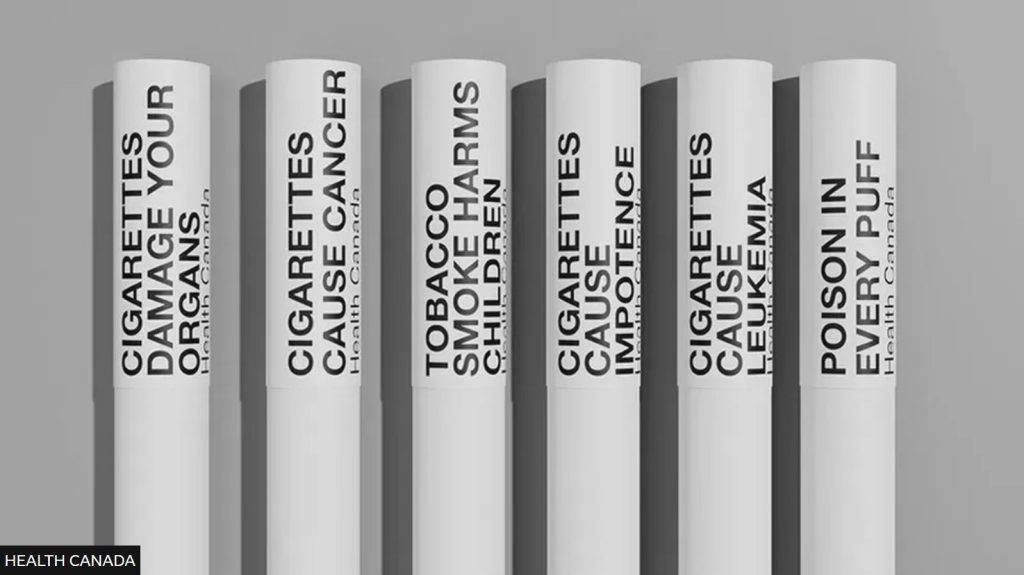
Canada became the first country to mandate health warnings printed directly on individual cigarettes. The measure is being phased in, with all king-size cigarettes required to carry warnings by July 2024, followed by regular-size cigarettes and little cigars by April 2025. The warnings, printed near the filter, include messages on harms such as risks to children, organ damage, and diseases including leukemia, as well as impacts on sexual health. A second set of six rotating warning messages is scheduled for introduction in 2026. The initiative forms part of Canada’s broader public health strategy to reduce smoking prevalence to below 5% of the adult population by 20352,3,4.
References:
- https://www.imperialtobaccocanada.com/en/attachments/Imperial_Tobacco_Canada_warns_that_the_proposed_federal_flavour_regulations_on_vaping_products_would_make_a_less_harmful_alternative_more_harmful.pdf ↩︎
- https://canadagazette.gc.ca/rp-pr/p2/2023/2023-06-07/html/sor-dors97-eng.htm ↩︎
- https://www.canada.ca/en/health-canada/services/smoking-tobacco/regulating-tobacco-vaping/tobacco/tobacco-regulations-facts.html ↩︎
- https://www.canada.ca/en/health-canada/services/health-concerns/tobacco/legislation/tobacco-product-labelling.html ↩︎

