


The Haypp Group spearheads the global transformation from smoking to smoke-free alternatives. With origins in Scandinavia, Haypp Group is at the intersection of two mega consumer trends: the shift from offline to online interactions and the transition from smokable products to smoke-free products. Haypp Group is present in seven countries and served more than 1,100,000 consumers in 2024. Being the global leader in the e-commerce of smoke-free products, Haypp is a disruptor in the broad tobacco/nicotine industry. We met with Gavin O’Dowd, CEO of Haypp Group to hear more about the Haypp Group and the nicotine pouch category.
Link to Haypp Group: Interview – Part I
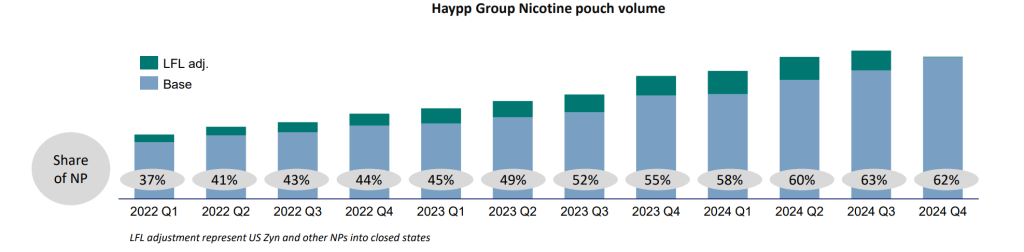
Tobacco Insider: Thank you for the update on ZYN, Gavin. I assume everybody wants to hear about that. Now, if we take a step back; many people associate the prospects of Haypp with the nicotine pouch category because over 60% of your volume is coming from nicotine pouches and the weight of category in total sales is increasing. So, what would you say on the prospects of the category in the US, Europe and elsewhere? In terms of consumer acceptance, in terms of immediate market opportunities?
Gavin O’Dowd: Let me give a little bit of context and history on this one because I tend to be a sort of a believer in the old expression: “predictions are pretty dangerous things to do, particularly the ones about the future”. I’ll give a little bit more context on the past. When I was the General Manager for BAT in Sweden and Norway, we bought a small business called Winnington – which had a brand that is now called VELO, the leading nicotine pouch brand in Europe. When I launched it in Norway, a couple of weeks after the acquisition, people told me that it will work in Norway, but it will never work in Sweden. A year later people told me that it will work in Norway and Sweden, but it will never work outside Norway or Sweden. A year or two later, they said it will work in Norway and Sweden and Switzerland, but it will never work elsewhere. And then, when the product was launched in the US and got a good traction in the West Coast, particularly in California… they said it would only work in California, but not elsewhere. I have heard the story as regards to the limitations of the category so many times over the past 8.5 years. So, I have a smile when I hear it now.
I know that one of the very large brand owners has come out recently and said that, in the US, they envisaged that, in the not inconceivable future, this category could be 20% to 30% of the nicotine usage in the US. That is making forward-looking sort of predictions on where the category gets to – which is not what I’m doing here. But I am conscious that every time I’ve heard in the past that this category is about to hit a ceiling, it won’t work with this consumer segment or in this market or people from this background, that has been proven wrong over and over again. And, for that reason, I feel as though there’s a long journey for this category to go.
Tobacco Insider: We also believe the category has a lot of room for growth – which is good news for Haypp Group. But, a point that can derail this great story is regulation. Let’s talk a bit about that. First of all, do you foresee that the online retail of nicotine pouches will be allowed in all major jurisdictions – because there are some discussions around limiting the online sales of nicotine products. Second, the most important point in the whole equation is youth access prevention – something that all regulators are very concerned about it. Do you see any advantages of an online platform in preventing the underage access? What are the precautions you are taking on this point?
Gavin O’Dowd: So, if I start off with the first one; regulatory outlook for the category is, of course, one of the key dynamics. But I think it has to be borne in mind where these products are when it comes to the harm or risk to the user relative to cigarettes. I think it is broadly accepted and I’m think I’m being quite conservative here to say that they are sub 2% of the risk to the user of that of cigarettes. I think many in the industry would actually put them significantly below this. So I think that logic means that these products have an entirely different relationship with society versus the smoking related diseases and the 8-million-deaths which has been coming in each year from cigarettes and continues to come in markets where regulation hasn’t supported reduced-risk products.
You can see how successful these products have been. [Smoking in] Sweden is now running at about 5.3% of the adult population, which is close to 5%, where the World Health Organisation set the target for a smoke free nation. You can see great progress in risk reduced products in the UK. The US is starting to gut the traditional cigarette market and you can see the beginning of recognition by a multitude of regulators across the space – more recently, by the marketing granted orders coming out for ZYN, which really shows that there is benefit for public health. So, I’m quite confident that rationality and science will actually play out and people will listen to reason when it comes to the overall category. I think the industry is quite confident as well – looking at the levels of investment that they have all been placing into the category.
Moving over to the online;online has historically a bit of a tainted reputation for selling products, whether it was anything from alcohol to perhaps vapes number of years ago. You would know the questionable age verification in this space. Age verification is the primary focus because, otherwise, the society and regulators in general do not mind, in fact, are quite positive towards smokers moving away from cigarettes. What people really want to make sure is that there is no underage use.
As a digital platform, we have much more controls in place than you can get in any store. Controls will vary from one country to another. If we take Sweden or Norway as an example, there’s a tool called Bank ID. When you rig it up on your phone, you use it for everything; you use it for doctor’s appointments, to register your kids to school, to buy a house, to vote. It is a pretty robust tool. And, the app on your phone recognises your face each time you use it. That’s a precursor for you to be able to log in and approve the transaction. In addition to that, we have the same process in place at the boxes where people pick the products up in Sweden; it’s quite common for people to pick the products up at a bus stop or a metro stop. QR code comes up, you scan it, it checks your face again to identify you are the right person; only then will the box pop open and we keep the digital records for these transactions as they occur. So we can guarantee that, for example, in Sweden where we have 31% share in the market and there is an underage use problem, we have 0% share in the underage market. That is how solid it is.
In the US, it’s a slightly different relationship with government based technology. But there are strong underlying data structures. The Department of Motor Vehicles is fantastic on this. You can lock down the person and the transaction that’s gone through. Is this a person that lives in that house? Are they registered? Is the date of birth correct? They have to put their phone number in and we send a one-time password to that phone which they have to put in as they’re closing through. So that’s amazing as well. And again, there’s never been any issues on that one.
Then, if you look at the UK, we’ve recently gone live with some fantastic AI from a group called Yoti for facial recognition whereby your camera comes up at the end, you move your face left and right. And it will read if there is a risk that you may look under 25, and if you do, you have to come up with another form of identity in order to be able to push through. But not only are we able to guarantee that nobody under the legal age gets any products from us, but we can also maintain the records. So if somebody goes back to us with a transaction that occurred 6 months ago and gives us the date and time or the name of the transaction, we can pull it up. With the digital records, I think the universe has started to change radically when it comes to the age recognition in the industry and people are recognising this. The historical legacy of some old e-commerce spaces, and there are still players out there which are ropey on this space, is completely different. Now the challenge is how quickly do we get offline up to the sort of standards that we’re dealing with online.
Tobacco Insider: One critical point is to create awareness on this digital validation among the regulators. Do you have any initiatives on creating more awareness on the enabling technologies in the digital toolbox in terms of youth access prevention?
Gavin O’Dowd: We do, we share it. We talked earlier about our data and insights. We share a lot of our data both with regulators both directly and often via the industry. We also share it with leading academics. Some leading universities in North America and in Europe publish papers on it. And you can also see that, not just the controls – which are there -, but very few consumers actually buy from us are under the age of 25 and there’s a very systemic reason for that. You don’t come to us to buy a single can because it’s not economically viable.
You come to us to buy 20 and then you’re dealing with $80-$100 out of pocket. And I think it’s fair to say that you have to have been earning a few pay checks before you’re comfortable to drop $100 for your next month’s worth of nicotine pouches.
We do engage heavily on it. But there’s another aspect of this which I think is quite important to bear in mind. As an industry, we’re not alone on this. There are many other industries which are going through this at around the same time. Social media is a prime example of this. They’re having to restrict more and more of what they’re sending to people in the form of content until they can guarantee that that person is above certain ages. So you’re right, the politicians historically haven’t been aware of this, but they’re starting to experience this from many more categories than simply the nicotine or the alcohol industry. They’re having to deal with this a lot more on digital content and what the solutions are there. So they’re becoming quite aware in it on forums outside of this industry as well.

Tobacco Insider: We have two more questions which are rather quick. Everyone is used to seeing the Haypp numbers going up, up, up. It came as a surprise that, in the last quarter, there were around 50,000 less active customers on sequential basis. There could probably be multiple different reasons: termination of the tobacco sales in the US, California ban and the absence of ZYN. Can you provide some clarity on the different drivers and how much they contributed to this surprise drop in the number of active users?
Gavin O’Dowd: Firstly, when you analyse quarter-on-quarter basis, there will always be a little bit of volatility because there is a small degree of seasonality around our business around two key points in the year – one of which is Christmas. So generally we tend to get a lot less sales around the Christmas window and I’m talking here about 3-4 days – from the 20th or 21st up until maybe the first or second of January. Another one often tends to be around Easter, but for a shorter period there. So you have to take into account the seasonality effect. In addition to that, there were, of course, some extra points such as the shutting down of tobacco business in the US. We were planning on shutting that down at the end of 2025 and we brought it forward to the end of Q3 2024. Then, shutting down of California and, of course, the absence of ZYN meant that we didn’t have a significant number of those consumers during Q4. But if you look at the overall growth and the like-for-like growth in those numbers, they are continuing to grow robustly in Q4 to Q4.

Tobacco Insider: And then, the famous discussion of dry versus moist nicotine pouches. It doesn’t really matter for you as you actually sell both. But there is a big debate on this when it comes to projecting the future of the U.S. market. What’s your take on that? Do you have a read on the consumer preference of dry and moist pouches?
Gavin O’Dowd: I have to admit that it’s not the first time I was asked this question. As you can imagine, as the largest provider of insights – and we share many of our insights directly with the c-suite of the five large nicotine/tobacco companies, we get questions around this quite a lot. And I often get questions as well as regards to what is the difference across consumers in different countries, and why do they behave so differently? So my data scientists greatly smile when they look at these questions coming through, because it turns out that, actually, homo sapiens are pretty consistent irrespective of which language they speak and which continent they live in. And when we take a look at what is it that consumers want, it doesn’t matter geography by geography. They want three key things: it is the three key features for choosing the product, not the brand, but the product itself. It is the flavour. It is the nicotine release. And it is the mouthfeel. These are the three factors, generally in that order, that they want. Not that hugely dissimilar from each other in terms of weight.
The consumer does not know what is wet, what is dry. They do not know if they want wet or they want dry. What they know is that they want flavour, nicotine release and mouthfeel. Now what has happened so far, and it’s always very difficult to determine how technology will evolve over time, is that the higher level of moisture you have, product tends to be better at delivering the flavour and nicotine – but this is a sort of a broad brush statement because there are exceptions to every rule. So for that reason, we can see that in markets where both products have been in existence for seven or eight years, the dry format tends to have gone down quite significantly. In Sweden, the Silicon Valley of this category, I don’t think there’s a problem that consumers want more moisture or not – what they want is the flavour, nicotine release and mouthfeel.

Tobacco Insider: Do you see any difference between new users and experienced users in terms of product preference?
Gavin O’Dowd: I think what you see more is the differences across particular consumer segments. And we break it down into about 30 key segments and then about 87 sub segments. What you can see is certain segments, often male, often sub 35, they will start off with lower nicotine levels and over the first 24 months, they will lift up to cross an actual benchmark on their nicotine level. And then they will revert back down to the mean and then they will continue along from there and the range of products they will use over that journey will be quite extensive as they go through. Now, I probably should have touched this a little bit in the assortment, we do not sell strong and ultra strong products. So we have a nicotine cap and every product that we sell in every market, we will send it off for independent testing on the nicotine levels, but also on the pH levels – to make sure that it’s not sufficiently high to damage the gum or sufficiently low to damage the enamel on the teeth. And that ingredients are all up to scratch. So we will make sure that there won’t be anything ultra strong in that space, but you will see people go through that S curve almost over the first – it will vary a little bit – 70 to 110 weeks that they’ve entered into the category. Then, they will revert back to a mainstream nicotine level and that becomes the primary driver when it comes to the nicotine release.
On the flavour space, people generally start off in the mainstream flavours and revert out to the edges. The only exception to this tends to be the older consumers, particularly those above 40, where they will often start off with more on the fruity flavours or on the coffee flavours. And it’s quite interesting on this space where people often associate a broader pallet of flavours being more attractive to youth. One of the flavours that we sell across Europe is strawberry. The average age of our strawberry user profile is 48. So it is completely different to what people perceive. We went off to do some research on this with a group of people, to which we got some very stern responses of what do you mean?: “I’m a lady in my late 40s and I like strawberries too”. So it’s which is actually not that irrational when I think about it. So I think the nicotine piece is one aspect on this and the flavour piece is another. But again, it needs to be looked at more as a segment of the market rather than a market in totality because there’s too much noise if you start to mix the segments.
Tobacco Insider: Just out of curiosity, what’s the nicotine concentration limit that you apply? What is the mean nicotine level, 10 milligrams?
Gavin O’Dowd: We bring it in at 20 and we’re working on bringing it down at this point in time.People have to be very conscious of what is a mean on this space because the amount of nicotine within a pouch is somewhat academic. It’s about the amount of nicotine you take out and then subject to the format of the pouch – going back to the dry versus moist, which you tend to have slightly higher nicotine release. So it will vary a little bit from market to market, but at a global level, we’re dealing with around 10 milligrams as the midpoint.
Tobacco Insider: So, 10 is the mean, 20 is the limit. Consumers start probably around 3-6 milligrams and then they go up before reverting to 10 milligrams.
Gavin O’Dowd: It depends on where they come from. So if you take a look in the US, where most of our consumers are actually coming from cigarettes, they will often come in around about the six to eight milligrams. And if you take a look in the UK, where about 72%-73% of our users come in from vaping and some of them have been using slightly stronger vapes, they will often actually start slightly higher.

Tobacco Insider: This was very educating discussion for everyone. A lot of insights. Last but not least, what are a few key things that you would like investors to keep in mind about Haypp Group?
Gavin O’Dowd: I’d like people to have an opinion on where risk reduction in general is going and the amount of people that are moving away from cigarettes to nicotine pouches – which is by far the fastest growing of the three categories in risk reduced products at this point in time. Moving on from there, online is taking a significant share in this market – disproportionately higher share, the longer the market exists. And moving on from there, in every market that Haypp operates in, it is by far the largest player when it comes to the online space. And then I would like people to remember how we underpin that with our operating model – both our scale and the benefits of scale, which reinforce that, complemented by our ancillary revenue coming in from the insights and media. And when it comes to the outlook and what we’re going to do differently, we’re not planning on doing things fundamentally differently. We quite like what we do, but we’re planning on doing is things fundamentally better and that’s where we dedicate all of our focus.
Tobacco Insider: Thank you very much, Gavin, for all the insights and the opportunity to meet with you.
Gavin O’Dowd: Thank you very much.

Chief Executive Officer (CEO), Haypp Group: Gavin O’Dowd
Also the 8th largest shareholder of Haypp Group with a 3.4% stake. At Haypp Group since September 2017. A chartered management accountant who trained in Accenture and PwC. Gavin spent 11 years in the nicotine industry, at BAT, in several key leadership roles, including Group Corporate Finance, CFO Iberian and General Manager for Sweden and Norway.
Company Profile: Haypp Group
Based in Stockholm, Sweden, Haypp Group is the world’s largest online retailer for smoke-free nicotine products. Present in seven countries with eleven e-commerce sites, Haypp Group had over 1 million active consumers in 2024. The Group’s e-commerce sites include haypp.com (and variants haypp.com/uk, haypp.com/de, haypp.com/se), nicokick.com, snus.com, snushjem.no, snusbolaget.se, snusmarkt.ch, northerner.com, snuslageret.no, snusnetto.com, nettotobak.com and vapeglobe.de.
Link to: Haypp Group Reports & Presentations

