


Transformation of the Business Portfolio1
ITC continues the pursuit of diversifying its business and reducing its reliance on tobacco: revenue and profit from non-tobacco businesses (FMCG; Agriculture; Paperboards, Paper & Packaging; Hotels) have increased by 150% and 220%, respectively over the past decade – coupled with +730bps expansion in return on capital employed.
The weight of cigarette business in gross revenue is down to 39% in the most recent quarter (Q2 FY24): nevertheless, as a high-margin business, tobacco is still the core profit generator with 79.5% weight in operating profit. Recall: “ITC: Q2 2024 Results“

Tobacco Market
– Legal cigarettes correspond to ~9% of total tobacco consumption, but generate ~80% of tobacco tax revenue: in periods of tax stability, tax revenue grows much faster (~10% per annum) thanks to the volume recuperation from illicit trade
– Illicit cigarette market size is 1/3rd of legal industry (making India the 3rd largest illicit cigarette market worldwide)
– India’s per capita cigarette consumption is one of the lowest in the world. However, India is by far the largest oral (chewing) tobacco market (Khaini, Zarda, Gutkha) – bigger than the rest of the world combined
– ITC’s cigarette volume declined 30% from FY13 to FY21. However, relative stability in taxes and claw back from illicit trade as well as ITC’s focused/agile portfolio/market interventions led to significant volume increase in the past two years: FY23 volume is only 4% below FY13 volume.


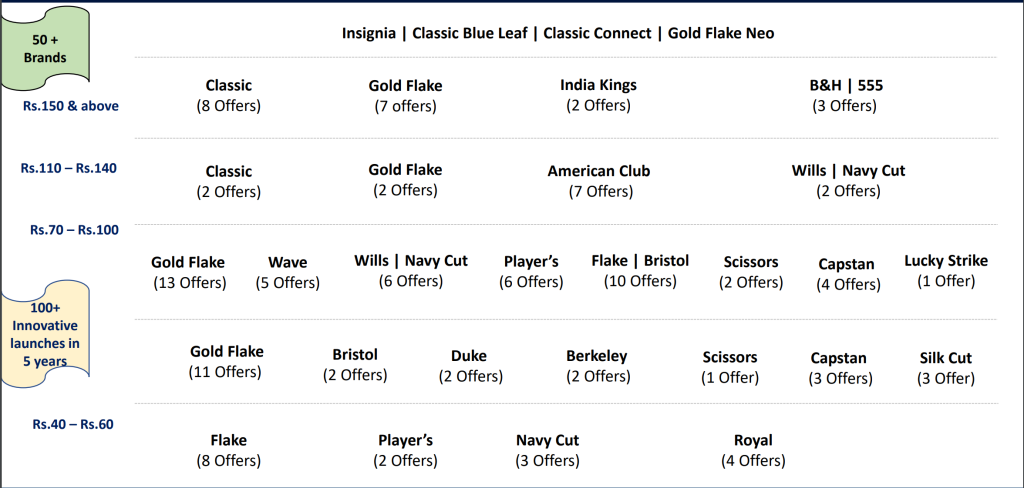
– ITC is leading every cigarette segment with a strong & versatile portfolio of 50+ Brands, including the flagship Classic and Gold Flake Trademarks. Price range: Rs.40 – Rs.150+ (roughly, $0.5 – $2)
– ITC brands are available across 7Mn+ outlets in India with ~120 SKUs
– R&D: 80 scientists with focus on “Seed to Smoke” value chain
Nicotine & Tobacco Derivatives
– ITC is India’s largest buyer, processor, consumer & exporter of tobacco (40% of total Indian exports)
– Indian tobacco offers a sweet-spot in terms of nicotine content and price
– Supply of high-end nicotine fails to keep pace with the rapidly growing demand: 2027 supply gap is projected to be equivalent to 50% of the 2022 market size (i.e. input cost pressure on nicotine-containing products)
– Mysuru factory (to manufacture and export of nicotine & nicotine derivative products) is expected to commence exports over the next few months
– Integrated Farm-to-Flask(Pouch) Model: 99.9% purity and quality specifications as per the US & EU pharmacopoeia
References:

