


January 2026: Russia to Begin Extra-Judicial Blocking of Online Tobacco Sales Sites
Russian authorities will start blocking websites that sell tobacco and nicotine-containing products without a court order beginning in March 2026. The measure, passed by the State Duma and set to take effect on March 1, 2026, aims to restrict online access to such products, particularly to limit minors’ exposure and sales through digital channels.
The new regulation will allow telecom regulators to add offending sites directly to a prohibited list, speeding up enforcement and preventing operators from evading restrictions by changing domains. The policy is part of broader efforts to tighten control over the online sale of products subject to legal age limits.
September 2023
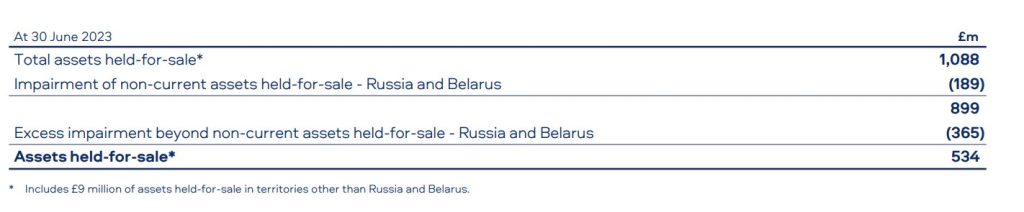
BAT sells its Russian business to local management. Going forward, the business will be known as the ITMS Group1.
The Belarusian business is also being transferred. BAT’s operations in Russia include Moscow HQ, 75 regional offices and a factory in St. Petersburg. BAT also has an office in Belarus. The two countries account for ~2.7% of BAT’s revenue and ~2.5% of operating profit.
BAT already recognized £629Mn charges related to the transfer of the Russian business: £554Mn impairment charges and £75Mn associated costs (£58Mn in 2022, £17Mn in H1 2023). Nevertheless, total Russian assets are still valued at £525Mn. BAT didn’t disclose the transaction value (- only mentioned that they will have no rights to dividends, royalties or amendments from the transferred business going forward). It is highly likely that already recognized impairment charges are not large enough to cover the loss and more impairment charges are on the way.
July 2023
In an interview, JT’s CEO noted that JT has the intention “to keep its Russian factories running for as long as possible”2 – despite suspending all new investments, marketing activities and the planned launch of Ploom X in March 2022 and, later, announcing that it was considering to sell its Russian operations (April 2022).
February 2023
PMI says it’d rather keep its Russian business than sell on stringent Kremlin terms3, noting that regulatory constraints in Russia entail very complex terms & conditions for any divestment transaction. PMI started to re-include Russia & Ukraine results in its consolidated statements. At the end of 2022, PMI had $2.5Bn of total assets in Russia and $0.4Bn in Ukraine.
In March 2022, PMI suspended the planned investments (product launches, commercial/manufacturing investments) and scaled down the manufacturing operations in Russia. Between March 2022 and February 2023, PMI had repeated its intention to exit the Russian market in an orderly manner on numerous occasions.
April 2022
Imperial Brands announced the transfer of its Russian business to investors based in Russia, pending the registration of the transaction with local authorities4. In FY21, Russia and Ukraine represented in total ~2% of Imperial’s net revenues and 0.5% of its adjusted operating profit. Imperial estimates a non-cash write off of ~£225Mn for this transaction.
Market Overview
Philip Morris International (PMI), British American Tobacco (BAT) and Japan Tobacco (JT) are among the largest foreign companies operating in Russia. Actually, a recent study5 puts PMI ($7.9Bn) at the top of the the list for the revenue (including excise tax) generated in Russia by foreign companies in 2022. JT ranks #2 ($7.4Bn) and BAT ranks #5 ($4.2Bn). Four major tobacco companies, including Imperial Brands, dominate the Russian cigarette market with their cumulative share standing at 83.3% in H1 20236.
In terms of % of total revenues generated, JT is the most exposed to Russia: $2Bn net revenue (at current FX rates) in 2022 for JT Group, corresponding to ~11 % of the total revenue7. PMI is the second most exposed: $2.3Bn net revenue (our estimate), corresponding to 7% of the total revenue.
The Western companies operating in Russia are under pressure from both sides: the Western interest/influence groups are demanding these companies to untangle their ties with Russia while the Russian Administration is forcing companies from “unfriendly” countries to sell their operations to locals at nominal prices. Since Dec 2022, Russia has forced foreign companies to sell their assets to Russian buyers at a 50% discount and charged them an exit fee of at least 10% of the transaction value. In June 2023, President Putin signed a confidential decree giving the Russian government powers to buy Western companies at a “significant discount”8. In September 2023, a new Russian law came into effect, opening the way to seize the assets of companies from “unfriendly countries” with 75+Bn rubles in annual revenue or 4,000+ employees in Russia9. Lately, in August 2023, Dutch brewer Heineken had to sell its Russian operations to Russia’s Arnest Group for €1, taking a €300Mn hit. The deal came after Russia seized the local assets of Danish beer rival, Carlsberg10.
At the time of writing, Imperial Brands and BAT exited Russia. PMI and JT have the intention to operate in Russia as long as possible.
References:
- https://www.bat.com/group/sites/UK__CRHJSY.nsf/vwPagesWebLive/DOCVEFRJ ↩︎
- https://www.rt.com/business/579350-japan-tobacco-russia-business ↩︎
- https://www.ft.com/content/656714b0-2e93-467b-92d6-a2d834bc0e2b ↩︎
- https://www.imperialbrandsplc.com/media/key-announcements/2022/russia-update ↩︎
- https://www.dw.com/en/foreign-firms-in-russia-continue-to-help-fund-putins-war/a-66109492 ↩︎
- https://tass.com/economy/1661315 ↩︎
- https://www.politico.eu/article/report-tobacco-and-food-giants-made-billions-in-russia-after-ukraine-invasion ↩︎
- https://www.themoscowtimes.com/2023/06/15/putin-signs-secret-decree-to-buy-discounted-western-companies-ft-a81510 ↩︎
- https://foreignpolicy.com/2023/09/01/russia-western-companies-coporate-hostage-diplomacy ↩︎
- https://apnews.com/article/heineken-russia-ukraine-war-brewer-netherlands-04cd3aade48f93360181ab69260ccc33 ↩︎

