


September 2026: Constitutional Court Unanimously Upholds Volume-Based Taxation on E-Cigarette Liquids
South Korea’s Constitutional Court has delivered a unanimous ruling upholding the constitutionality of the current volume-based taxation system applied to e-cigarette liquids. In a joint decision addressing a constitutional petition filed by multiple e-cigarette liquid importers, sellers, and individual operators, alongside a review case referred by the Seoul Administrative Court, all justices ruled that the existing fixed-rate levy system does not violate the Constitution.
The legal challenge centered on provisions under the Individual Consumption Tax Act and the Local Tax Act, which impose a flat rate based on the volume of nicotine solution – specifically charging a local tobacco consumption tax of ₩628 per milliliter and an individual consumption tax of ₩370 per milliliter. The petitioners argued that applying a flat levy based strictly on volume, irrespective of the solution’s sales price or actual concentration, was unreasonable and infringed upon their property rights.
However, the Constitutional Court rejected these claims, emphasizing that measuring the volume of nicotine solution provides an objective and easily verifiable metric. The court noted that the volume-based approach is a rational policy choice designed to guarantee tax administrative efficiency, ensure legal stability, and secure predictable fiscal revenues. Furthermore, the justices underscored that the taxation framework aligns with legislative objectives to curb harmful tobacco consumption and protect public health.
September 2026: South Korea to Ban Minors from Unmanned E-Cigarette Retail Outlets
South Korea’s Ministry of Gender Equality and Family announced a regulatory measure prohibiting minors from entering unmanned e-cigarette shops, addressing growing concerns over unverified youth sales at automated retail locations. The advance notice, issued on September 14, targets unstaffed businesses that sell e-cigarette devices and liquids using vending machines. While recent amendments to the Tobacco Business Act reclassified e-cigarettes under general tobacco regulations, the absence of on-site staff at automated shops created significant loopholes in age verification. Under the draft notice, operators of unmanned vape outlets must implement entry-level age verification mechanisms and display clear signage restricting youth entry and employment.
Non-compliance carries strict legal penalties. Operators who fail to prevent youth entry or omit required signage face up to two years in prison or fines reaching ₩20 million. Employing a minor at these locations carries penalties of up to three years in prison or a fine of up to ₩30 million. The public comment period runs through October 6. Following regulatory review and approval by the Youth Protection Committee, the Ministry plans to finalize and enact the policy later this year, with enforcement taking effect immediately upon promulgation.
June 2026: South Korea Reconsiders Cigarette Tax Hike as Public Support Grows
South Korea is once again considering raising cigarette taxes after the Health & Welfare Minister said the government needs to review tobacco pricing as part of broader tobacco control efforts. While no formal proposal has been introduced, the country’s Sixth National Health Promotion Plan (2026–2030) includes a commitment to review increases in the health promotion levy, with the long-term aim of bringing cigarette prices closer to the OECD average.
Cigarette prices have remained unchanged at ₩4,500 (US$3.30) per pack since 2015, despite around 20% inflation over the past decade. Current prices are less than half the OECD average, leading academics and public health experts to argue that the real price of cigarettes has eroded and that regular, inflation-linked tax increases are needed to preserve their public health impact.
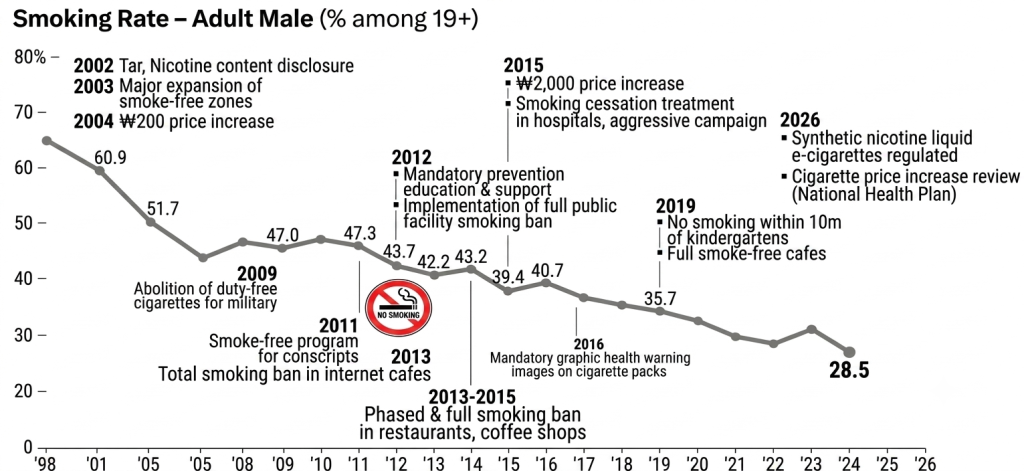
Public opinion appears supportive of higher tobacco taxes. A recent survey found that 63% of respondents favored raising cigarette taxes, while 53% preferred a gradual increase to around ₩6,000 before moving toward ₩10,000 per pack, rather than an immediate jump. The government has emphasized that any future tax increase would require broad public consultation and social consensus.
April 2026: South Korea Classifies Synthetic Nicotine as Tobacco, Tightening Vape Regulations
South Korea is moving to significantly tighten oversight of nicotine products by bringing synthetic nicotine e-cigarettes under the legal definition of tobacco, closing a long-standing regulatory gap. The revised Tobacco Business Act – set to take effect on April 24, 2026 – will subject these products to the same rules as conventional cigarettes. Under the new framework, liquid e-cigarettes will face restrictions on advertising, mandatory health warnings, and bans on online sales, while their use will also be prohibited in smoke-free areas, with fines applied for violations.
The reform reflects a broader policy shift from defining tobacco based on leaf content to any product containing nicotine – whether natural or synthetic. This change is aimed at addressing rising use among younger consumers and ensuring consistent regulation across emerging nicotine categories. Industry participants have raised concerns about the impact, noting that retailers will need to meet stricter licensing requirements, with some warning of potential store closures.
Overall, the move positions South Korea among jurisdictions adopting a more comprehensive approach to nicotine regulation, aligning alternative products more closely with traditional tobacco controls.
April 2026: South Korea May Follow Japan in Heated Tobacco Tax Increase
South Korea’s tobacco market is shifting significantly toward heated tobacco (heat‑not‑burn) products, prompting increasing speculation about possible tax changes similar to recent moves in Japan. In South Korea, traditional cigarette sales are forecast to fall from ₩14.3 trillion in 2023 to ₩12.7 trillion by 2028, while heated tobacco sales are expected to grow from ₩3.2 trillion to ₩5.2 trillion in the same period. Total tobacco sales overall may rise modestly from ₩17.8 trillion to ₩18.1 trillion as growth in heated products offsets declines in conventional cigarettes and other tobacco products.
Estimated Sales Amount of Conventional Cigarettes and Heated Tobacco Products (Source: National Assembly Budget Office Research Report)
| Category | 2023 | 2028 |
|---|---|---|
| Conventional Cigarettes | ₩14.3 trillion | ₩12.7 trillion |
| Heated Tobacco Products | ₩3.2 trillion | ₩5.2 trillion |
| Total Tobacco Market | ₩17.8 trillion | ₩18.1 trillion |
Currently, cigarettes cost about ₩4,500 per pack in South Korea, with total taxes of around ₩3,323 on traditional cigarettes and about ₩3,004 on heated products – a tax gap of roughly ₩319 per pack. Some argue that aligning heated tobacco taxes with traditional cigarettes would reduce this advantage and could slow the rapid expansion of the heated category. Long‑term projections suggest overall cigarette prices could reach approximately ₩10,000 per pack, near the OECD average, which could contribute to reduced smoking rates, especially among men, by 2030. Critics note that higher tobacco prices can disproportionately affect low‑income consumers because demand for tobacco products is relatively inelastic.
Comparison of Taxes: Conventional Cigarettes vs Heated Tobacco (per pack)
| Tax Component | Conventional Cigarette (₩) | Heated Tobacco (₩) | Difference (₩) |
|---|---|---|---|
| Tobacco Consumption Tax | 1,007 | 897 | -110 |
| Local Education Tax | 443 | 395 | -48 |
| Individual Consumption Tax | 594 | 529 | -65 |
| National Health Promotion Contribution | 841 | 750 | -91 |
| Waste Management Fee & Others | 38 | 33 | -5 |
| Subtotal (excluding VAT) | 2,923 | 2,604 | -319 |
| Value Added Tax* (10%) | ~400 | ~400 | 0 |
| Total Tax Burden | 3,323 | 3,004 | 319 |
Japan recently implemented a multi-stage tobacco tax increase designed to narrow and eventually eliminate the tax advantage previously enjoyed by heated tobacco products, ultimately bringing them in line with conventional cigarettes. As part of a fiscal package to help finance expanded defense spending, the government raised heated tobacco taxes starting April 1, 2026, with a second stage planned for October 2026, eventually equalizing the tax burden on heated products with that on combustible cigarettes.
In South Korea, no immediate price hike is planned; policymakers state that any future adjustments would go through public consultation and careful review. Nonetheless, the dynamics unfolding in Japan – where heated tobacco tax equalization is underway – are increasingly referenced in discussions about South Korea’s future tobacco tax policy1.
January 2026: South Korea’s 2026 Tobacco Harmful Constituents Disclosure Plan
South Korea’s Ministry of Food and Drug Safety (MFDS) has finalized its 2026 implementation strategy under the Tobacco Harmfulness Management Act, effective November 2025, to systematically require testing and public disclosure of harmful constituents in all tobacco and related products sold domestically. By the end of January 2026, manufacturers and importers must commission certified laboratories to analyze specified harmful substances – 44 for cigarettes and cigarette-type products and 20 for liquid e-cigarettes – and submit results into a newly established electronic database for structured review and policy evaluation. The MFDS plans to disclose these findings publicly in October 2026 following deliberation by the Tobacco Harmfulness Management Policy Committee, with communication tailored for broader accessibility. The initiative also includes expansion of analytical methods to cover synthetic-nicotine e-liquids and other emerging products such as nicotine pouches, alongside the expedited designation of ISO-accredited testing facilities to meet rising demand. This plan supports enhanced transparency, reinforces the public’s right to know, and aligns regulatory oversight with international testing standards to better inform consumers and contribute to public health objectives.
December 2025: South Korea to Enforce Tobacco-Level Rules on Synthetic E-Cigarettes Starting April 2026
South Korea classifies liquid e-cigarettes that contain synthetic nicotine as tobacco products under its Tobacco Business Act, with the revised law taking effect on April 24, 2026. The change closes a long-standing regulatory gap that previously left synthetic nicotine vapes outside tobacco control, and brings these products under tobacco related duties and restrictions on health warnings, advertising and use in smoke-free areas. Measures will also include bans on online sales and marketing that could appeal to youth, aligning e-cigarette oversight more closely with conventional cigarettes. Ahead of the April 2026 rollout, additional restrictions on vending machines – including age-verification requirements and bans near schools – will begin from February 2026, further tightening how synthetic nicotine products can be sold.
December 2025: Synthetic nicotine tax will bring c.₩1.3 trillion governmental revenue over the next five years
Following the expansion of the definition of tobacco from “tobacco leaf” to “tobacco & nicotine”, synthetic nicotine-based products will be subject to the same excise tax as cigarettes. However, during the National Assembly’s tax review process, an exception was made to reduce the initial burden on small businesses involved in the manufacturing & distribution of synthetic nicotine, allowing for a two-year exemption. The exemption was compensated by an increased individual consumption taxes to meet the governmental revenue targets.
Taxation of synthetic nicotine e-cigarettes is expected to bring ₩1.29 trillion (US$870 million) governmental revenue over the next five years. Starting with ₩95 billion (US$64 million) in 2026, the synthetic nicotine tax is projected to amount to c.₩258 billion (US$174 million) per annum on average between 2026 and 2030.
December 2025: National Assembly approves the Amendment to the Tobacco Business Act
The National Assembly approved the amendment to the Tobacco Business Act that classifies e-cigarette liquids using synthetic nicotine as a raw material under the tobacco category. Prior to the amendment, products using synthetic nicotine were not defined as tobacco and have been excluded from taxation and regulatory restrictions. With c.95% of the e-cigarettes on the market using synthetic nicotine, criticism has steadily mounted that they fall into a regulatory blind spot. Despite several attempts since 2016, legislation has repeatedly failed due to the industry pushback. The National Assembly Budget Office estimated that ₩930 billion (US$630 million) annual tax revenue could be secured when the amendment takes effect.
November 2025: Amendment to the Tobacco Business Act passes the Legislation & Judiciary Committee
South Korea is set to finalize a major revision of the Tobacco Business Act that brings liquid and synthetic-nicotine e-cigarettes under the legal definition of cigarettes, closing a long-standing regulatory gap after nine years of debate. The Legislation and Judiciary Committee approved the amendment and the subsequent full parliamentary passage will formalize the change. The update broadens the definition of tobacco to include any product manufactured using nicotine, ensuring synthetic-nicotine vapes are regulated identically to conventional cigarettes, while explicitly excluding pharmaceutical nicotine products (Nicotine Replacement Therapies).
To ease market disruption, lawmakers added protections for the vaping sector, including a two-year grace period to meet designation requirements and a request that the government provide transition support for workers in the sector. Supplementary guidance also urges temporary tax relief to avoid sudden financial shock to the e-cigarette supply chain. Policymakers additionally raised concerns that tougher rules could fuel the emergence of nicotine analogues intended to bypass taxation, calling for government-led risk assessment of such substances and controls on the distribution of nicotine concentrate. The bill also tightens the oversight of tobacco retailer licensing and introduces priority rules for applicants with national merit or disabilities.
Several amendments were made during the final committee discussions, including shortening the implementation period to four months to prevent pre-regulation stockpiling, requiring risk assessments of existing inventory before sale, and adjusting the tax point to the time of manufacture or import to avoid retroactive taxation. The Minister of Finance emphasized the need to quickly bring all nicotine-based products into the regulatory framework and conduct early risk evaluations to mitigate unintended market effects.
November 2025: Amendment to the Tobacco Business Act is further delayed
The Amendment to the Tobacco Business Act, which seeks to regulate and tax synthetic nicotine products, is further delayed. The Amendment passed the National Assembly’s Planning & Finance Committee, but stalled in the Legislation & Judiciary Committee as the committe members demanded more deliberation- specifically, regarding to the spread of nicotine analogs (pseudo-nicotine products) which are not covered by the draft Amendment.
October 2025: Amendment to the Tobacco Business Act advances in the Parliament
The Ministry of Economy and Finance announced that an amendment to the Tobacco Business Act, which would regulate and tax synthetic nicotine products, passed the National Assembly’s Strategy and Finance Committee. The amendment revises the definition of tobacco for the first time in 37 years to include “products manufactured with nicotine as a raw material” and is expected to generate an additional ₩930 billion (US$660 million) in tax revenue. The next step in the legislative process is the National Assembly’s Legislation and Judiciary Committee’s review of the system and structure, followed by a plenary session vote.
However, the proliferation of pseudo-nicotine products, which are developed to circumvent synthetic nicotine regulations, continue to raise concerns about the need for additional legislative changes. A Bill to regulate nicotine-like substances is already pending before the National Assembly. The pending bill proposes a further amendment to the Tobacco Business Act to expand the definition of “cigarette” beyond tobacco and nicotine to include nicotine-like substances and cigarettes manufactured with chemical raw materials specified by Presidential Decree. In addition, a provision is included to prohibit labeling and advertising that misleadingly markets non-tobacco products as cigarettes.
September 2025: The Strategy and Finance Committee voted on a revision to the Tobacco Business Act to include synthetic nicotine in the definition of tobacco
The Strategy and Finance Committee of the National Assembly voted on a revision to the Tobacco Business Act to expand the definition of tobacco products from “made from tobacco leaves” to “made from tobacco leaves or nicotine”. With the amendment, synthetic nicotine (which is not made from tobacco leaves) is brought under the tobacco regulation.
Under the current law, synthetic nicotine was not classified as a tobacco product and synthetic nicotine vapes could be also sold in vending machines or near schools. Moreover, no excise tax was imposed on these products. The National Assembly Budget Office estimated that applying tobacco consumption tax to synthetic nicotine vapes would lead to ₩930 billion (US$670 million) tax revenue collection per annum. However, if the amendment passes the plenary session, vape prices are likely to rise signifcantly – which could result in a market contraction.
August 2025: National Assembly considers to include synthetic nicotine in the definition of tobacco
The amendment to the Tobacco Business Act, which includes synthetic nicotine in the definition of tobacco, will be discussed in the National Assembly amidst concerns about its effectiveness due to the lack of regulations on pseudo-nicotine (a nicotine derivative). National Assembly’s Planning and Finance Committee plans to convene its Economic and Financial Subcommittee in late-August 2025 to discuss the proposed amendment to the Tobacco Business Act. The amendment expands the scope of tobacco ingredients from “tobacco leaves” to “tobacco and nicotine”.
The current Tobacco Business Act limits tobacco to products made from tobacco leaves. Therefore, e-cigarettes using synthetic nicotine as an ingredient are exempt from the law. As a result, concerns have been raised that synthetic and analogue nicotine are being used as a gateway to youth cigarette consumption and are evading tax and advertising regulations. Some businesses are observed to exploit the lack of regulation by operating vending machines selling synthetic nicotine e-cigarettes near schools. There are also concerns that nicotine may be detected in products, contrary to sellers’ claims of nicotine-free products. The Korea Consumer Agency conducted an investigation of disposable liquid e-cigarettes sold online in March 2025 and found nicotine in some products labeled as nicotine-free.
Some lawmakers raised the concern that regulating only synthetic nicotine could leave another blind spot and limit the effectiveness of the regulation – unless pseudo-nicotine, along with synthetic nicotine, is included in the definition of tobacco in the National Assembly debate.
June 2025: Legislative Research Office proposes synthetic nicotine to be regulated as cigarettes
National Assembly Research Office suggests that the definition of “cigarettes” in the Tobacco Business Act should be expanded to “manufactured with nicotine as the raw material”. Tobacco Business Act only defines natural nicotine made from tobacco leaves as tobacco. Consequently, vapes with synthetic nicotine are not classified as tobacco, are not subject to restrictions such as online sales and are not subject to tobacco taxes or surcharges. Virtually all vapes sold in South Korea contain synthetic nicotine.
The Research Office points out that “as unmanned e-cigarette stores are rapidly expanding, social concerns about youth use of e-cigarettes are growing,” and stated that “the National Health Promotion Act’s regulations on cigarette vending machines should be applied to prevent the indiscriminate expansion of unmanned e-cigarette stores”. It also adds that “amendments to the Youth Protection Act, such as mandating the introduction of adult authentication devices equipped with ID theft prevention technology in unmanned stores, could be considered”. The Research Office highlights that a revision to the National Health Promotion Act could be necessary to prohibit the addition of sweeteners or flavorings during the manufacturing process of synthetic nicotine products as many teenagers start with and continue to use flavored e-cigarettes due to their unique taste and smell. It was pointed out that the Government needs to make efforts to encourage self-regulation by businesses to minimize the exposure to tobacco products on online video platforms, such as YouTube.
Previously, several bills were proposed in the National Assembly to expand the definition of cigarettes in order to regulate synthetic nicotine and were discussed three times in the Economic and Financial Subcommittee of the National Assembly Planning and Finance Committee. These bills are still pending.
May 2024: South Korea will amend the tobacco-related laws to include synthetic nicotine
The South Korean government will amend the tobacco-related laws to include synthetic nicotine in the definition of tobacco in an attempt to regulate the product category and curb its growing popularity among the youth. In South Korea, tobacco-related laws are governed by the National Health Promotion Act, under the jurisdiction of the Ministry of Health, and the Tobacco Business Act, under the jurisdiction of the Ministry of Finance2.
According to the current law, a tobacco product is defined as “what is manufactured in a state suitable for smoking, sucking, inhaling steam, chewing or smelling, by using tobacco leaves as all or any part of the raw materials.” E-liquid made out of synthetic nicotine is not covered under the current definition – thereby, not subject to oversight measures, such as the health warnings, ban on sales to minors or tobacco-related taxes.
The decision for the law revision follows British American Tobacco’s recent announcement that it is considering to launch a synthetic nicotine product in the country.

February 2025: Synthetic nicotine regulation fails to pass the parlimentary subcommitee
The amendment to the Tobacco Business Act that regulates synthetic nicotine containing vapes failed to pass the National Assembly’s Economic and Financial Subcommittee. Under the current law, synthetic nicotine is not considered as tobacco product and, thereby, is not subject to tobacco tax or surcharge. The amendment aims to expand the definition of tobacco raw materials from “tobacco leaves” to “tobacco and nicotine” and regulate synthetic nicotine vapes as tobacco products.
In November 2024, BAT’s South Korean affiliate, BAT Rothmans, launched synthetic nicotine e-cigarette, nomad. This launch triggered a sense of urgency among the lawmakers to establish regulations to govern the synthetic nicotine products. See below for further details.
The South Korean import volume of synthetic nicotine, which is in a regulatory gray area, has been in a steady increase trend: from 98 tons in 2021 to 121 tons in 2022 and to 216 tons in 2023. The import volume in the first 9 months of 2024, 316 tons, was already above the full-year 2023 volume.

