


Southeast Asia is one of the most populous geographical regions in the World with 675 million population. It is home to Indonesia, world’s largest cigarette market outside China. The Philippines, Malaysia, Vietnam and Thailand also rank within the Top-20 cigarette markets worldwide. Consequently, the Region is of great importance for the Tobacco Industry to balance out the shrinking cigarette sales volume in the West. For instance, world’s largest publicly traded tobacco company. Philip Morris International (PMI) sold more than 80 billion sticks of cigarettes in Indonesia in 2024 – which corresponds to 11.4% of its cigarette sales volume. The recent development in the Southeast Asian tobacco market are summarized below.
October 2026: Indonesia Considers Strict Flavor Restrictions for Tobacco and Nicotine Products Amid Push to Curb Youth Use
Indonesia, the world’s largest cigarette market outside of China, is considering tighter regulations on flavorings and additives across traditional tobacco and emerging nicotine products. The potential policy shift – focusing heavily on cooling agents and flavored variants – forms part of ongoing deliberations between health authorities and market stakeholders regarding public health protection and commercial impacts.
The proposed restrictions build upon existing Indonesian health legislation. Under current regulations, manufacturers are prohibited from using additives in tobacco products and electronic cigarettes unless those substances have been scientifically proven harmless. Article 432 defines additives to encompass flavorings, aromas, and colorings, while granting the health minister the authority to specify which substances are banned.
This latest regulatory momentum follows World Health Organization (WHO)-supported collaboration with Indonesia’s Food and Drug Authority. A recent technical paper recommended banning flavors in novel tobacco and nicotine products – including e-cigarettes, heated tobacco products, and nicotine pouches – specifically to reduce their appeal to young people.
Projections indicate the policy could carry notable economic implications, with retail sales estimates pointing to potential declines of 20% to 30% alongside significant reductions in conventional cigarette volumes. Policy discussions center on balancing these commercial and market adjustments against public health objectives. While the primary stated goal is youth nicotine prevention, regulatory evaluations also account for competing concerns, including the potential impact on adult smokers transitioning to lower-risk nicotine products and the risk of expanding illicit trade across traditional and new product categories. Among global tobacco companies, Philip Morris International (PMI) faces the most substantial exposure to Indonesia’s regulatory shifts, with international peers like Japan Tobacco and KT&G also monitoring developments closely.
October 2026: Illicit Tobacco Trade Remains Major Challenge in Asia-Pacific
The illicit tobacco trade remains a major issue across the Asia-Pacific region, where illicit market penetration significantly exceeds the global average of the mid-teens. A study by the European Union-Association of Southeast Asian Nations (EU-ASEAN) Business Council highlights widespread market distortion across Southeast Asia, with the Philippines and Malaysia identified as major destinations for illegal shipments and a priority focus for regional enforcement efforts.
The Philippines represents a major market in the region, with total cigarette volume exceeding 43 billion sticks. However, illicit trade led to cumulative government revenue losses of ₱154 billion (c. $2.5 billion) in 2024 and 2025. Of that total, approximately 84% was attributed to illicit cigarettes, while roughly 9% stemmed from illicit e-cigarettes. In 2025, more than one in four cigarettes sold onshore in the Philippines were illicit. This represents the second-highest illicit market share among the ASEAN-6, trailing only Malaysia’s 56.8%. By comparison, illicit cigarette market shares were lower in Thailand (23.6%), Vietnam (16.5%), Indonesia (11.5%), and Singapore (5.5%).
In the e-cigarette category, more than four in five products sold in the Philippines during the same period were illicit. In several other regional markets – namely Thailand, Vietnam, and Singapore – e-cigarette sales were found to be entirely illicit. A key vulnerability stems from the Philippines’ two-tiered tax structure for e-liquids, which applies different rates to freebase nicotine and salt nicotine liquids. Because the two formulations are visually indistinguishable without laboratory analysis, importers frequently misdeclare higher-taxed salt nicotine products as lower-taxed freebase liquids to pay substantially reduced taxes. To close this loophole, the Philippine Department of Finance (DOF) proposed to unify tax rates across all e-liquid products.
While steep excise tax increases carry the risk of fueling illicit market activity if not paired with strong law enforcement, effective border control can help safeguard government revenues. However, neighboring ASEAN member states need to adopt reciprocal export controls to curb transshipment flows across borders. Under current Philippine law, domestic manufacturers are prohibited from exporting cigarettes that fail to comply with the tax and regulatory mandates of the destination country. Because most other Asian economies lack equivalent rules, harmonizing export legislation across the ASEAN region using the Philippine export control framework as a baseline could alleviate the issue.
July 2026: Indonesia Set for Major Tobacco Overhaul Amid Industry Opposition
Indonesia is preparing to enact a sweeping regulatory overhaul of its tobacco market, introducing strict product limits and marketing restrictions designed to reduce public health risks and curb youth smoking. The Health Ministry’s draft rules set a firm baseline for all conventional tobacco and electronic cigarette products sold nationwide.
Major changes include:
– Product Caps: A maximum limit of 10 mg of tar and 1 mg of nicotine per cigarette.
– Ingredient Restrictions: A comprehensive ban on additives and flavorings.
– Packaging Mandates: Mandatory standardized plain packaging featuring significantly expanded pictorial health warnings.
– Sales & Advertising Controls: Raising the legal purchasing age to 21, prohibiting single-stick sales, restricting outdoor ads near schools, and banning social media promotions.
While these measures align with global health standards, their implementation will fundamentally alter Indonesia’s unique domestic market. Clove cigarettes (kretek), which account for roughly 90% of all sales, naturally contain far higher tar and nicotine levels than standard white cigarettes and rely heavily on flavor additives. Meeting the new caps will require a complete overhaul of traditional formulas and manufacturing processes.
The proposed rules directly impact the country’s largest manufacturers – including PT HM Sampoerna (controlled by Philip Morris International), Gudang Garam, Djarum Group, and Bentoel (part of British American Tobacco) – and have drawn fierce opposition from major producers and trade associations. Criticizing the government for a lack of timely clarity, industry groups warn that strict specifications and advertising bans will cause severe financial losses, disrupt retail distribution, and jeopardize millions of agricultural and manufacturing jobs dependent on tobacco and clove farming.
Despite industry resistance, health authorities view the overhaul as an essential intervention to protect younger demographics. With over 70 million active smokers, Indonesia remains the largest cigarette market in the world outside China, making this policy shift one of the most significant health transformations in the country’s history.
June 2026: Malaysia Weighs Vape Ban Following Drug-Laced Vape Seizures
Data from the Royal Malaysia Police (PDRM) covering vape seizures through April 2026 recorded hundreds of cases involving vape devices and e-liquids found to contain various synthetic drugs. Among the substances detected were benzodiazepines, nimetazepam, MDMA, synthetic cannabinoids, tetrahydrocannabinol (THC), and methamphetamine. Commenting on the findings, Malaysia’s Health Minister said the evidence provides a strong basis for considering a nationwide ban on vape products. The proposal is currently under government consideration.
May 2026: BAT Malaysia Reports First-Ever Quarterly Loss as Illicit Trade and Regulatory Costs Bite
British American Tobacco (BAT) Malaysia reported its first-ever quarterly loss since the 1999 merger that formed the company, as rising compliance costs tied to Malaysia’s retail tobacco display ban and worsening illicit cigarette trade severely impacted earnings. For the quarter ended March 31, 2026, BAT Malaysia posted a net loss of RM35.15 million, reversing from a net profit of RM23.27 million a year earlier. Revenue plunged 50.2% year-on-year to RM160.3 million from RM322 million previously.
The company said higher operating expenses were driven by investments required to comply with the retail display ban, alongside the rollout of a new route-to-market model designed to improve long-term operational efficiency. BAT Malaysia also booked RM10.7 million in redundancy-related costs linked to the restructuring initiative.
Illegal cigarette activity continued to weigh heavily on the legal tobacco market. Illicit cigarette incidence rose to 56.7% of total industry volume in Q1, up from 54.4% in the previous quarter – marking the first increase since 2021. Legal combustible volumes declined 4.5% year-on-year. Despite the loss, BAT Malaysia declared a first interim dividend of 5 sen per share, down from 7.5 sen a year earlier. The entitlement date is June 26, with payment scheduled for July 24. Shares closed at RM6.17, valuing the company at RM1.76 billion (US$444 million).
April 2026: Malaysia’s “RM4 Cigarette” Surge Reflects Rising Illicit Penetration and Evolving Supply Channels
Ultra-low-priced cigarettes – selling for as little as RM4 to RM8 per pack, a quarter of the legal price (upwards of RM20) – continue to underpin Malaysia’s entrenched illicit tobacco market, reinforcing strong consumer demand amid widening price differentials. Recent data points to a further deterioration in market conditions. Nationally, illicit cigarette incidence increased from 54.4% in November 2025 to 56.7% in January 2026, marking a 2.3 percentage point rise in just two months. This shift followed the introduction of a retail display ban and an excise tax increase in late 2025, suggesting policy tightening may be amplifying downtrading into illicit alternatives.
The market now broadly comprises three main types of illicit cigarettes. The first, and fastest-growing, category involves counterfeit tax stamps – products that carry what appears to be a legitimate Malaysian excise stamp but is in fact forged. These are the most difficult to detect, as they are specifically designed to mimic compliant products. The share of cigarettes bearing counterfeit Malaysian tax stamps has nearly doubled over the past three years, rising from 8.7% in 2023 to 16% in January 2026, a record high.
The second category consists of smuggled whites, typically unbranded or foreign-branded cigarettes that enter the country without a Malaysian tax stamp and without excise duties paid. These are often distributed in loose form or in plain packaging, reinforcing their informal retail presence. The third category includes smuggled kreteks – Indonesian-style clove cigarettes that are transported into Malaysia, particularly via Sabah and Sarawak’s porous land and maritime borders, again without duty payment.
From a consumer perspective, affordability remains the dominant driver, with illicit products offering a materially lower price point. However, these products bypass regulatory oversight, raising concerns around unknown ingredients and inconsistent quality, while also undermining fiscal and public health objectives. Overall, the “RM4 cigarette” dynamic reflects a structurally resilient illicit market in Malaysia, increasingly characterized by rising penetration, rapid post-policy growth, and more sophisticated forms of tax evasion.
February 2026: Stringent Vaping Regulations Are Taking Shape in Malaysia
Malaysia is preparing to tighten nationwide controls on vaping, with the first phase expected to target “open-system” devices – refillable products whose tanks can be manually topped up with e-liquid. Authorities have flagged concerns that such systems are more susceptible to abuse, including the addition of illicit or synthetic substances. Policymakers have discussed the possibility of a full national ban on vape products by mid-2026 or by year-end, depending on enforcement outcomes and regulatory developments. These deliberations come as the government ramps up implementation of the Control of Smoking Products for Public Health Act 2024, which entered into force on October 1, 2024 and establishes a comprehensive framework governing product registration, sales restrictions, packaging and labelling standards, advertising controls, and youth access.
In parallel, the Health Ministry also proposed a sharp increase in excise duty on vape liquids – from 40 sen (US$0.10) to 4 ringgit (US$1.00) per millilitre – representing a tenfold hike. The proposal was submitted to the Finance Ministry but has not yet been approved. If enacted, the measure would significantly raise retail prices and could reshape demand dynamics in a market that has expanded rapidly in recent years. According to official estimates, 5.8% of Malaysian adults – around 1.4 million people – currently use e-cigarettes. Conventional cigarette smoking, however, remains substantially more prevalent at 19% of adults, or roughly 4.8 million individuals.
Taken together, the proposed regulatory and fiscal measures signal a decisive shift toward stricter oversight of the nicotine market, with authorities seeking to balance public health priorities, youth protection concerns, and tax policy considerations amid growing scrutiny of vape-related harms.
February 2026: BAT Malaysia’s quarterly profit surges on cigarette retail price hike, higher shipments
BAT Malaysia’s net profit for Q4 2025 more than doubled to RM121.2 million from RM49 million a year earlier. Revenue rose 45.2% to RM948 million from RM653 million. Retail prices of BAT Malaysia’s cigarette brands, which include Dunhill, Benson & Hedges, Peter Stuyvesant, KYO, Rothmans and Luckies, were hiked in November 2025 year following the two-sen-per-stick excise duty hike announced under Budget 2026. Shipment volume surged 172% as retailers built up stock ahead of the retail price adjustment. Favorable shipment phasing, coupled with focus on the core combustible portfolio and operational cost discipline, contributed to the strong earnings.

For the FY25, BAT Malaysia’s net profit was up 10.5% to RM202.5 million from RM183.1 million in FY24, as revenue slipped 5.2% to RM2.20 billion from RM2.32 billion. Operating expenses for the year declined by 16%, driven by cost optimisation efforts and lower VUSE-related costs following the transition out of VUSE vape portfolio, partially offset by higher regulatory implementation expenses. Proactive cost management helped cushion the impact of lower revenue and volume on the overall performance, resulting in a profit from operations of RM304 million compared with RM279 million registered a year ago.
The legal combustible segment recorded a 1.4% decline in volume for the year despite a 3% improvement in illicit incidence, with tobacco black market share easing from 57.2% to 54.4%. The gains from reduced illicit trade were insufficient to counter ongoing structural pressures, as the legal combustible segment continued to be affected by a sustained consumer shift toward reduced-risk products. Moreover, the recent excise duty increase, effective November 1, 2025, has widened the price gap between legal and illegal tobacco products, further incentivising the black market activity. These trends, compounded by phased implementations of Public Health Act, contributed to a 1.1% decline in the Group’s overall market share. BAT Malaysia stated that illicit trade remains the single largest structural barrier to a sustainable legal industry and the government’s tax revenue recovery and, sustained and intensified enforcement, alongside the accelerated rollout of the digital tax stamp program, will be critical in reclaiming domestic legal market volumes, safeguarding tax revenue and building a more regulated and sustainable industry ecosystem.
January 2026: Malaysia’s High Court Sets A Date For The Judicial Review of Vape Regulation
Malaysia’s High Court scheduled May 15, 2026 to deliver a ruling on a judicial review application by three NGOs challenging the Government’s 2023 decision to remove vape liquids and gels from the Poisons List. The NGOs argue that the amendment deregulated vape products and left a legal gap that could allow sales to minors, and they seek declarations that the change was irrational and lacked proper consultation under the Poisons Act. The Government contends that subsequent legislation – the Control of Smoking Products for Public Health Act 2024 – addressed regulatory gaps by prohibiting the sale and use of smoking and tobacco substitute products to minors, and maintains the ministerial amendment was a lawful exercise of power under existing poison control laws.
January 2026: Indonesia’s Excise Revenue Falls in 2025
Data from the Ministry of Finance’s Directorate General of Customs and Excise show that Indonesia’s total excise revenue reached IDR 221.7 trillion (US$14.1 billion) in 2025, marking a 2.1% decline from 2024 and achieving only 90.8% of the target set in the 2025 State Budget. Tobacco excise remained the dominant contributor at IDR 211.7 trillion (US$13.5 billion), down 2.4% from a year earlier. In contrast, excise revenue from e-cigarettes rose 7.4% year on year to IDR 2.84 trillion (US$181 million) with the largest contribution coming from open-system e-liquids.
Since January 1, 2024, e-cigarettes have been formally subject to Tobacco Product Excise (CHT) and cigarette piggyback taxes under Minister of Finance Regulation No. 96/2024, which also sets minimum excise rates based on retail selling prices, including IDR 6,240 per gram (US$0.40) for solid e-cigarettes, IDR 1,368 per gram (US$0.09) for open-system liquid refills, and IDR 41,983 per gram (US$2.67) for closed-system liquids. Although excise rates in 2025 remained unchanged from 2024, retail prices of e-cigarettes increased during the year.
January 2026: Vietnam introduces tougher penalties on e-cigarette and heated tobacco use
The Vietnamese Government has tightened restrictions on electronic cigarettes and heated tobacco products; under the newly issued Decree 371, users of electronic cigarettes or heated tobacco products can now be fined ₫3-5 million ($114-$190), with authorities are also empowered to confiscate and destroy the offending products. Moreover, any individual found to be harbouring others who use e-cigarettes or heated tobacco at locations under their ownership or management may face fines ranging from ₫5 million to ₫10 million ($190-$380). Organisations will face penalties twice as high, reaching up to ₫20 million ($760) for violations involving the provision of premises. Officials framed the measures as a tightening of oversight at a time when the use of alternative nicotine products is increasing rapidly, particularly among the youth.
December 2025: Malaysia Accelerates Plans for a Nationwide Vape Ban
Malaysia advances toward a comprehensive nationwide ban on vaping, with Health Ministry emphasizing that the decision is about when rather than if the prohibition will take effect. The Cabinet agreed in principle on the direction of a full ban, and the Health Ministry is aiming to finalise and implement the policy by mid-2026 or, at the latest, the end of the year, pending completion of required regulatory and legislative steps. Health Ministry highlighted growing public health concerns, including mental health issues linked to adulterated vape liquids and synthetic substances, as key drivers of the move toward prohibition.
November 2025: BAT hikes cigarette prices in Malaysia
British American Tobacco (BAT) raised the prices of its cigarette brands to reflect the excise duty hike announced as part of the 2026 Budget. Excise duties were increased by two sen per stick (RM0.40 per pack) for cigarettes, RM40 per kg for cigars/cigarillos and RM20 per kg for heated tobacco products.
The last excise duty hike in Malaysia was a decade ago as the illicit market, which accounts for 54% of total cigarette consumption, is already fueled by the unaffordability of legal cigarettes. Malaysian Govenment allocated RM700 million budget in FY26 to boost enforcement efforts and curb illicit cigarette trade.
| Brand | New Price | Old Price | Change |
| Dunhill | RM18.2 | RM17.7 | 2.8% |
| Benson & Hedges | RM18.4 | RM17.9 | 2.8% |
| Peter Stuyvesant | RM16.7 | RM16.2 | 3.1% |
| KYO | RM14 | RM13 | 7.7% |
| Rothmans | RM12.9 | RM12.4 | 4.0% |
| Luckies | RM12.4 | RM12 | 3.3% |
October 2025: BAT Malaysia reports 90% profit decline in Q3 2025
British American Tobacco (BAT) Malaysia reported 51% revenue and 90% profit decline in Q3 2025. Lower revenue is driven by the phasing of shipments to meet the product requirements for new Pictorial Health Warnings (which came into effect on October 1, 2025) and discontinuation of VUSE product line-up. Total shipment volume declined by 21%. BAT stated that the underlying legal industry volume stayed resilient, with 2.5% year-on-year decline, despite the new pictorial Health Warnings and retail display ban.
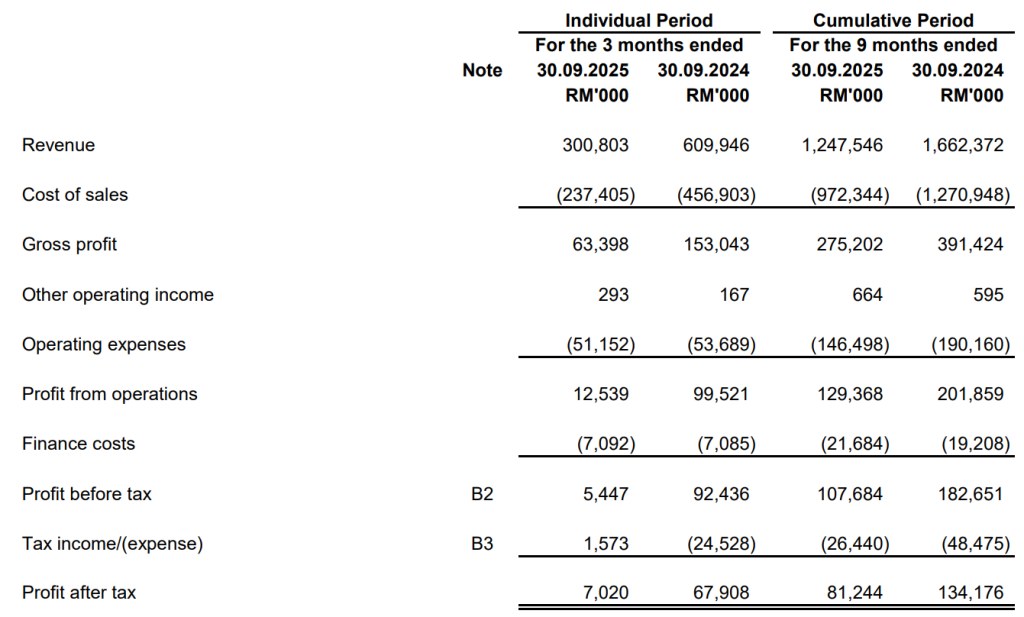
Meanwhile, following the tabling of Budget 2026, Malaysian Government announced an excise duty increase of RM0.02 per stick, effective November 1, 2025. As the risk of further volume leakage from the legal to illicit cigarette market increases subsequent to the excise tax hike, Malaysian Government allocated of over RM700 million (US$167 million) to strengthen enforcement and digitalisation. With initiatives such as digital tax stamps and enhanced screening systems, the Government hopes to curb the illicit trade. Illicit cigarettes account for 54% of total consumption in Malaysia.
October 2025: Vietnam plans to ban investment and trade in e-cigarettes and heated tobacco products
The National Assembly Standing Committee continued deliberations on the amendment to the Investment Law which classifies e-cigarettes and heated tobacco as a prohibited investment and business sector under Article 6 of the Investment Law and paves the way to the implementation of the Resolution No. 173/2024/QH15 of the National Assembly adopted in November 30, 2024. The Resolution concurs to ban the production, trading, importation, concealment, harboring, transportion, and use of e-cigarettes, heated tobacco products, and addictive, health-harming substances. However, such items for warranty & inspection, scientific research, healthcare, pharmaceutical production, national defense & security and “export only, not for consumption in Vietnam” would be exempt from the prohibition.
September 2025: Tobacco excise tax will remain unchanged in Indonesia in 2026
Indonesia will keep its excise tax rates on tobacco products unchanged next year, after considering the impact such taxes have on employment in the tobacco industry. The decision was taken following a meeting with the Indonesian Cigarette Manufacturers Association, which recommended no change in the rates for 2026.
The Finance Minister also committed to issue a new regulation to curb the circulation of illegal cigarettes, particularly those sold without excise bands and have spread widely in recent years. Data from the Ministry of Industry shows that illegal cigarettes accounted for 3% of the total cigarette volume in 2019. The figure climbed to 6.9% in 2023. Most of these untaxed cigarettes are machine-rolled clove cigarettes (Sigaret Kretek Mesin/SKM) – without excise stamps or with counterfeit stamps, misused stamps and reused stamps.The Minister noted that the illegal circulation of cigarettes is disrupting the domestic tobacco industry, causing a drop in legal cigarette production, and several producers have reported impacts such as idle rolling machines, reduced utilization, and layoffs, which ultimately affect workers’ welfare. In parallel to the new regulation, Tobacco Products Industry Zones (KIHT) will also be expanded to more regions as the Government aims to attract illegal cigarette producers to join these special zones, enabling them to operate legally as part of the tax-paying system.
Indonesia, which has one of the world’s highest smoking prevalence rates in the world, did not raise excise rates on tobacco products in 2025, arguing that the policy had done little to curb cigarette consumption, but instead encouraged smokers to shift to cheaper or illegal cigarettes. Before 2025, Indonesia had raised excise tax rates for tobacco products almost every year since 2014 to discourage smoking, especially among its youth. A 2023 survey revealed that 7.4% out of 70 million active smokers in the country were between the age of 10 to 18.
August 2025: Smoking products grossed in RM15.3 billion in duties since 2021 in Malaysia
Excise duties on smoking products added up to RM15.3 billion ($3.6 billion) to government revenue between 2021 and July 2025. The total tax revenue collected from devices, nicotine, and non-nicotine liquids or gels used in electronic cigarettes and vapes in the same period amounted to only RM288.5 million – only 1.9% of the total tax revenue collected.
Products classified as demerit goods, such as cigarettes, tobacco products, and nicotine and non-nicotine liquids or gels used in electronic cigarettes and vapes, are subject to excise duty, in addition to sales tax and import duty (if imported) in Malaysia. Initially, excise duty was imposed on non-nicotine liquid or gel used in electronic cigarettes at a rate of RM0.40 per millilitre. In addition, all types of electronic and non-electronic cigarette devices, including vapes, were subjected to ad valorem excise duty at a rate of 10%, effective January 1, 2021. Subsequently, the scope of excise duty was expanded to include nicotine liquids and gels used in electronic cigarettes and vapes from May 1, 2023. The excise duty rate for both nicotine and non-nicotine liquids and gels is set at RM0.40 per millilitre.
August 2025: Thailand seizes over 4 million e-cigarettes and arrests 3,200 people
In a comprehensive crackdown on e-cigarettes, Thailandese authorities seized more than 4 million e-cigarettes and related products worth ฿580 million (US$18 million) in nationwide crackdowns in 2025. Over 3,200 arrests were made in operations targeting the illegal sale of e-cigarettes and 11,000 urls were blocked. A government spokesman stated that the crackdown has forced many sellers to go underground, shifting from physical shops to online platforms and social media channels.
E-cigarette smugglers face up to 10 years in prison, a fine of five times the value of the products, or both. Sellers risk up to three years’ imprisonment and a fine of up to ฿600,000 (US$18,500) under the Consumer Protection Law, in addition to five years’ imprisonment or a fine four times the product’s value under the Customs Act. Possessing e-cigarettes also carries a penalty of up to five years in jail or a fine four times the product’s value, or both1.
August 2025: Malaysia considers a complete ban on vapes
The Malaysia Ministry of Health (MoH) will present an expert committee’s recommendation on banning electronic cigarettes and vapes to the Cabinet once the study is completed – marking a key step towards implementing the ban. The Malaysian Health Minister stated that enforcement of the Control of Smoking Products for Public Health Act 2024 (Act 852) has already shown positive results, with the number of smoking product variants in the market dropping by 59% to 2,794 in June 2025 from 6,824 before the Act’s enactment.
July 2025: 1 in 3 vapes are laced with etomidate in Singapore
A third of vapes seized during enforcement operations in Singapore were found to contain the etomidate, an anaesthetic agent used for the induction of general anaesthesia and sedation for short procedures. Due to increased abuse via vapes, Singapore will list etomidate under the Misuse of Drugs Act (MDA) from September 1, 2025. The MDA listing paves the way for users and sellers of Kpods – vapes containing etomidate – to be treated in the same way as those who abuse or traffic drugs like nimetazepam, also known as Erimin-5, with mandatory rehabilitation for users and jail time for sellers. Currently, etomidate is listed under the Poisons Act. Under this law, users face only a fine whole sellers face possible jail time of up to two years. Meanwhile, Health Minister urged users to stop immediately, highlighting deaths linked to etomidate. When vaped, etomidate can trigger spasms, breathing difficulties, seizures and psychosis.
Vaping remains banned in Singapore since 2018. Possessing, using or buying vapes carries a maximum fine of S$2,000 (US$1,560). Anyone who distributes, imports or sells vapes and their components can be jailed for up to six months and fined up to S$10,000. Those found in possession of or using pods containing etomidate can be jailed for up to two years and fined up to S$10,000 (US$7,800).
June 2025: Malaysia loses RM5 billion (US$1.2 billion) in tax revenue to illicit cigarettes annually
A recent NielsenIQ study finds that illegal cigarettes make up 54.6% of all cigarettes sold in Malaysia, underlining the size and strength of the black market. Nevertheless, the weight of illicit cigarette in total consumption is in a slow & steady decline since its peak at 63.8% in 2020 – mostly driven by the stronger enforcement actions and the ban on trans-shipment of tobacco products.
Top 10 contraband brands combined account for around 75% of all illicit cigarettes smuggled into Malaysia. The study reveals that 69% of illegal cigarette packs carry no tax stamp at all, while 31% bore counterfeit stamps. Increased use of fake tax stamps indicate that criminal networks are becoming increasingly sophicated and adept in exploiting weaknesses in the regulatory system and circumventing enforcement actions.
It is estimated that Malaysia incurs RM5 billion (US$1.25 billion) in tax revenue loss annually due to the rampant illicit cigarette trade.
June 2025: Evaluation of vape registry applications will continue until October 1, 2025 in Malaysia
Malaysia’s Health Ministry (MOH) disclosed that it is currently evaluating registration applications for electronic smoking products – including vape devices and e-liquids – submitted under the Control of Smoking Products for Public Health Act 2024 (Act 852). The application window opened in October 2024 and closed in April 2025, and no products have yet received MOH approval. The evaluation phase will continue until October 1, 2025, at which point any unregistered products will be prohibited from sale. Upon approval, registered vape products will receive a certificate permitting them to be retailed through authorised channels – specifically convenience stores or licensed specialty vape outlets, excluding venues such as night markets. Applications must include laboratory testing and will be screened for banned substances – items containing illicit components (e.g. psychedelic mushrooms) face outright rejection. Notably, MOH’s oversight extends to nicotine‑containing products only; standalone devices are governed by the Ministry of Domestic Trade and Cost of Living (KPDN) under Sirim certification and are excluded from Act 852.
MOH emphasised stringent controls: retailers must stock only MOH‑registered products, or risk licence rejection by local authorities like Kuala Lumpur City Hall. Spatial rules mandate vape retailers to maintain a minimum distance of 40 m from higher‑learning institutions and 3 m from kindergartens or general commercial areas like 7-Eleven.
April 2025: British American Tobacco will stop selling VUSE vape products in Malaysia in Q3 2025
British American Tobacco (BAT) announced that it will remove VUSE vape products from the Malaysian market in Q3 2025 in compliance with the Control of Smoking Products for Public Health Act 2024 (Act 852) and its regulations that will take effect on October 1, 2025. According to the Act 852, e-cigarettes will be officially included in the statutory regulatory system with comprehensive requirements to be imposed on the product labeling, retail display, sales channels and content ingredients. Based on the re-assessment of VUSE’s commercial viability under the new vape regulations, BAT decided to focus on delivering combustible (cigarette) value growth in Malaysia.

April 2025: Malaysia’s vape market size reached RM3.5 billion in 2024
Malaysia’s highly fragmented vape market grossed RM3.48 billion ($780 million) in retail turnover in 2024. Malaysia imposes a minimal excise tax of 40 sen ($0.09) per millilitre on vape liquids containing nicotine which renders vape products an affordable alternative to cigarettes. There are about 100 importers, 200 brands, 2,500 specialist shops and 7,500 general stores involved in the Malaysian vape market. British American Tobacco was the first global tobacco company to introduce its vape brand, VUSE, in Malaysia in July 2023.
Philip Morris International (PMI) launched VEEV NOW and VEEV ONE vapes in April 2024. Despite the launch of IQOS (PMI) in 2018, heated tobacco remains to be a small category in Malaysia, capturing only 2% of the total nicotine industry. BAT’s glo and, since January 2025, Japan Tobacco’s Ploom are also present in Malaysia.
The Control of Smoking Products for Public Health Act 2024 came into force on Oct 1, 2024 in Malaysia to regulate tobacco and nicotine products, including vapes or e-cigarettes (vapes) and heated tobacco products (HTPs). Local vape companies are required to register with the customs department by April 2025. In addition, general retail shops will be subject to a ban on displaying tobacco and vape products from April 2025.
April 2025: Generational shift in nicotine consumption habits in the Southeast Asia
A generational shift is happening in the nicotine consumption habits in the Southeast Asia as smokers move away from traditional cigarettes towards alternative nicotine products, notably e-cigarettes (vapes) and, to a much lesser extent, heated tobacco products (HTPs). While the widespread adoption of e-cigarettes is a relatively recent phenomenon with the majority of users across the region initiating use within the last two years, use of HTPs remain relatively low.
The prevalence of alternative nicotine product use in Southeast Asian countries is nearing or even exceeding half of the incidence of smoking. In Singapore, new nicotine product use prevalence reaches 5.4% compared to 9.2% smoking prevalence. In Malaysia and the Philippines, smoking prevalence leads 19.7% versus 12.2% and 20.7% vs. 9.5%, respectively2. Younger demographics, particularly those under 35, exhibit a lower prevalence of cigarette smoking but a significantly higher uptake of alternative nicotine products compared to older age groups.
Several key factors are contributing to the increasing popularity of e-cigarettes and HTPs. Flavor variety stands out as a primary driver, with fruit and menthol flavors dominating consumer preference. The perception that e-cigarettes are “cheaper” than traditional cigarettes is another significant motivator for adoption. Ease of access and engagement over the social media play a crucial role. In addition, the perceived lower health risk and social acceptability of the alternative nicotine products contribute to their appeal.
Despite bans in Singapore and Vietnam, the entrenched presence of alternative nicotine products underscores a significant challenge: illicit trade. The shift from (expensive) duty-paid cigarettes to (cheap) untaxed, unregulated new nicotine products adds to the existing illicit tobacco trade issue in the region.

