


October 2026: U.S. E-Vapor Revenue Slips in Mainstream C-Stores as Sales Migrate to Alternative Channels
Total U.S. convenience store revenue for vaping contracted 5.1% year-over-year to $6.22 billion. The downturn was driven by a 13.1% decline in unit volume down to 303 million units, which outweighed a 9.2% gain in average unit price, now standing at $20.55.
| Product | Dollar Sales | 1-Year % Change | Category Share | 1-Year pp Change | Unit Sales | 1-Year % Change | Unit Price | 1-Year % Change |
|---|---|---|---|---|---|---|---|---|
| Vaping Products | $5.94 B | -6.6% | 95.40 | -1.53 | 282 M | -14.5% | $21.05 | 9.3% |
| Vaping Accessories | $287 M | 42.3% | 4.60 | 1.53 | 20.8 M | 13.9% | $13.76 | 24.9% |
| Vaping Category | $6.22 B | -5.1% | 100.00 | 0.00 | 303 M | -13.1% | $20.55 | 9.2% |
Dollar sales in the core vaping products segment – comprising pre-filled pods, single-use disposables, and e-liquids – dropped 6.6% to $5.94 billion, as unit shipments fell 14.5% to 282 million units. Rather than indicating a drop in overall consumption, this trend reflects a notable channel shift. Vapers are increasingly sourcing products outside tracked convenience retail, migrating toward specialty vape shops, unmonitored independent stores, and direct-to-consumer websites that stock non-authorized disposable vapes and flavor varieties restricted in traditional c-stores. Although volume contracted, a 9.3% price increase to $21.05 per unit helped soften the overall dollar decline, even as the segment’s market share shrunk by 1.53 percentage points to 95.4%.
Conversely, vaping accessories posted remarkable growth, with dollar turnover jumping 42.3% to $287 million and its category share expanding 1.53 percentage points to 4.6%. Unit sales for accessories rose 13.9% to 20.8 million units, while average unit prices climbed 24.9% to $13.76. Rapid expansion in this segment is being fueled by device innovation and cross-category usage across nicotine and legal cannabinoid markets. Demand remains elevated for universal 510-thread batteries and multi-use power units, heavily utilized by dual-use consumers purchasing state-legal THC or hemp-derived cannabinoid offerings (such as Delta-8 and THC-A). In addition, modern hardware equipped with digital screens, variable wattage, and smart battery features has boosted sales of charging equipment, while ongoing maintenance of open-system devices continues to support replacement coil, pod, and tank purchases.
September 2026: BAT Launches New Flavored Vuse Pods in U.S. Following Shift in FDA Enforcement Guidelines
R.J. Reynolds Tobacco Company, the U.S. subsidiary of British American Tobacco (BAT), has initiated a phased U.S. rollout of new flavored Vuse Pro e-cigarette pods. The commercial move follows recent updates to the U.S. Food and Drug Administration’s (FDA) enforcement priority guidelines, triggering a major shift in the ongoing regulatory landscape for flavored vapor products.
Unveiled as part of BAT’s H1 2026 investor presentation, the new Vuse Pro pod lineup expands the brand’s offerings beyond traditional tobacco options. The phased Q3 launch introduces four new non-tobacco flavor profiles at 5.0% nicotine strength: Fresh Mint, Peach, Berry and Watermelon. All four variants will be sold in standardized four-pod packages compatible with the Vuse Pro closed-loop system.

The expansion comes on the heels of modified FDA enforcement priority guidelines issued earlier this year. Under the agency’s updated compliance policy, federal regulators have concentrated enforcement resources primarily on illicit, unregulated disposable vapes while establishing clearer operational parameters for major manufacturers with pending premarket tobacco applications (PMTAs). BAT is leveraging these updated priorities to recapture market share from unauthorized grey-market disposables that have dominated retail shelves in recent years.
The product launch has drawn swift criticism from public health groups and youth advocate organizations. Opponents contend that introducing fruit and mint flavors at a high 5.0% nicotine concentration threatens to rekindle youth vaping concerns, pointing to historical survey data showing that fruity and minty flavors are overwhelmingly preferred by underage users.
In response, tobacco companies maintain that offering diverse flavor options to adult consumers is vital for encouraging full transition away from combustible cigarettes. BAT emphasizes that its pod-based closed system, paired with stringent retail age-verification standards, ensures these products reach their intended adult target audience as retail distribution expands across the country throughout Q3 2026.
September 2026: U.S. E-Vapor Sales Decline in Tracked Retail as Volume Shifts to Untracked Channels
Total U.S. convenience store sales for e-vapor products contracted by 5.7% year-over-year to $6.22 billion over the 52-week period ending July 12, 2026, as a 13.7% drop in unit volume to 304 million units outweighed a 9.3% increase in average unit price to $20.45.
| Product | Dollar Sales | 1-Year % Change | Dollar Share | 1-Year pp Change | Unit Sales | 1-Year % Change | Unit Price | 1-Year % Change |
|---|---|---|---|---|---|---|---|---|
| Vaping Products | $5.94 B | -7.1% | 95.5 | -1.5 | 283 M | -15.1% | $20.96 | 9.4% |
| Vaping Accessories | $279 M | 40.5% | 4.5 | 1.5 | 20.6 M | 12.2% | $13.51 | 25.3% |
| Total E-vapor | $6.22 B | -5.7% | 100.0 | 0.0 | 304 M | -13.7% | $20.45 | 9.3% |
Core vaping products – comprising pre-filled pods, disposables, and e-liquids – drove the overall category contraction. Dollar sales for vaping products fell 7.1% to $5.94 billion, while unit volume plunged 15.1% to 283 million units. Rather than signaling a broader decline in consumer nicotine demand, this shift reflects a major migration of sales out of mainstream convenience stores toward untracked retail channels. Consumers and retailers are increasingly sourcing e-vapor items from specialty stores, low-tier unmonitored convenience stores, and direct-to-consumer online platforms. These alternative channels offer wider access to non-authorized disposable vapes and diverse flavor profiles facing strict regulatory hurdles in mainstream tracked outlets. An average unit price increase of 9.4% to $20.96 helped cushion the severe volume loss in tracked retail.
In contrast, vaping accessories experienced explosive growth, surging 40.5% in dollar sales to $279 million and expanding its dollar share of the e-vapor market by 1.5 percentage points to 4.5%. Unit volume for accessories rose 12.2% to 20.6 million units, while average unit prices jumped 25.3% to $13.51. Growth in this segment is being fueled by hardware innovation, evolving consumer preferences, and strong cross-category usage across nicotine and cannabis channels. Retail demand is surging for universal 510-thread batteries and multi-use power units, heavily utilized by dual-use consumers purchasing state-legal THC or hemp-derived cannabinoid products (such as Delta-8 and THC-A) alongside traditional nicotine options. Furthermore, the popularity of complex, high-tech devices equipped with digital screens, variable wattage, and advanced power management features has increased demand for external charging hardware and USB-C accessories. Additionally, ongoing maintenance for open-system devices continues to support sales of replacement coils, pods, and tanks, while consumer preference for feature-rich, premium hardware has significantly driven up average unit prices.
August 2026: U.S. C-Store Vape Sales Drop 6.0% as Volume Shifts to Untracked Channels; Accessories Surge 38%
Total electronic smoking device sales in U.S. convenience stores fell 6.0% year-over-year to $6.22 billion for the 52 weeks ending June 14, according to Circana data. Category contraction was driven by core vaping products, which dropped 7.4% in dollar sales to $5.95 billion as unit volume fell 15.3% to 286 million units.
| Product Segment | Dollar Sales | 1-Yr % | Dollar Share | 1-Yr Share Chg | Unit Sales | 1-Yr % | Price Per Unit | 1-Yr % |
| Electronic Smoking Devices | $6.22 B | -6.0% | 100.0% | 0.0 | 306 M | -14.0% | $20.33 | +9.3% |
| Vaping Products | $5.95 B | -7.4% | 95.6% | -1.4 | 286 M | -15.3% | $20.83 | +9.3% |
| Vaping Accessories | $271 M | +38.2% | 4.4% | +1.4 | 20.4 M | +8.9% | $13.28 | +26.9% |
However, the 7.4% decline in tracked retail sales does not represent a slowdown in overall consumer vaping demand. Instead, significant sales volume is shifting away from traditional c-stores toward untracked retail channels – including independent small retailers, specialty retailers, and online sellers – where unauthorized and illicit disposable vape products continue to dominate the market. Average unit prices for vaping products rose 9.3% to $20.83, helping cushion broader revenue losses despite the steep volume contraction in mainstream stores.
In stark contrast to core vaping liquids and pods, the vaping accessories subcategory posted massive growth, surging 38.2% to $271 million. Unit volume for accessories rose 8.9% to 20.4 million units, while average unit prices spiked 26.9% to $13.28. This accessory growth is directly tied to the growing “make your own vape” and open-system customization trend. As consumers seek lower long-term costs and custom flavor profiles, more vapers are opting for open systems and modular devices, driving demand for standalone hardware like replacement coils, refillable pod tanks, external batteries, and fast-charging cables. Furthermore, c-store retailers are capitalizing on cross-category demand by stocking universal 510-thread battery hardware and accessories that serve dual purposes for both nicotine e-liquids and legal alternative cannabinoid vaporizers.
July 2026: FTC Warns E-Cigarette Firms Over Deceptive Domestic Origin Marketing
The Federal Trade Commission (FTC) has issued official warning letters to three e-cigarette companies regarding marketing claims that potentially misrepresent the geographic origin of their products. The regulatory agency stated it has reason to believe that these businesses advertised certain vaping products as “Made in the USA” or “Made in Texas,” despite indications that the items or their significant components were imported from overseas.
According to the FTC’s Bureau of Consumer Protection, unqualified domestic origin claims require a product to be “all or virtually all” manufactured within the United States. The warning letters advise the entities to review their advertising across all marketing channels, including social media hashtags and implied patriotic messaging, to ensure compliance with the Made in USA Labeling Rule and Section 5 of the FTC Act. This targeted action follows a March executive order directing the commission to prioritize enforcement against unlawful domestic origin claims to maintain fair competition and consumer trust.
June 2026: U.S. Vaping Category Continues to Contract as Higher Prices Cushion Volume Declines
The U.S. vaping category remained under pressure in tracked convenience-store channels during the 52 weeks ending March 22, 2026, with declining unit volumes only partially offset by higher prices. According to Circana data, electronic smoking device sales fell 6.4% year over year to $6.26 billion, while unit sales dropped 14.0% to 314 million units. The category-wide average price increased 8.8% to $19.94 per unit, helping to mitigate the impact of weakening demand.

The decline was concentrated in vaping products themselves, which account for 96% of category sales. Dollar sales of vaping products fell 7.5% to $6.01 billion, while unit sales declined 14.7% to 294 million units. Average prices rose 8.5% to $20.42 per unit, indicating that pricing and product mix improvements partially compensated for the ongoing volume contraction.
By contrast, vaping accessories posted strong growth. Accessory sales increased 28.9% to $250 million, expanding their share of the category from 2.9% to 4.0%. Unit sales were broadly stable, declining only 1.5%, while average prices surged 30.8% to $12.75 per unit. Accessories typically include replacement pods, cartridges, coils, chargers, batteries, and other device-related components purchased separately from the primary vaping device.
Competition from illicit disposable products amid regulatory uncertainty, FDA PMTA delays and ineffective enforcement actions continue to weigh on legal-market sales. While vaping remains a multi-billion-dollar category, recent growth within nicotine has increasingly shifted toward modern oral products such as nicotine pouches, leaving vapor products to contend with declining volumes and a greater reliance on pricing to support revenue in the legal market.
January 2026: Walgreens Reintroduces E-Cigarette Sales as Juul’s U.S. Retail Presence Expands
Walgreens has quietly resumed selling e-cigarette products in many of its U.S. stores for the first time since it removed vaping products in 2019 amid widespread health concerns and a backlash over youth use. Walgreens – now owned by private equity firm Sycamore Partners – is stocking select vape products again, including those from JUUL Labs, in c.6,000 of its nearly 8,000 locations nationwide. The return of vape products comes as FDA has authorized a number of “compliant” e-cigarette products since 2021, making retailers more comfortable carrying devices that meet current regulatory standards. Altria-owned NJOY also lists Walgreens among its retailers, further broadening the chain’s vape offering. Meanwhile, major competitors like CVS and Walmart continue to abstain from selling e-cigarettes, with CVS having exited all tobacco sales and Walmart limiting cigarette availability in some stores.
Walgreens’ decision to reintroduce e-cigarettes follows a notable shift in the U.S. regulatory landscape. In 2022, the U.S. Food and Drug Administration initially rejected JUUL Labs’ premarket tobacco product applications and issued a marketing denial order, citing insufficient evidence that the products met the statutory public-health standard. That decision was later stayed and ultimately reversed as the FDA continued its scientific review. In late-2025, the Agency authorized the marketing of several JUUL products, including the JUUL device and tobacco- and menthol-flavored pods at 3% and 5% nicotine strengths, concluding that they were “appropriate for the protection of the public health.” These authorizations place JUUL among a limited group of e-cigarette brands legally cleared for sale in the U.S., alongside products from NJOY, VUSE, and Logic. The FDA’s decision remains controversial, however, with public-health groups arguing that menthol authorization risks renewed youth uptake, underscoring the ongoing tension between harm-reduction goals for adult smokers and youth-prevention concerns.
January 2026: Truth Initiative Warns Rapidly Evolving Nicotine Market Is Outpacing Regulation and Increasing Youth Risk
A new Truth Initiative report finds that the rapidly evolving U.S. nicotine market is outpacing regulation and increasing the risk of youth addiction, with about one-third of underaged (aged 13-18) and young adult (aged 18-27) vapers reporting use of high-tech “smart” vapes with screens or Bluetooth features. Top 5 vape brands, Geek Bar, Raz, Vuse, Juul and Breeze Smoke, collectively hold c.75% share in the U.S. vape market; Geek Bar & Raz – two of the top five vape brands – now offer top-selling products with “smart” features that gamify nicotine use and are sold in a wide range of flavors at relatively low prices.
Nearly all current e-cigarette users aged 13–27 use flavored products. Flavored disposables account for 93.2% of disposable e-cigarette sales and 93% of the more than 7,000 e-cigarette products on the market as of the end of 2024. Total nicotine sold in e-cigarettes surged 249% between February 2020 and June 2024 and oral nicotine pouch sales nearly tripled from $145 million to $404 million between January 2023 and December 2024, driven largely by flavored products that could appeal to young users. The report calls for stronger enforcement and expanded prevention and cessation resources.
Download Truth Initiative: 2025 Trends Report
December 2025: Vape Sales in Convenience Stores Continue to Decline in the U.S.
In the U.S. multi-outlet and c-store channel, vape sales declined 9.2% to $1.39 billion (annual run-rate: $6.02 billion) in the 12 weeks ending October 5, 2025 (Circana data) as the U.S. consumers continue to shift to illegal disposable vapes sold mostly in the independents and specialty stores (i.e. untracked channels). Altria, owner of Marlboro in the U.S., reported that number of vapers increased by 10% from 19 million to 20.9 million over the 12 months ending September 30, 2025. Number of vapers using disposable vapes increased by 19% from 12.4 million to 14.8 million – now representing around 71% of the total vapers (vs. 65% a year ago). Consequently, U.S. multi-outlet and c-store channel is experiencing 17.6% sales volume decline in the vape category growing, at least, by 10%.

June 2025: 100k-puff Vapes are now Available in the U.S. Market
Chinese manufacturers are rushing to launch ultra high-capacity disposable vapes, delivering up to 100k puffs (equivalent to 5,000 cigarettes, 250 packs or about a year’s consumption based on 20-puff-a-cigarette conversion rate), in the U.S. market. One such device, HorizonTech 100K model, has a 40ml e-liquid capacity and aims to set a new benchmark in cost effectiveness. In Boost Mode (max 40W power output), the device delivers up to 60k puffs. In Regular Mode (max 30W), it delivers up to 100k puffs and claims to extract 2,500 puffs per ml of e-liquid. HorizonTech 100K is available in 12 different flavors of fruit, mint and fruit & mint fusions. The regular price of HorizonTech 100K on online retailers is $33.99, but it can be purchased for as low as $15.99 on various sites.

May 2025: Vape Sales in Convenience Stores Continue to Decline in the U.S.
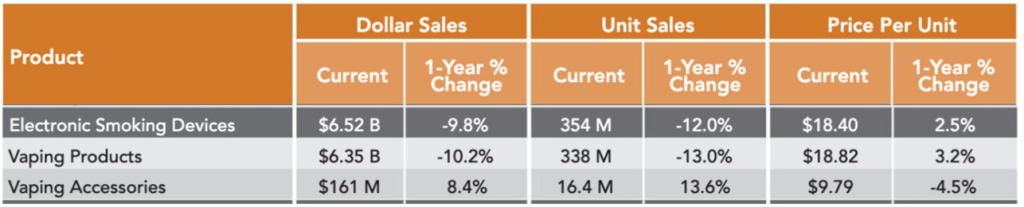
In the U.S. multi-outlet and c-store channel, vape sales declined 9.8% to $6.52 billion in the 52 weeks ending April 20, 2025 (Circana data) as the U.S. consumers continue to shift to illegal disposable vapes sold mostly in the independents and specialty stores (i.e. untracked channels). Altria, owner of Marlboro in the U.S., reported that number of vapers increased by 14% from 18 million to 20.5 million over the 12 months ending March 31, 2025. Number of vapers using disposable vapes increased 38% from 10.5 million to 14.5 million – now representing around 70% of the total vapers (vs. 58% a year ago). Consequently, U.S. multi-outlet and c-store channel is experiencing 13% sales volume decline in a category growing double-digit.
May 2025: Monthly E-cigarette Sales Volume Increased by ~250% in the U.S. Since 2020, Driven by Illegal Disposable Vapes
According to a new study1 based on Circana retail sales data, from February 2020 to June 2024, monthly e-cigarette sales volume increased by +34.7% in number of units sold (from 15.7 million to 21.1 million units) and by +249.2% in amount of nicotine sold (i.e. volume in mL x nicotine concentration in mg/mL; from 2.7 billion to 9.4 billion milligrams) in the U.S. Growth in e-cigarette sales volume measured in nicotine amount is 7.2 times the growth in number of units – a phenomenon driven by the surge of illegal disposable vapes with high e-liquid volume. Between January 2017 and September 2022, average e-liquid volume in a disposable vape increased from 1.1 to 5.7 mL and average nicotine strength increased from 1.7% to 5%; thereby, average nicotine amount in a disposable vape soared from 1.9mg to 28.5mg. These bigger & cheaper vapes deliver nicotine at more accessible price points; most disposable vapes deliver nicotine levels equivalent to a carton of cigarettes (i.e. 200 cigarettes) or more in a single device which typically costs US$15-20.

From February 2020 to June 2024, disposable vape sales volume jumped by 201.3% in number of units sold and by 2,365% in nicotine amount sold. In the same period, pod sales volume declined by -23.8% in number of units sold and increased by just +1.3% in nicotine amount sold. Disposable vapes, favored by the youth, account for 74% of the nicotine amount sold and 58.1% of the units sold. As of June 2024, on average, a disposable vape contains 9.0 times more e-liquid than a prefilled pod (usually 1.5-2ml). The price per milligram of nicotine in prefilled pods is 3.7 times greater than that of disposable devices.
March 2025: Tracked Vape Sales Volume Declined by 12.3% in 2024 in the USA
U.S. vape market has been further dominated by the illegal disposable vapes in 2024. Illicit vapes now represent more than 60% of the U.S. vape market, even up to 80% according to some estimates. As of December 2024, the Food and Drug Administration (FDA) had granted marketing orders to 34 vape products which collectively has only 2% share in the overall U.S. vape market. Enforecement of FDA’s rules remains a major challange in the market. More States set out mandatory registries of vape products allowed for sale; 24 registry laws were proposed so far with Governors signing the legislation into law in 6 of them. However, enactments in Utah and Iowa have been put on hold pending the outcomes of lawsuits. Moreover, additional flavor bans at the state and municipal levels, such as in the one in Columbus, Ohio, create further complications without necessarily bringing law & order to the marketplace.

According to the Circana sales data, vape market declined by 9.1% and 12.3% in value and volume, respectively, in traditional retail in 2024 – despite 17.6% growth in the number of vapers to 20 million. Fast-growing illegal vapes are sold mostly in (untracked) independent retailers and online. However, the vaping accessories subcategory experienced a strong growth in sales (+18.6% in value), presumably as a result of its use in cannabis vaping.
February 2025: Sales of Unauthorised Flavored Disposable Vapes in the USA Amounted to $2.4 Billion in 2024 in Tracked Channels
Sales of unauthorised, flavoured disposable vapes in the United States amounted to $2.4 billion in 2024, or 35% of the $6.8 billion worth of e-cigarettes sold in tracked convenience stores and supermarkets, according to the private retail sales data from market research firm, Circana2. Unauthorised vape sales amounted to $3.2 billion in 2023 and $2.8 billion in 2022.

The private Circana data tracks around 11,000 unauthorised flavoured disposable e-cigarette products sold under hundreds of different brand names. However, Circana does not track vapes sales made online, in independent stores and in speciality vape outlets. The figures showed a 25% contraction in flavoured disposable vape sales in 2024. This is in contradiction to Altria’s estimates which reveal a 30% growth in the U.S. vape market in 2024, driven entirely by illegal products. It is clear that tracked channels are irrelavant in depicting the overall US vape market. A detailed overview of the US vape market (legal & illegal, tracked & untracked) is available in our “USA NGP/RRP Market: 2024-2030” report.
Nevertheless, US FDA’s efforts [to crack down illegal vape] seem to have some impact on the illegal brand mix. Previously best-selling brands, such as Esco Bars and Elf Bars, dropped out of the top 10 most sold vapes in 2024 while other brands, including Geek Bar, have taken their place.


