



May 2026: Canada’s Tobacco and Vaping Act Review Highlights Enforcement Gaps Amid Growing Illicit Market
Canada’s third legislative review of the 2018 Tobacco and Vaping Products Act (TVPA) concluded that stronger compliance and enforcement measures are needed as illegal tobacco and vaping products continue to expand across the country. The review identified challenges including limited enforcement resources, outdated IT systems, difficulties monitoring online sales, and the growing complexity of the vaping market.
The report proposed several measures to strengthen oversight, including greater collaboration with provincial authorities and Indigenous communities, expanded enforcement tools, more inspections, increased use of AI and automation, and tougher penalties for non-compliance. Recent amendments also increased the number of offences subject to fines from 10 to 104, with penalties now ranging from CAD$500 to CAD$3,000.
The review comes as concerns mount over Canada’s illicit tobacco market. A recent KPMG report found that non-regulated and illegal products now make up 38% of the Canadian tobacco market and account for up to CAD$2.1 billion in uncollected tax revenue for governments across Canada. By comparison, a 2025 KPMG report covering 38 European countries estimated Europe’s illicit tobacco market at around 10%. Industry stakeholders argued the government review understated the scale of the illicit trade problem and called for a more coordinated national enforcement strategy to combat contraband tobacco and unauthorized nicotine products.
March 2026: Convenience Stores Reinforce Their Dominance in Canadian Tobacco Sales
According to the Convenience Store News Canada, cigarette use among convenience shoppers in Canada has increased modestly year over year, rising from 26% to 28%, while convenience stores continue to serve as the primary purchase channel for smokers. The findings are based on the 2026 C-store IQ National Shopper Study, which surveyed more than 2,000 convenience and gas station customers across the country. The study found that three-quarters of smokers purchase cigarettes at convenience stores, reinforcing the channel’s central role in tobacco retail.
Millennials (30 to 45 years old) are playing a particularly significant role in cigarette purchasing. More than one-third of millennials (34%) report that they smoke regularly, and 79% say they buy cigarettes at convenience stores. The same cohort also over-indexes in vaping and e-cigarette use, with 19% reporting regular use compared with a 16% overall average. Generation Z (legal age to 29 years old), however, continues to drive growth in the vaping category. Nearly three in ten Gen Z shoppers (29%) report that they use vaping or e-cigarette products regularly, highlighting the generational shift toward alternative nicotine products.

The data also indicates a gradual shift in purchasing channels for vaping products. Fewer users report buying from specialty vape shops, with the share declining nine percentage points year over year to 53%, narrowing the gap with convenience stores. This suggests that convenience retailers are increasingly capturing a larger share of the vaping category alongside traditional tobacco products.
Brand loyalty remains strong across both cigarette and vape consumers. More than one-third of users (36%) say they would switch stores if their preferred brand were unavailable. Among millennials, this figure rises to 43%, underscoring the importance of consistent product availability, inventory management, and disciplined assortment strategies for convenience retailers seeking to retain tobacco and nicotine customers.
March 2026: Smoking Declines in Canada as Legal Tobacco Sales Fall and Illicit Trade Expands
Fewer Canadians are smoking, continuing a long-term downward trend in tobacco use across the country. In 2024, only 13% of Canadians used a tobacco product, a sharp decline from 29% in 2001. About 11% of adults reported smoking cigarettes, and roughly 300,000 Canadians who smoked in 2023 quit in 2024 – equivalent to c.8% of all smokers. The figures reflect ongoing public health efforts, higher prices, regulatory restrictions, and shifting consumer preferences toward alternative nicotine products.
Retail sales data confirms the decline in combustible tobacco. According to NielsenIQ, cigarette sales fell 8.2% year over year in 2024 to $3.3 billion in convenience stores. Sales of other tobacco products, including non-combustible formats, declined by 10% compared with 2023, falling to $241.5 million1. Shipment data from Statistics Canada shows an even steeper decline in cigarette volumes. In December 2025, the agency reported that the total number of cigarettes sold decreased 15.8% to 931 million compared with December 2024, which corresponds to an annual run-rate of roughly 11 billion sticks. The data suggests that cigarette consumption continues to decline at a steady pace.
At the policy level, the federal government continues to pursue aggressive smoking reduction targets. In January 2026, Health Canada released a progress report on the Canada Tobacco Strategy, a national initiative launched in 2018 aimed at reducing tobacco use to less than 5% of Canadians by 2035. The report serves as a mid-point evaluation, highlighting both the progress made in reducing smoking prevalence and the challenges that remain, particularly among certain demographic groups and regions.
However, some government measures designed to curb smoking – particularly high taxes and strict regulations – have had unintended consequences, most notably the growth of the counterfeit & contraband tobacco market. Legal tobacco sales have declined much faster than smoking rates, suggesting that some consumption has shifted to illegal products rather than disappeared entirely. This dynamic has disproportionately affected legal retailers, particularly convenience stores, which must comply with taxation and regulatory requirements while competing with untaxed illegal products.
A 2024 report by EY Canada estimates that the illegal tobacco market in Canada is worth $1.3 billion annually. To combat the growth of illicit trade, industry groups and retail associations are advocating for expanded enforcement powers and additional resources for municipal and provincial police, stronger enforcement against online sales channels where underage consumers can purchase illegal nicotine products, and mandatory retailer training programs such as the ID Please age-verification initiative. Together, these measures are aimed at protecting legal retail channels while supporting broader public health objectives.
November 2025: Imperial Tobacco Canada praises the Governments of Ontario and Alberta
British American Tobacco (BAT)’s Canadian affliate, Imperial Tobacco Canada (ITCAN) praises the Governments of Ontario and Alberta for their decisive action against contraband tobacco, reinforcing commitment to public safety and the protection of government revenues. In Ontario, illicit tobacco accounts for c.40% of the market, translating to an estimated C$557 million in annual lost tobacco tax revenue. In Alberta, c.30% of the market is illegal, resulting in C$185 million in lost tax revenue. Royal Canadian Mounted Police (RCMP) estimates that 175 organized crime groups are involved in the contraband tobacco trade in Canada, often using profits to fund other criminal activities.
ITCAN notes a list of steps taken in these provinces:
– Alberta: Introduction of two new administrative penalties under the Tobacco Tax Act targeting the purchase, storage, and sale of contraband tobacco. Requirement of all enforcement agencies to report seizures of illegal tobacco, ensuring consistent provincial data collection and enabling more strategic, intelligence-driven enforcement
– Ontario: Continued commitment to enforcement and policy consultation, including exploring collaborations with law enforcement, stakeholders, and First Nations partners. Review of authorities and potential amendments to support police officers with the training and education.
ITCAN also underlines the inaction of the Federal Government, particularly on matters that extend beyond the provincial jurisdictions, such as the online sales of contraband tobacco as well as illegal vapes & nicotine pouches.
June 2024: Retail tobacco sales dropped to C$11.8 billion in Canada
In May 2018, The Tobacco Act was amended in Canada to become the Tobacco and Vaping Products Act (TVPA) in order to create a new legal framework for regulating vapes. The TVPA includes a requirement for a legislative review three years after coming into force and every two years thereafter. The First Review, with focused on vaping, was tabled in the Parliament in December 2022. The Second Review2, with focus on progress made towards achieving the tobacco-related objectives, was tabled in June 2024. The Canadian Government presents TVPA as an essential element of Canada’s goal of reducing the prevalence of tobacco use from the current rate of 12% to less than 5% of the population by 2035.
Key notes from the Second Review:
– Smoking rates for people aged 15 years and older declined from 26.8% (6.6 million people) in 2001 to 11.9% (3.8 million people) in 2022. Recording the steepest decline, smoking rate among the youth (aged 15-19) reached an all-time low of 1.6% (note that the impact of vaping not mentioned in the Report)
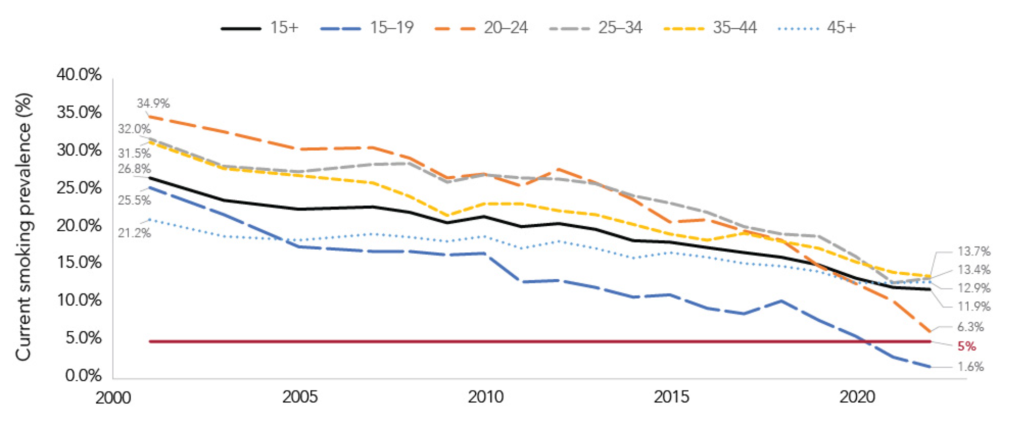
– Canada’s smoking population has become relatively older over time. Smokers, aged 45 years or older, made-up 35.1% of the smoking population in 2001 and 57.9% in 2022. Meanwhile, the share of young smokers (aged 15-19) declined from 8.1% to 0.9% in the same period

– Despite significant declines in smoking prevalence for the population as a whole, some communities and regions have not benefited from the same rate of decline. Indigenous people (First Nations, Inuit and Métis), Northern Regions, construction workers, people with a mood and/or anxiety disorder, lowest household income quintile and less-educated have significantly higher smoking rates when compared to the population.
– Retailers sold C$11.8 billion worth of tobacco products in 2022, compared to C$12.6 billion in 2020. Cigarettes and cigars represent 94% and 3% of the total tobacco market, respectively. All other tobacco products, fine-cut tobacco (RYO/MYO) and smokeless (chewing tobacco, oral snuff and nasal snuff), account for the remaining 3%.
– Cigarette sales volume declined by 42% from 2013 to 2022. The number of cigarettes sold in 2022 was 18.4 billion sticks, down 12.1% from 2021. In 2022, tobacco industry revenue for cigarettes was estimated at C$4 billion, down 6.1% from 2021. Industry revenue per stick increased by ~7% to 22.1 cents in 2021 (from 20.6 cents/stick in 2021).

4 areas are identified in the Second Review for potential action:
– Prioritizing engagement, cooperation and reconciliation with the Indigenous people
– Addressing barriers to cessation (the prevalence of quitting smoking has been stable around 8%-9% over the past 20 years)
– Strengthening enforcement, increasing transparency and addressing industry interference
– Ensuring legislative framework is responsive to modern realities (technical innovations and new products, online sales, innovative international best practices)
References:

