


February 2026: New Zealand Approves First Quit‑Vaping Medicine as Youth Use Climbs
New Zealand’s medicines regulator Medsafe approved the country’s first product specifically indicated to help people quit vaping, marking a milestone in clinical support for nicotine dependence. The product now recommended for this purpose is Nicorette QuickMist, a nicotine mouth spray that delivers controlled doses of nicotine to relieve cravings and withdrawal symptoms for people looking to stop vaping or smoking. The spray contains 1 mg of nicotine per dose and is designed to be used as part of a step‑down quitting plan that helps users gradually reduce their dependence on nicotine. Medsafe’s approval gives it a therapeutic indication for treating nicotine vaping dependence, meaning it’s officially recognised as a treatment option in New Zealand.
Nicorette QuickMist is manufactured under the longstanding Nicorette brand, which is owned by Kenvue outside the United States and has been widely used for smoking cessation for decades. The mouth spray’s approval for vaping cessation reflects growing recognition that vaping can create rapid and high‑frequency nicotine dependence, particularly among younger users. By helping reduce cravings and manage withdrawal, the product adds a clinically backed tool for those already struggling with addiction.
December 2025: Daily vaping prevalence continues to rise in New Zealand
The most recent New Zealand Health Survey (NZHS) finds that while smoking rates have plateaued at historically low levels, vaping has become widespread – particularly among younger adults, Māori and Pacific peoples, and in more deprived communities. The prevalence figures raise concerns over rising nicotine use overall, especially given the potential health risks for non-smokers initiating vaping.
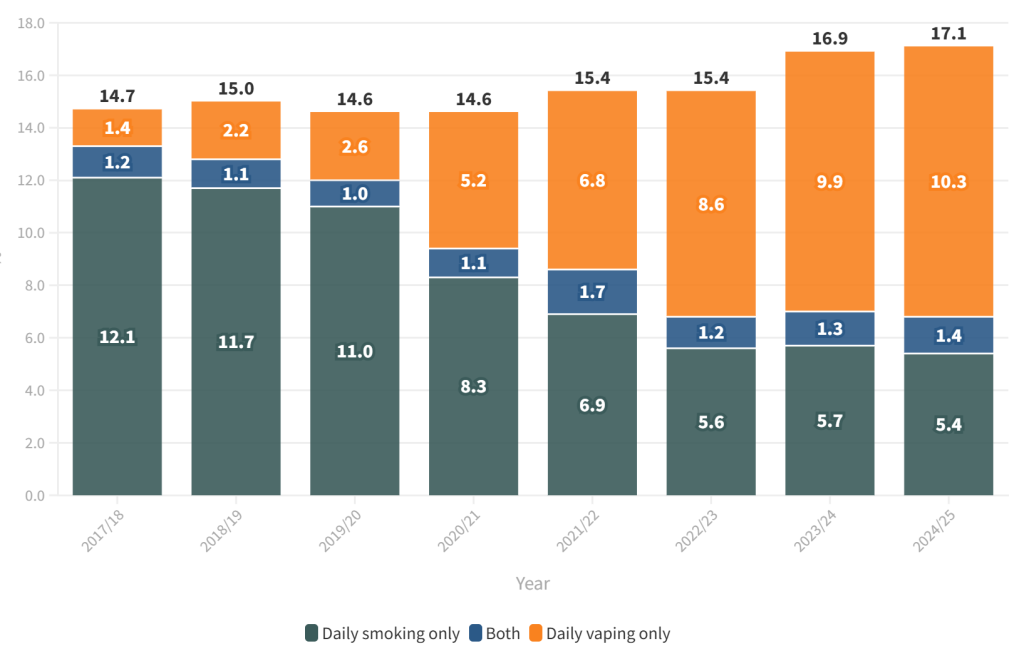
The data show that daily vaping among adults (aged 15 and older) reached 11.7% in 2024/25 – similar to the 11.1% from 2023/24, but much higher than the 3.5% recorded in 2019/20. This translates into an estimated 509,000 daily vapers across New Zealand.
Vaping prevalence remains highly stratified by age, ethnicity and socioeconomic context. The highest rates are seen among younger age groups: 23.0% of 18-24-year-olds and 20.5% of 25-34-year-olds vape daily, and 13.6% of those aged 15–17 are estimated to vape daily. Together, 15-24-year-olds account for c.138,000 of the daily vapers – over one quarter of the total. By ethnicity, daily vaping is most prevalent among Māori (27.5%) and Pacific peoples (20.0%), and among people living in more deprived neighbourhoods: in the most deprived quintile, 21.1% of adults vape daily versus just 7.2% in the least deprived areas. Adjusting for age and gender, Māori are over 2.5 times, and Pacific peoples about 1.4 times, more likely to vape daily than non-Māori/non-Pacific respectively.
NZHS report notes that the long-term decline in daily smoking has slowed: in 2024/25, daily smoking stands at 6.8% (c. 294,000 adults), similar to the rate in recent years – but far below the 16.4 % observed in 2011/12. Although reductions in smoking and increases in vaping have coincided, the net result has been a rise in total daily nicotine use (smoking or vaping), which increased from 14.7% to 17.1% since around 2019/20.
Despite recent regulatory tightening – including bans on disposable vapes and stricter packaging, flavour, retailer-location, and visibility rules introduced between late 2023 and June 2025 – these measures are unlikely to have contributed to the observed 2024/25 vaping levels, because most survey data were collected before their implementation. It is argued that further regulatory strengthening and enforcement may be required if the goal is to reduce nicotine uptake among adolescents and young adults.
Download the Vaping Prevalence & Trends 2024/25 report
June 2025: Disposable vape ban goes into effect on June 17, 2025
The distribution, manufacturing, sale and supply of disposable vapes now is banned in New Zealand from June 17, 2025. Ban on the type of vapes that are the most popular among youth is a step forward, states the Associate Health Minister. The 2023/24 NZ Health Survey identified that 10.5% of people aged 15-17 vape daily. In addition, removing disposable vapes from the market is etimated to reduce vape-related e-waste by over 80%. Critics note that a surge in black market acitivity and emergence of Big Puffs (high-capacity, rechargable throwaway vapes) could circumvent the effectiveness of the disposable ban1.
New advertising rules also go into effect. Vaping devices, products and packaging can no longer be displayed at general retailers. Vape stores (speciality retailer) must not display products in any way that makes them visible from outside their place of business and the restrictions include advertising, display in online stores and in vending machines. Vape stores are also prohibited to advertise or post about vaping products on social media platforms such as Facebook, Instagram, Twitter or Google business listings. Vape stores can no longer use promotional techniques, such as product giveaways, discounts, reward points, cash rebates, gifts, games and lotteries, for vaping products. Violators could face a NZD2000 (US$1,200) infringement fine. Full details on “Advertising restrictions for vaping and other notifiable products” can be found on the Health New Zealand’s website.
Pre-filled pos-style vapes will still be sold in New Zealand – the only country in the World that has more vapers than smokers. In 2011, New Zealand Government set the goal of “Smokefree New Zealand by 2025” – which means that adult smoking prevalence should be reduced to 5% or less. The latest data reveals that there are still about 300,000 daily smokers – corresponding to 6.9% of adults – in New Zealand. Smoking rates among minority cultural populations of Māori and Pacific migrant peoples (Māori and Pasifika) remain concerningly high and New Zeland is likely to fail to achieve the 5% target by December 2025.
December 2024: New vape regulations go into effect in New Zealand
Consequent to the changes made to the Smokefree Environments and Regulated Products Act 1990, fines for selling vapes to minors and publishing prohibited vape advertisements are increased in New Zealand. Moreover, new vape stores are prohibited to open within 100 metres of early childhood education centres – in addition to the existing restriction of at least 300 metres from schools or marae. The ban on disposable vapes is delayed for six months to allow retailers to prepare for the changes.

References:

