


In the rapidly evolving landscape of nicotine consumption, ZYN has emerged as a transformative force, offering a smokeless, spit-free alternative to traditional tobacco products. These nicotine pouches, designed to be discreetly placed between the gum and lip, have captured a significant share of the global nicotine market, particularly in the United States, where ZYN commanded over 70% of the nicotine pouch industry in 2023. Created by Swedish Match, a company with deep roots in smokeless tobacco, ZYN represents a modern evolution of nicotine delivery, free of tobacco but still delivering the addictive substance through a sleek, user-friendly format. Since its acquisition by Philip Morris International (PMI) in 2022, ZYN has been positioned as a cornerstone of the company’s vision for a “smoke-free future.” This article delves into ZYN’s origins, design, market growth, cultural impact, health and regulatory considerations, competitive landscape, and future prospects, providing a comprehensive look at why this nicotine pouch has become a cultural and commercial juggernaut.
Origins of ZYN
ZYN was launched in 2014 by Swedish Match, a Stockholm-based company with over a century of expertise in smokeless tobacco products, notably snus, a moist tobacco product popular in Scandinavia. Unlike snus, which contains tobacco, ZYN pouches are tobacco-free, using nicotine extracted from tobacco leaves combined with food-grade ingredients. This distinction has been pivotal in positioning ZYN as a cleaner, more socially acceptable alternative to traditional tobacco products, appealing to consumers seeking convenience and discretion.
Swedish Match introduced ZYN on a small scale in the U.S. market in 2014, initially targeting Colorado before expanding to other western states by 2016. Simultaneously, the product was rolled out in Sweden, leveraging the country’s familiarity with snus to test the nicotine pouch concept. The early years focused on building brand awareness and refining the product to suit diverse consumer preferences. By 2017, Swedish Match recognized ZYN’s potential to become a major player in the U.S., prompting significant investment in manufacturing infrastructure.
In 2017, Swedish Match began expanding its U.S. production facility in Owensboro, Kentucky, to meet growing demand. The $115 million investment culminated in the opening of a state-of-the-art plant in May 2019, capable of producing ZYN pouches domestically. This move reduced reliance on imports from Sweden and signaled the company’s commitment to scaling ZYN’s presence in the U.S. By the end of 2018, ZYN was available in approximately 13,500 U.S. stores, a number that surged to 100,000 by the end of 2020, reflecting rapid consumer adoption.
The acquisition of Swedish Match by Philip Morris International in November 2022 marked a turning point for ZYN. PMI, a global tobacco giant, saw ZYN as a strategic asset in its pivot toward reduced-risk products, aligning it with other offerings like Iqos (heated tobacco) and Veev (vaping products). Prior to the acquisition, PMI had entered the nicotine pouch market through its 2021 purchase of AG Snus, which owned the Shiro brand. However, ZYN’s superior market performance and brand recognition quickly made it the centerpiece of PMI’s nicotine pouch strategy.
Design and Product Offerings
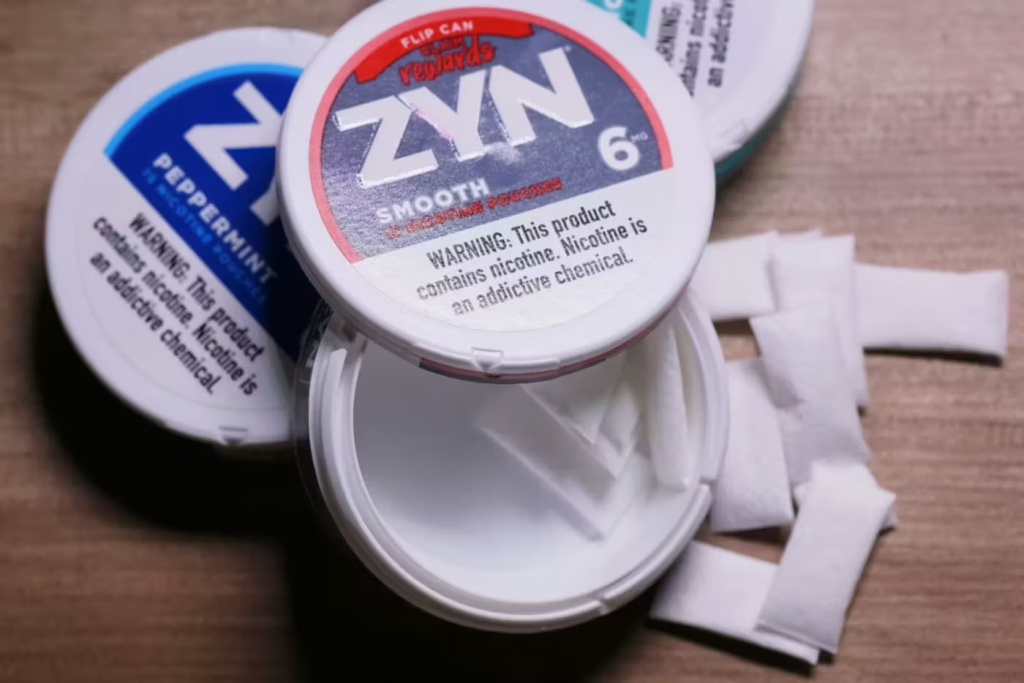
ZYN pouches are sold in sleek, round cans containing 15 or 20 pouches, depending on the market. The pouches are made from plant fibers, which allow nicotine to diffuse when moistened by saliva, delivering a controlled release of nicotine through the oral mucosa. Designed for placement between the upper lip and gum or between the gum and cheek, ZYN pouches can be used for up to an hour, offering a discreet and convenient nicotine experience without the need for spitting or smoking.
ZYN is available in a range of nicotine strengths, typically 3 mg or 6 mg per pouch in the U.S., catering to both light and heavy users. The product lineup includes flavored and unflavored varieties, with popular flavors such as Wintergreen, Spearmint, Cool Mint, Peppermint, Cinnamon, Coffee, and Citrus, alongside an unflavored option for those seeking a neutral experience. The variety of flavors has been a key driver of ZYN’s appeal, allowing users to customize their experience while avoiding the stigma associated with traditional tobacco odors.
The pouches’ composition—nicotine, food-grade fillers, flavorings, and plant-based fibers—sets them apart from tobacco-containing products like snus or chewing tobacco. This tobacco-free formulation aligns with growing consumer demand for “cleaner” nicotine alternatives, particularly among younger demographics who prioritize health-conscious choices without sacrificing the nicotine hit.
Market Growth and Sales
ZYN’s meteoric rise in the U.S. market is a testament to its strategic positioning and consumer appeal. In 2018, Swedish Match reported sales of 12.7 million cans in the U.S., a figure that quadrupled to 50.4 million by 2019. The company’s annual report for 2018 marked the first year of profitability for its U.S. snus and nicotine pouch segment, driven largely by ZYN’s success. By 2020, sales reached nearly 130 million cans, and by 2021, the figure climbed to 198 million. The global sales boom continued, with PMI reporting 384.8 million cans sold worldwide in 2023, a 62% increase from 237 million in 2022.
This rapid growth strained supply chains, leading to a widely publicized shortage in May 2024. PMI responded by announcing plans for a new manufacturing facility in Colorado, set to begin production in 2026. This facility aims to bolster ZYN’s supply chain resilience and meet the surging demand, particularly in the U.S., where the brand commands over 70% of the nicotine pouch market as of 2023, up from a 60% share between 2019 and 2022.
ZYN’s dominance is not limited to the U.S. The brand is distributed in Scandinavia, the UK, Switzerland, South Africa, Pakistan, and other countries, primarily in Europe. Its global footprint reflects its versatility, appealing to diverse markets with varying nicotine consumption habits. In Sweden, where snus is culturally entrenched, ZYN has carved out a niche among consumers seeking a tobacco-free alternative. In the UK, ZYN’s sleek branding and social media presence have resonated with younger audiences, though not without controversy.
Cultural Impact and the “Zynfluencer” Phenomenon
ZYN’s rise has been accompanied by a cultural shift, particularly in the U.S., where it has become a pop culture phenomenon. Dubbed “Zynfluencers,” social media personalities and everyday users have popularized the pouches through platforms like TikTok, Instagram, and X, showcasing their convenience and variety of flavors. The term “Zynnie” has entered the lexicon, referring to ZYN pouches in a playful, colloquial manner. Memes and viral videos featuring ZYN have proliferated, often highlighting its discreet use in settings where smoking or vaping is impractical, such as offices, airplanes, or social gatherings.
This cultural traction has been fueled by ZYN’s appeal to a younger demographic, particularly Gen Z and millennials, who view it as a trendy, less stigmatized alternative to cigarettes or vaping. The pouches’ portability and lack of visible vapor or smoke make them ideal for urban professionals and college students, who often use them in settings where traditional nicotine products are frowned upon. Posts on X have highlighted ZYN’s role in social settings, with users praising its ability to deliver a nicotine hit without drawing attention.
However, this cultural embrace has not been without criticism. In 2021, Swedish Match faced backlash in the UK for a marketing campaign with the slogan “Can’t smoke? Can’t vape? Can Zyn.” Critics argued that the campaign promoted nicotine use in non-smoking environments, potentially undermining public health efforts to reduce nicotine addiction. The controversy highlighted the fine line between marketing innovation and ethical responsibility in the nicotine industry.
ZYN’s rewards program, launched to incentivize repeat purchases, has also drawn scrutiny. The program allows users to accumulate points for buying ZYN products, redeemable for prizes such as electronics or gift cards. A 2024 article by Alaina Demopoulos in The Guardian criticized the program, with the headline “Use nicotine, win an iPad!” arguing that it gamifies nicotine consumption and targets younger users. This criticism underscores broader concerns about the normalization of nicotine use through slick marketing and loyalty schemes.
Health and Regulatory Considerations
While ZYN is marketed as a tobacco-free alternative, its nicotine content makes it addictive, raising health concerns. Nicotine, regardless of delivery method, can increase heart rate, elevate blood pressure, and contribute to cardiovascular risks over time. The long-term health impacts of nicotine pouches are still under study, but preliminary research suggests they pose fewer risks than combustible tobacco products due to the absence of harmful tar and carcinogens associated with smoking.
Public health experts have expressed mixed views on nicotine pouches. Proponents argue that products like ZYN offer a harm-reduction pathway for smokers seeking to quit, aligning with PMI’s “smoke-free future” vision. Critics, however, warn that the appeal of flavored pouches and their accessibility could attract non-smokers, particularly youth, to initiate nicotine use. In the U.S., the Food and Drug Administration (FDA) regulates nicotine pouches as tobacco products, requiring manufacturers to submit premarket tobacco product applications (PMTAs). As of September 2025, ZYN has received FDA authorization for marketing, but ongoing scrutiny of its youth appeal and marketing practices persists.
In Europe, ZYN faces varying regulatory landscapes. In Sweden, where snus is culturally entrenched, nicotine pouches are subject to fewer restrictions than in other EU countries, where tobacco harm reduction policies differ. The UK has seen debates over ZYN’s marketing, with calls for stricter advertising regulations to prevent targeting non-smokers. In 2024, posts on X highlighted concerns about ZYN’s availability in convenience stores and online platforms, with some users advocating for age verification to curb underage access.
Competitive Landscape
ZYN’s dominance in the nicotine pouch market faces competition from brands like On!, Rogue, and Velo, owned by British American Tobacco (BAT). BAT’s Velo, launched in the U.S. in 2019, has gained traction, particularly with its Velo Plus line introduced in 2024, which uses synthetic nicotine and offers higher nicotine strengths (up to 9 mg) and a broader flavor range. According to a March 2025 NielsenIQ report, Velo’s U.S. market share reached 10%, driven by Velo Plus, while ZYN’s share dipped toward 55%, reflecting competitive pressure.
Despite this, ZYN’s brand loyalty and first-mover advantage keep it ahead. On! and Rogue emphasize similar tobacco-free formulations and flavor variety, but their market shares remain smaller. BAT’s investment in Velo, including a 2025 expansion of its Tobaccoville, North Carolina facility, signals a push to challenge ZYN, particularly with Velo Plus’s “wet” pouch format, which contrasts with ZYN’s “dry” pouches [1]. PMI’s acquisition of Swedish Match has strengthened ZYN’s position by integrating it into a broader portfolio of reduced-risk products, but emerging brands and potential regulatory changes could pose challenges, especially if restrictions on flavored nicotine products gain traction.
Future Prospects
Looking ahead, ZYN’s trajectory appears robust, driven by its strong brand identity and growing consumer base. The new Colorado manufacturing facility, set to open in 2026, will enhance PMI’s ability to meet demand and expand ZYN’s global reach. Innovations in flavor profiles, nicotine strengths, and sustainable packaging could further solidify its appeal, particularly among environmentally conscious consumers.
However, ZYN faces challenges on multiple fronts. Regulatory pressures, particularly around youth access and marketing, could impose stricter controls, potentially limiting growth. Public health campaigns aimed at reducing nicotine addiction may also shift consumer perceptions, especially if long-term studies reveal significant health risks associated with prolonged pouch use. Additionally, cultural attitudes toward nicotine products could evolve, with ZYN’s “cool” factor potentially waning as new alternatives emerge.
On the global stage, ZYN’s expansion into markets like South Africa and Pakistan suggests untapped potential in developing economies. Tailoring products to local preferences, such as region-specific flavors or culturally relevant marketing, could drive further growth. Posts on X from international users indicate curiosity about ZYN’s availability, with some calling for wider distribution in Asia and Latin America.
ZYN has redefined the nicotine landscape, offering a discreet, tobacco-free alternative that resonates with modern consumers. From its humble beginnings in Colorado to its global presence under PMI’s stewardship, ZYN’s success reflects a blend of innovative design, strategic marketing, and cultural relevance. Yet, its rapid rise has sparked debates about health, ethics, and regulation, underscoring the complexities of harm reduction in the nicotine industry.
As ZYN continues to shape the future of nicotine consumption, its ability to balance growth with responsibility will be critical. Whether it remains a cultural touchstone or faces new challenges, ZYN’s story is a compelling case study in the evolution of consumer habits and the ongoing quest for a “smoke-free” world.

