


July 2026: Industry Watchdog Highlights Common Legislative Issues for Heated Tobacco Products
The Campaign for Tobacco-Free Kids, a tobacco industry watchdog, has published a guidance document outlining common regulatory and legislative drafting issues related to heated tobacco products (HTPs). The resource is intended to help policymakers assess whether existing tobacco control legislation adequately covers HTPs, including both electronic heating devices and tobacco sticks, and identifies four areas that commonly require clarification.
The four common issues highlighted are:
– Definitions: Whether legal definitions of tobacco products, tobacco advertising, promotion and sponsorship are broad enough to cover both HTP tobacco sticks and devices.
– Smoke-free laws: Whether existing definitions of smoking or tobacco smoke also apply to HTP use and emissions.
– Product categorization: How HTPs should be classified where different tobacco product categories are subject to different regulatory requirements.
– Sales bans: Where HTP sales are prohibited, whether legislation also explicitly covers public use, advertising, promotion and sponsorship of both tobacco sticks and devices.
Download HTP: Common Regulatory and Drafting Issues document
June 2026: Nicotine Pouch Market Explodes by 660% as Big Tobacco Targets Youth, Watchdog Warns
Global sales of nicotine pouches have grown by an estimated 660% since 2020 and are projected to reach $25 billion by 2028, according to market data published in a new brief by tobacco industry watchdog, STOP. The report, “Understanding Nicotine Pouches: Current Evidence and Industry Activity,” details how the rapid expansion of tobacco-free, oral pouches is heavily driven by major transnational tobacco companies looking to secure new consumer bases.
According to the findings, three corporations – Philip Morris International (PMI), British American Tobacco (BAT), and Altria – control more than 75% of global nicotine pouch sales. These firms utilize their existing manufacturing and distribution infrastructure to quickly scale up product availability.
Key data points from the market analysis include:
– Top Markets: The largest consumer bases for nicotine pouches are currently located in the United States, Sweden, Denmark, Pakistan, and Austria.
– U.S. Expansion: In the United States, which represents the largest single market, sales grew by more than 1,300% between 2019 and 2025.
– High Strengths: Sales of products with higher nicotine concentrations are growing faster than lower-strength variants.
The report also highlights a growing trend of “poly-use,” where consumers use pouches alongside traditional cigarettes or e-cigarettes rather than using them strictly as a cessation aid. An internal BAT company document cited in the brief notes that poly-users drive 80% of the firm’s total revenue growth across its alternative product categories. The brief states that market growth is heavily supported by promotions designed to appeal to younger demographics, including the use of fruit and mint flavors, social media campaigns, and lifestyle branding. In the U.S., an estimated 85% of youth pouch users report preferring flavored options.
Furthermore, manufacturers have heavily marketed the discreet nature of the pouches, promoting them for use “whenever, wherever” – including settings where smoking or vaping is legally restricted. The report also notes an increasing entry into low- and middle-income countries with young populations, including Kenya, Nigeria, and the Philippines.
Because nicotine pouches are a relatively new product category, they currently face fewer regulations or lower tax rates than traditional tobacco items in many jurisdictions. According to the report, tobacco companies frequently leverage this regulatory gap to establish market presence before local governments implement oversight frameworks. The brief notes that industry lobbying often involves emphasizing potential tax revenues or investments to local governments, or conversely, warning of job losses if restrictions or bans are implemented.
May 2026: Global Marlboro Campaign Draws Criticism as a Contradiction to PMI’s Smoke-Free Transition
Philip Morris International (PMI) is facing renewed controversy following the rollout of a global Marlboro advertising campaign, despite its long-stated ambition to transition away from cigarettes and toward a “smoke-free future.” The campaign has triggered strong criticism from NGOs and public health advocates, who argue it highlights a contradiction between PMI’s transformation narrative and its continued reliance on combustible cigarette marketing.
The campaign, reportedly launched under the “I AM Marlboro” platform, spans at least 20 countries and includes television advertising, outdoor billboards, in-store displays, and digital media channels. Its messaging focuses on themes of identity, self-expression, and personal choice, with slogans such as “I know who I am… I am Marlboro” and “Make your own legacy,” positioning Marlboro as a lifestyle and identity brand rather than emphasizing the product itself. Critics argue that this approach echoes earlier Marlboro marketing strategies historically associated with aspirational imagery and youth appeal. NGOs and tobacco control organizations have accused PMI of hypocrisy, pointing to its public statements that cigarettes “belong in museums” while simultaneously investing in renewed global cigarette brand promotion. They argue the campaign’s emphasis on identity and lifestyle may indirectly reinforce appeal among younger adult audiences.
The timing of the campaign comes amid continued pressure on PMI’s traditional cigarette business. Combustible cigarette volumes remain under structural decline in many developed markets, while competitive pressure in international markets has intensified, particularly from Japan Tobacco (JT) and KT&G, which have expanded their presence across several geographies. Against this backdrop, the Marlboro campaign is likely an effort to re-energize the brand and support volume stability. While PMI continues to emphasize growth in its smoke-free portfolio, cigarettes still represent a substantial share of profitability, making both pricing power and volume resilience critical to achieving financial targets.
PMI’s strategy reflects a dual-track approach: advancing smoke-free transformation while simultaneously reinforcing the commercial strength of its flagship cigarette brand. In this context, Marlboro remains central to PMI’s cash generation even as the company publicly promotes a long-term shift away from smoking.
May 2026: WHO Warns Nicotine Pouches Are Being Aggressively Marketed to Youth as Global Sales Surge
The World Health Organization (WHO) has issued a warning over the rapid global growth of nicotine pouches, arguing that the products are increasingly being marketed toward adolescents and young adults through social media influencers, lifestyle branding, flavored products, and sponsorships linked to youth culture and sports.
According to the WHO, retail sales of nicotine pouches exceeded 23 billion units in 2024, representing growth of more than 50% compared with the previous year. The organization also noted that the global nicotine pouch market was worth nearly US$7 billion in 2025, underlining the category’s rapid commercial expansion.
The WHO said nicotine pouches frequently fall through regulatory gaps worldwide. Around 160 countries currently have no specific regulation for nicotine pouches, while 16 countries ban their sale entirely. Another 32 countries regulate the products in some form, including five countries that restrict flavours, 26 that prohibit sales to minors, and 21 that ban advertising, promotion, and sponsorship.
WHO officials argued that some nicotine pouch products are “engineered for addiction,” citing high nicotine concentrations, fast-delivery technologies, attractive packaging, and flavor profiles designed to appeal to younger consumers. The agency called on governments to introduce stronger safeguards, including nicotine caps, tighter marketing restrictions, and flavor bans
November 2025: COP11 exposes deep divisions in global tobacco control as focus shifts to COP12
The Eleventh Session of the Conference of the Parties (COP11) to the WHO Framework Convention on Tobacco Control convened in Geneva from 17 to 22 November 2025, bringing together around 160 Parties and more than 1,600 participants. The meeting focused heavily on the environmental damage caused by tobacco across its entire lifecycle, the growing influence of the tobacco industry in global policymaking, and the increasingly complex debate surrounding novel nicotine products. Although the conference produced several notable outcomes, it also exposed significant divisions within the FCTC process, especially on the regulation of alternatives such as e-cigarettes, heated tobacco products and nicotine pouches. These tensions ultimately shaped the substance and tone of COP11, making it one of the most contested sessions to date.
A major theme in Geneva was the environmental burden created by cigarettes, plastics and emerging nicotine technologies. Delegates were urged to address tobacco’s ecological impact more aggressively, particularly the waste produced by filters and disposable devices. A global push for a phase-out of cigarette filters received strong support from public-health and environmental advocates, yet member states failed to reach consensus. Several countries resisted binding measures, and the European Union displayed internal divisions that slowed progress. As a result, discussions on filters will now continue toward COP12. Despite the lack of a ban, Parties did adopt a broader decision encouraging stronger environmental regulation and improved management of tobacco-related waste. The meeting also reinforced the need for liability mechanisms under Article 19, opening the door for enhanced civil and criminal accountability for the damages caused by the tobacco industry.
Another major area of debate was the regulation of novel nicotine products. For the first time at a COP meeting, these products occupied a central place in the agenda, reflecting their rapid rise in global markets. Delegations were deeply split between countries favoring strict prohibitions based on youth-use concerns and those promoting a harm-reduction approach supported by evidence from markets such as New Zealand and Sweden. Two competing proposals – one more industry-aligned and another grounded in precaution – created visible friction, and neither side secured consensus. In the end, the mandatory measures originally envisioned were softened, and the issue was formally deferred to COP12. Alongside these debates, Parties agreed on a full ban on the sale and use of all tobacco and nicotine products, including e-cigarettes, on United Nations premises, reaffirming the organization’s commitment to a smoke-free environment.
Industry interference was a persistent concern throughout the week. Public-health organizations and civil-society groups detailed significant lobbying efforts, the use of front groups and attempts to influence national positions prior to the conference. The parallel “Good COP 2.0” event in Geneva was cited as a striking example of private-sector attempts to shape the narrative around tobacco and nicotine regulation. Many delegates called for stronger implementation of Article 5.3, which obliges Parties to protect policymaking from commercial influence. The high level of interference was widely viewed as one of the reasons key regulatory decisions stalled.
Financing also played an important role in the outcomes of COP11. Parties reaffirmed the need for sustainable domestic funding for tobacco control, emphasizing taxation as the primary tool for securing long-term resources. The conference also examined forward-looking “endgame” measures, including generational bans and other strategies to significantly reduce or eliminate tobacco use over time. Although these proposals remain exploratory, they indicate a growing appetite among some Parties to push beyond traditional regulatory boundaries.
Overall, COP11 delivered a combination of progress, deferral and strategic repositioning. It solidified global attention on environmental harms and industry accountability, strengthened the importance of national financing and preserved momentum toward exploring long-term endgame options. At the same time, it revealed substantial fractures between Parties over how to manage new nicotine products and how aggressively the global regime should move toward prohibitive measures. These divisions will shape the agenda heading into the next conference.
COP12 will take place in Yerevan, Armenia, in 2027. Many of the unresolved issues from Geneva – including the cigarette filter debate, transparency requirements for product composition, liability frameworks and the entire regulatory direction for novel nicotine products – will return to the table. The outcomes of COP11 ensure that COP12 is likely to be one of the most consequential meetings in the history of the FCTC, with the potential to redefine global tobacco control for the coming decade.
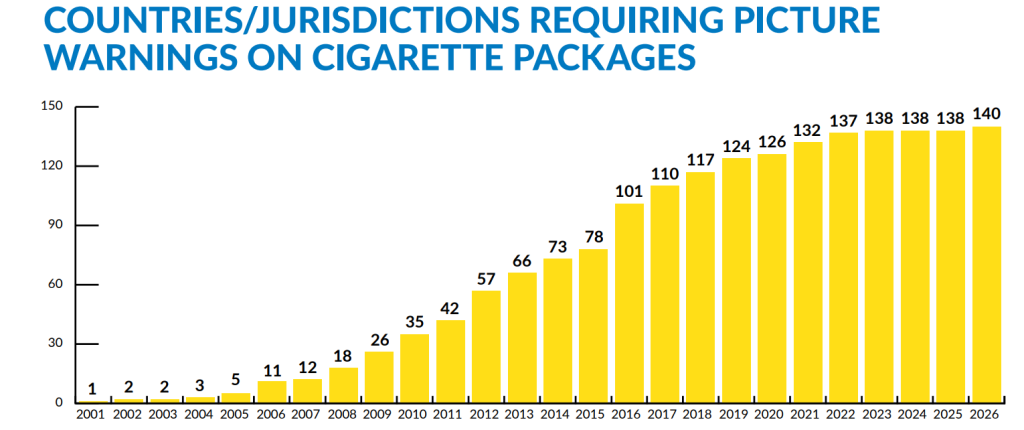
November 2025: 140 countries & territories now require pictorial health warnings on cigarette packs
140 countries & territories now require pictorial health warnings on cigarette packs, marking an increase from 35 in 2010. After Canada becoming the first country in the world to require pictorial health warnings in 2001, 66% of the world’s population now live in a conutry where cigarette packs carry pictorial health warnings. Pictorial warnings are assumed to be especially valuable for low-income countries where there are higher rates of illiteracy and where governments have few resources for consumer education.
In total, 130 countries & territories have required warnings to cover at least 50% of the front and back of the pack (on average), up from 24 in 2008 and 107 in 2018. There are now 77 countries & territories with a size of at least 65% of the front & back of the pack (on average) and 11 with at least 85% – including Turkey (85%/100%), New Zealand (75%/100%), India (85%/85%), Thailand (85%/85%) and Hong Kong (85%/85%). Guidelines under the World Health Organization (WHO) Framework Convention on Tobacco Control (FCTC) recommend that warnings should be as large as is achievable; include a rotated series of graphic pictures; be at the top of both the front and back of packs.
Moreover, 27 countries & territories adopted plain packaging (up from 9 in 2018), 3 have it in practice, and 14 are in the process of implementation. Plain packaging means cigarette packages can’t display brand colours, logos or design elements, and must use a standard shape and colour, making all brands look the same. WHO FCTC recommend that countries should consider implementing plain packaging on cigarette packs.
Australia was the first country to implement plain packaging in 2012. Plain packaging has since been implemented in France (2016), United Kingdom (2016), Norway (2017), Ireland (2017), New Zealand (2018), Saudi Arabia (2019), Turkey (2019), Thailand (2019), Canada (2019), Uruguay (2019), Slovenia (2020), Belgium (2020), Israel (2020), Singapore (2020), Netherlands (2020), Denmark (2021), and Guernsey (2021), Hungary (2022), Jersey (2022), Finland (2023), Mauritius (2023), Oman (2024), Georgia (2025) and Myanmar (2025), with implementation to be required in Iceland (2027) and Syria (2027).
Finally, Canada and Australia required health warnings to be printed directly on every individual cigarette – first implemented in Canada in 2024 and, then, in Australia in 2025.
Download the CCS Cigarette Health Warning report
October 2025: USA blocks the new UN political declaration
At the fourth high-level meeting of the United Nations General Assembly on noncommunicable diseases (NCDs) and mental health, the assembly sought to adopt a political declaration aimed at accelerating prevention and treatment efforts. The text reaffirms the goal of reducing premature mortality from NCDs by one-third by 2030 and sets measurable targets for the next five years, including on tobacco, hypertension, and mental health. However, the declaration was blocked by the United States, forcing a vote in the General Assembly.
As part of the political declaration and for the first time, Member States have set a quantified target to reduce the number of tobacco users by 150 million by 2030. To achieve this goal, the text encourages the implementation of measures consistent with the WHO Framework Convention on Tobacco Control (FCTC). These include increasing taxation on tobacco products, strengthening health warnings, banning advertising, promotion, and sponsorship, and ensuring comprehensive protection against exposure to smoke in places of collective use: public and professional places. The declaration also broadens its scope to include new nicotine products placed on the market by tobacco manufacturers, calling on States to regulate, or even ban, e-cigarettes, heated tobacco, and other nicotine delivery devices.
The declaration also calls on Parties to accelerate the implementation of the FCTC and its Protocol to Eliminate Illicit Trade in Tobacco Products, emphasizing the need to ensure the absence of any industry interference. Finally, it emphasizes the importance of promoting safe and evidence-based cessation programs to support smokers who wish to quit. The comprehensive approach aims to strengthen prevention, reduce addiction, and prevent new generations from initiating tobacco and nicotine use.
The declaration failed to be adopted by consensus as the United States vetoed the declaration, stating that certain provisions – including the taxation of “unhealthy” products – exceeded the role of the United Nations and infringed on national sovereignty. As a result of the U.S. objection, the text will have to go to the General Assembly for a vote to be formally adopted.
June 2025: Number of countries regulating vapes is growing, but the global regulation remains inconsistent and inadequate, according to the WHO
World Health Organization (WHO) issued the 2025 Global Tobacco Epidemic report. According to the WHO report, as of 2024, 133 countries (out of 195 in total) have introduced some form of regulatory framework for Electronic Nicotine Delivery Systems (ENDS), including e-cigarettes or vapes. Among these, 42 countries – covering a population of 2.7 billion people – have taken the strongest approach by implementing outright bans on the sale of ENDS. An additional 91 countries, home to 3.7 billion people, have adopted various legislative measures that range from partial restrictions to more comprehensive controls. Despite the global regulatory momentum, 62 countries – accounting for 1.7 billion people – still have no laws or regulations in place regarding ENDS, leaving their populations vulnerable to unregulated products and aggressive marketing by the industry players.

Health warnings are increasingly being applied to ENDS products, though unevenly. Of the 153 countries that allow the sale of ENDS, health warnings are required on both devices and e-liquids in 53 countries, on devices only in three countries and on e-liquids only in nine countries. 88 countries still do not require any health warnings labels on ENDS. Additionally, ENDS advertising, promotion, and sponsorship are regulated to varying degrees. In 63 countries, ENDS fall under the same advertising bans that apply to traditional tobacco products. Another 47 countries have enacted specific rules governing how ENDS can be promoted, but the lack of consistency leaves significant loopholes. Restrictions on the use of ENDS in public places have also gained ground. Ninety-nine countries now ban or restrict their use in indoor public areas, workplaces, or public transportation. However, enforcement and comprehensiveness of these laws vary.
A particularly pressing concern highlighted in the report is the widespread availability and appeal of flavored ENDS products, which are often marketed in a way that specifically targets children and adolescents. Only seven countries (Finland, Hungary, Latvia, Lithuania, Montenegro, Netherlands and
Slovenia) have imposed a complete ban on flavored ENDS. Fifteen countries have opted for partial flavor restrictions, allowing some to remain on the market. Meanwhile, 74 countries – representing a population of 1.9 billion – have no legal minimum age for purchasing ENDS products, leaving youth populations exposed to early nicotine initiation.
The WHO expresses strong concern over the marketing tactics used by ENDS manufacturers, which often include claims of reduced harm and cessation benefits that are not supported by independent, robust evidence. These tactics have been especially effective in appealing to young people through sleek packaging, social media campaigns, and flavored products that mimic candy, fruit, or dessert. WHO calls for stronger and more consistent regulation of ENDS across all countries. This includes implementing standardized health warnings, expanding advertising and promotion bans, banning or strictly limiting flavors, and setting minimum age laws to prevent youth access.

Countries where ENDS sales is banned: Argentina, Brazil, Brunei, Cabo Verde, Cambodia, Cook Islands, Cuba, North Korea, Ethiopia, Gambia, Ghana, India, Iran, Iraq, Jordan, Kazakhstan, Kyrgyzstan, Laos, Maldives, Marshall Islands, Mauritius, Mexico, Nauru, Norway, Palestine, Oman, Palau, Qatar, Singapore, Sri Lanka, Suriname, Syrian, Thailand, Timor-Leste, Turkey, Turkmenistan, Uganda, Uruguay, Vanuatu, Venezuela and Vietnam
February 2024: WHO FCTC took place in Panama
After being postponed from November 2023 (because of unrest in the host country), the tenth session of the Conference of the Parties (COP10) to the WHO FCTC (Framework Convention on Tobacco Control) took place in Panama on February 5-10, 20241.
COP10 adopted decisions
– to protect the environment and the health of all people from the cultivation, manufacture, consumption and waste disposal of tobacco products (language around Article 18 strengthened)
– to address cross-border tobacco advertising, promotion and sponsorship and the depiction of tobacco in entertainment media.
Other decisions adopted by COP10 were related to the promotion of human rights through the WHO FCTC as well as strengthening the WHO FCTC Investment Fund. In addition, two expert groups were established to work on forward-looking tobacco-control measures (Article 2.1) and means to hold the tobacco industry liable (Article 19).
Regulation of the new nicotine/tobacco products was expected to be under the spotlight during the event. However, (supposedly) under significant industry pressure, action on new tobacco products was delayed. Instead of a final agreement on e-cigarettes and heated tobacco products, the delegates agreed to create a working group to develop regulatory recommendations until COP11 (- effectively, postponing any decision by two years). At the COP, a number of countries, led by Guatemala and including the Philippines, China, Russia, Antigua & Barbuda, echoed industry talking points that frames heated tobacco products and vapes as less risky than cigarettes and called for more debate/research on the topic.
WHO FCTC is signed by 183 parties (covering more than 90% of the world population) and entered into force in 2005. The biennial COP and Meeting of the Parties (MOP) act as governing bodies working on implementing the treaty.
References:

