


August 2026: Lawmakers and Advocates Push Uniform Vape Excise Taxes to Recover Revenue Losses and Curb Illicit Trade
Philippine lawmakers, health advocates, and industry representatives are calling for reforms to establish a unified, risk-based excise tax regime on vapor products as the national government seeks to recover foregone revenues, curb tax avoidance, and address public health concerns.
The policy push comes after 2025 Bureau of Internal Revenue (BIR) data revealed that over 90% of excise taxes collected across all vape categories were declared as freebase nicotine products. Under the current tax structure, freebase nicotine is taxed at just ₱6.95 per milliliter (ml), whereas nicotine salt vapes are levied at ₱60.29 per ml. Lawmakers noted that this stark tax rate disparity has created regulatory loopholes, incentivizing vendors to misdeclare products as freebase nicotine to evade higher taxes.
Competing Proposals and Industry Positions
Multiple measures have been submitted to Congress and executive bodies to restructure vape taxation:
– House Bill 5364 (Vape Tax Unification Bill): The bill proposes unifying tax rates across nicotine salt and freebase products. Rodriguez estimates the bill will generate an average annual collection of ₱6 billion from 2027 to 2030, while bringing the market share of illicit trade down to 10% by 2028.
– House Bill 10289: This bill seeks a single rate of ₱15 per ml beginning in 2027, followed by an annual tax increase of 5% starting in 2028.
– Department of Finance (DOF) Proposal: Supported by the Youth for Health Coalition, the DOF proposal pushes for a significantly higher unified excise tax of ₱72.93 per ml for both salt and freebase vapes to deter youth access and reduce student accessibility.
– Industry Association Proposal: The Philippine E-Cigarette Industry Association (PECIA) advocated for a ₱10 per ml uniform tax rate. PECIA warned that excessively high taxes risk pushing consumers to unregulated black markets, adding that PECIA’s member association is 100% compliant with current tax laws.
Proponents of risk-based taxation argue that lower-risk alternatives should carry lighter tax burdens compared to traditional cigarettes to encourage adult smokers to switch. The Philippines has roughly 16 million adult smokers – a number that has stayed relatively unchanged over the past decade – with World Health Organization data indicating an annual quit rate below 4%.
May 2026: Philippine Health Department Pushes for Total Vape Ban as Lawmakers Reassess Rules
The Philippines’ Department of Health (DOH) is advocating for a total ban on vape products as lawmakers review existing regulations amid rising nicotine use, particularly among young people. Health officials argue that current safeguards are insufficient, with growing evidence that minors continue to access and use vaping products despite regulatory limits. Concerns raised during Senate discussions highlight increasing use among adolescents, including those as young as early teens.
The DOH also emphasized the health risks associated with vaping and nicotine products, linking them to serious conditions such as cardiovascular disease, cancer, and lung illnesses. If a full prohibition proves difficult to implement, the department has suggested a fallback measure of restricting vape products to plain tobacco flavor to reduce their appeal to minors. The push indicates increasing emphasis on public health objectives, with policymakers focusing on strengthening rules and addressing weaknesses in enforcement rather than relying on the current regulatory framework.
March 2026: Illegal Vape Seizures Surge in the Philippines as Authorities Step Up Enforcement
Authorities in the Philippines state that the illegal trade in vaping products has grown significantly, with a large share of flavored vapes on the market believed to be smuggled and sold outside the country’s regulatory framework. According to regulators, flavored vape products marketed with descriptors attractive to minors are typically smuggled and have not been licensed for sale. Officials warn that youth-appealing flavor names and packaging are strong indicators of illicit supply, as these products have not passed the required approval and compliance procedures.
Enforcement against illegal vape products has intensified in recent years. According to the Department of Trade and Industry, the market value of confiscated vape products rose sharply from ₱5.4 million (US$90,000) in 2023 to ₱32 million (US$550,000) in 2024, before surging to ₱519 million (about US$8.7 million) in 2025. The steep increase highlights both the rapid expansion of the illicit vape market and the growing scale of enforcement operations targeting smuggled devices and e-liquids.
Authorities say illegal vape products are often distributed through informal retail networks and online channels, making monitoring and enforcement more challenging. Officials have emphasized the need for stronger inspections and inter-agency coordination to curb smuggling, protect consumers from unregulated products, and ensure that legally compliant businesses operate on a level playing field.
January 2026: Philippines Proposes Ban on Open-system Vapes
The Philippines’ Department of Trade and Industry (DTI) put forward a draft policy that would ban the use, manufacture, importation and distribution of open-system vaping devices, pods and e-liquids, and is seeking stakeholder feedback on the proposal. The move, which is based on consumer safety concerns about uncertified and modifiable products that may pose health risks, would also halt processing of product safety licenses for these items under existing law.
Under the proposal, open pods – refillable cartridges that allow users to add e-liquid manually – and vaping liquids would be removed from the regulated market. DTI’s consultation period on the draft Department Administrative Order is limited, with comments being accepted until early February 2026.
August 2025: Bureau of Internal Revenue filed 75 criminal complaints for illicit vape trade
The Bureau of Internal Revenue (BIR) filed 75 criminal complaints before the Department of Justice against individuals and businesses engaged in the illicit trade of vape products, with a total tax liability of ₱711 million. The charges include tax evasion, unlawful possession or removal of articles subject to excise tax without payment and failure to file excise tax returns. In April 2025, BIR also filed a ₱8.7 billion worth of tax evasion cases against large-scale illicit vape businesses.
The complaints stemmed from a series of nationwide BIR enforcement operations that uncovered the rampant sale of untaxed vape products, including those without the required internal revenue stamps and proper BIR registration. The operations resulted in the seizure and confiscation of a significant volume of illicit vape products.
August 2025: (DTI) ordered online merchants to immediately take down illegal vape product postings
The Department of Trade and Industry (DTI) ordered e-commerce sites and other digital platforms to immediately take down illegal vape product postings. DTI stated that certain online merchants are engaged in the sale, or offering for sale, of uncertified vapor products: “These products lack the required fiscal markings or tax stamps and Philippine Standard License marks – in violation of Sections 4(d) and 18 of Republic Act (RA) 11900 or the Vaporized Nicotine and Non-Nicotine Products Regulation Act; Republic Act 4109, commonly known as the Standards Law; and Department Administrative Order No. 02, series of 2007”.
E-commerce sites and other digital platforms were subsequently given seven days to remove web pages, platform listings or applications of merchants identified as offering illegal or uncertified vape products. Continued violations will be subject to fines under RA11900 (₱100,000-400,000), RA11967 (₱20,000-1,000,000) and the Consumer Act (₱500-300,000) and other relevant trade and industry laws, and violators may have their operations suspended in the Philippines.
July 2025: Bureau of Internal Revenue (BIR) increased the floor price for cigarettes and vapes
The Bureau of Internal Revenue (BIR) increased the floor price for cigarettes, heated tobacco products and vaporized nicotine products for the first time since September 2024. According to the National Tax Research Center, the minimum retail price set by the BIR takes into account an estimate of the excise tax and value-added tax to be paid, plus a reasonable production cost. The new prices will take effect fifteen days following the publication in the Official Gazette or the BIR’s official website, whichever comes first.
The new floor price for a pack of cigarettes is now ₱85.57 (US$1.5), up from ₱78.58 (US$1.37). The production cost assumption for cigarettes is raised to ₱10.25 (¢18) per pack from ₱7.16 (¢13). The floor price for heated tobacco products per 20-piece pack is raised to ₱61.47 (US$1.07) from ₱60.11 (US$1.07). The production cost assumption fell to ₱19.04 (¢33) from ₱19.54 (¢34) in the September 2025 release.
Meanwhile, the BIR set a ₱353.18 (US$6.2) floor price for two milliliter (ml) nicotine pods, against ₱180.67 (US$3.2) earlier, with the production cost assumption rising to ₱200.68 (US$3.5) from ₱52.11 (¢89) earlier. Meanwhile, the floor price was set as ₱183.31 (US$3.2) for disposable pods, ₱174.89 (US$3.1) for prefilled pods and P98.18 ($1.7) for disposable devices.
In the first half of 2025, BIR collected ₱59 billion ($1 billion) excise taxes from tobacco products, up 34% year on year. Collections from vapor products rose a remarkable 738% to ₱1.5 billion ($26 million) in the same period.
July 2025: Tax collected from vapes increased 738% in the first half of 2025
Total tobacco excise tax collection increased by 34% to ₱59 billion ($1 billion) in the first six month of 2025. In particular, vape products posted a remarkable 738% jump in collections to ₱1.5 billion ($26 million), from only ₱179 million a year ago, after the Bureau of Internal Revenue (BIR) took full control of excise tax collections on vape products, imported or domestically produced, through their inclusion in the cigarette stamp system. Coupled with aggressive enforcement activities on illicit products, regulatory control and monitoring of the vape products’ taxability led to the explosive growth in collections. In 2024, BIR mandated the fourth generation internal revenue stamps for all imported and locally manufactured vape products. Lack of internal revenue stamps means non-payment of excise taxes, which would result in the seizure of vape products and the possible filing of tax evasion cases.
The Philippine E-Cigarette Industry Association (PECIA), the industry group composed of around 300 manufacturers and distributors of e-cigarettes and vapes in the country, is supportive of the excise tax collection. There is a notable recovery in the legal vape market – likely driven by intensified raids and factory closures in areas such as Bulacan, Valenzuela, Butuan and Zamboanga. These actions disrupted illicit operations and may have helped redirect volumes back into the legal market.
Tobacco excise tax makes around 5% of the overall tax collection of the BIR.
July 2025: NBI intensifies its crackdown on the illegal vape market
The National Bureau of Investigation (NBI) intensified its crackdown on the illegal vape market through a series of large-scale operations. In July 2025, NBI Special Task Force (NBI STF) seized illicit vaping products worth ₱90million (US$1.6 million) and arrested several suspects in multiple different raids across the country. Arrested individuals are charged for the violation of the Republic Act No. 1190, Vaporized Nicotine and Non-Nicotine Products Regulation Act (simply known as the Vape Act).
May 2025: NBI seized ₱63 million worth of illegal vapes in three operations
The National Bureau of Investigation (NBI) announced that its Cybercrime Division (CCD) has seized ₱63 million (US$1.1 million) worth of smuggled vape products in three separate operations. The raids took place in Marilao (Bulacan), Parañaque City, and Pasay City. Bureau of Internal Revenue (BIR) and the Department of Trade and Industry (DTI) supported the operations. The seized vape products are in violation to Republic Act No. 11900, which regulates the importation, manufacture, sale, packaging, distribution, use, and communication of vaporized nicotine and non-nicotine products and novel tobacco products, as well as to Republic Act No. 8424, the Tax Reform Act.
May 2025: The Bureau of Internal Revenue demands higher vape taxes
During the fourth Senate hearing of the Committee on Ways and Means, the Bureau of Internal Revenue (BIR) demanded higher tax on vape products while remaining firm on taxing cigarettes and heated tobacco products at the same rate to contain excise tax leakages and smuggling. Department of Finance (DOF) shares the same opinion that the tax on vape products should not be lower than traditional tobacco.
Under Republic Act No. 11467, a pack of cigarettes is taxed ₱66.15, while a pack of heated tobacco products is imposed ₱35.83 in excise tax. As for vape products, those with nicotine salt liquid are levied at ₱57.33 per milliliter, while the excise tax containing conventional freebase or classic nicotine vape amounts to ₱66.15 per 10 milliliters. BIR states that one pack of cigarettes can be consumed in 300 puffs, while the lowest number of puffs that can be consumed in one vape product is 600 puffs. The tax rates on cigarettes, heated tobacco and vape products are set to increase by 5% every year.
Excise tax collections from tobacco in the Philippines fell to ₱134 billion in 2024 from ₱176 billion in 2021, with estimates of annual revenue losses amounting to ₱54.4 billion in 2024 due to the surging illicit trade. The Committee projects that the rampant illicit tobacco trade and misdeclaration of vapor products to cost the government a combined ₱240.3 billion in excise tax leakages over the next three years.
The Committee evaluates the measures to:
– increase the excise rates for cigarettes and vapes by 2% every even-numbered year starting January 1, 2026, and by 4% every odd-numbered year from January 1, 2027, until December 31, 2035 instead of an annual 5% increase
– impose an unitary specific tax rate on all vape products instead of lowering the excise tax rates on tobacco
– implement the flavor ban on vapes to discourage consumption among the youth
– request Department of Trade and Industry (DTI) to conduct a market analysis to determine the extent of non-compliance with regulations, such as unlicensed and unregistered vapor products, misdeclaration on types of nicotine and non-compliance with the flavor ban
– create of an inter-agency task force against the illicit trade of excisable products.
April 2025: The Bureau of Internal Revenue filed ₱8.7 billion tax evasion charges against Flava and other illicit importers/distributors of vape products
The Bureau of Internal Revenue (BIR) filed before the Department of Justice (DOJ) tax evasion charges ₱8.7 billion (US$155 million) against unregistered importers and distributors of Flava, Denkat, and Flare vape products in the Philippines. The charges filed were for violations of the National Internal Revenue Code of 1997 (NIRC), including unlawful possession of vape products without payment of excise tax under Section 263, tax evasion under Section 254, and failure to file excise tax returns under Section 255. BIR re-iterated its commitment to bring on more criminal cases against the illicit vape traders.
April 2025: DTI filed formal charges against Philip Morris International
Department of Trade and Industry’s (DTI) Office for the Special Mandate on Vaporized Nicotine and Non-Nicotine Products (OSMV) filed formal charges against Philip Morris Fortune Tobacco Company (PMFTC), Philip Morris International’s (PMI) Philippines subsidiary, and issued a Preliminary Order and/or Preventive Measures Order (POPMO). According to OSMV, PMFTC’s promotion of heated tobacco product, IQOS, at the Steve Aoki live event and the images & information that showcase and encourage the consumption of heated tobacco products violate the Section 12(d) of the RA11900 Act which prohibits “any promotion of posts, messages, or images encouraging the use or purchase of tobacco products”.

OSMV ordered PMFTC to immediately cease all online and offline advertising related to the IQOS ILUMA x Steve Aoki limited edition. PMFTC is required to immediately take rectification measures, and remove all digital/online or offline advertisements, marketing materials, information, and images, particularly those targeting minors or portraying tobacco consumption as an “ideal lifestyle” content. The orders take immediate effect, prohibiting PMFTC from promoting and advertising IQOS ILUMA x Steve Aoki limited edition products at the “Steve Aoki Live” event that is scheduled to take place at the Xylo club in Bonifacio Global City (BGC), Taguig on April 26, 2025.
April 2025: President lauds the efforts to crackdown on illegal vapes
President Marcos lauded the coordinated efforts of the different government agencies, noting a steady increase in the volume of confisicated illegal vapes by the authorities since 2023, and renewed his commitment to crackdown on illegal vapes. He led the inspection seized vapes at the Bureau of Customs (BOC) grounds in Manila. In 2024 alone, ₱6.66 billion ($116 million) worth of illegal vapes were confiscated in 48 BOC seizure operations.
March 2025: History of e-cigarette regulation in the Philippines
The Republic Act 11900, Vaporized Nicotine and Non-Nicotine Products Regulation Act, or simply the Vape Act, was enacted on July 25, 2022 in the Philippines to regulate the “importation, sale, packaging, distribution, marketing and use of vaporized nicotine and non-nicotine products and novel tobacco products,” such as e-cigarettes (vapes) and heated tobacco products (HTPs). Below is a timeline of developments since then:
– Congress approved the Vape Act, which became effective in June 2024, and named the Department of Trade and Industry (DTI) as the lead Agency in implementation of the legislation. Complementary roles were assigned to the Department of Health (DOH), Food and Drug Administration (FDA), Department of Social Welfare and Development (DSWD), Department of Education (DepEd), Bureau of Internal Revenue (BIR), and Local Government Units (LGUs).
– DTI first formulated the Implementing Rules and Regulations (IRR) for the enforcement of the Vape Act. The IRR set the minimum age for the sale and purchase of vape products as 18 years old (including a mandate on Point-of-Sale communiation on minimum age) and defined the labelling & health warning requirements. Moreover, it introduced certain restrictions on the sales points (in proximity to places frequented by the minors) and use in public spaces.
– Subsequently, DTI, through its Bureau of Philippine Standards (BPS), issued the Technical Regulation for Vapes and Heated Tobacco Products and ordered the mandatory certification of all vape products, both locally made and imported, starting June 2024.
– In March 2024, the DTI’s Fair Trade Enforcement Bureau (FTEB) suspended the sale, manufacturing, import, and distribution of Flava Corporation’s highly popular vape products for its alleged violations of the Vape Regulation Act, particularly product communication restrictions, including the use of flavor descriptors and celebrities. Read more: Flava Vape Philippines, Flava Vape: Questions and Answers.
– In May 2024, DTI, in collaboration with the Philippine National Police (PNP), seized nearly ₱25 million worth of illegal vape products in Paranaque City.
– In July 2024, DTI suspended online sale of vapor products on e-marketplaces in compliance with the law’s mandate to prevent minors from accessing vapor products, especially through online channels.
– On August 16, 2024, DTI established the Office for the Special Mandate on Vaporized Nicotine and Non-Nicotine Products (OSMV) with the exclusive authority over vaporized nicotine and non-nicotine products, their devices, and novel tobacco products. This effectively transferred all related functions of the Bureau of Philippine Standards (BPS), including product and warehouse registration, to the OSMV.
– In September 2024, together with the Bureau of Internal Revenue (BIR), Bureau of Customs (BOC), and Philippine National Police (PNP), DTI conducted operations in the cities of Pasay and Manila that resulted in the confiscation of vape products that violated the packaging and internal revenue fiscal marking requirements
– Also, in September 2024, DTI filed formal charges against Relx, Flare, Team X, and Funky Monkey for violating the internal revenue fiscal marking requirement of RA11900. The penalties for selling or trading of the suspended products include a fine of ₱2 million for the first offense, ₱4 million for the second offense, and ₱5 million and cancellation of licenses for the third offense. Additionally, DTI suspended the trading of Shft & Dr Freeze, Aerogin & Don Bars, Chillax, Black Elite and Lost Mary products for their alleged violation of the internal revenue fiscal marking requirements.
– In October 2024, DTI suspended the trading of 12 vape brands, including Nixx, Demon Vape, Steep N Drip, Snowplus, Instabar, Denkat, Geekbar, Vapengin, Wave (SirJack), Boss, Nevoks Bar and Uzoq, due to non-compliant packaging.
– In November 2024, the Bureau of Customs reported that ₱5.07 billion worth of e-cigarette items were seized by the government authorities in the first 10 months of 2024 as part of the ongoing efforts to crack down on smuggled vape products.
– In November 2024, DTI amended the IRR of RA 11900 to further reinforce enforcement. OSMV was put in charge of reviewing and streamlining the technical regulations concerning the mandatory product certification of vaporized nicotine and non-nicotine products.
– As of March 2025, nine vape brands have received the Philippine Standard (PS) license. These are X-Vape, Tomoro, Vagend, Phantom Vape, RELX, One Bar, KLIQ, Truez and Don Bars. In addition to the vape brands, Philip Morris International (PMI)’s IQOS line-up is also certified: IQOS and Bonds by IQOS devices as well as Terea, Heets and Blends tobacco sticks.
March 2025: DTI tightens the measures against the illegal trade of vape products
Department of Trade and Industry (DTI) drafted a new set of rules and requirements to tighten the measures against the illegal trade of vape products, promote consumer safety, and streamline importation procedures. The Agency asks the public and stakeholders to help provide insights on the draft Department Administrative Order (DAO) for the amended documentary requirements in the issuance of a Statement of Confirmation (SOC) for product importers under DAO 22-06 (2022).
The draft order outlines new documentary requirements for importers seeking an SOC – a mandatory certification that verifies the legitimacy and compliance of imported vape products and tobacco items. In the proposed order, importers must submit an expanded set of documents consisting of a packing list, commercial invoice, Bill of Lading / Airway Bill, production batch details, and a valid Philippine Standard (PS) License. Additional compliance requirements include a ₱150,000 ($2,600) surety bond, a valid certificate of registration from the Bureau of Customs, proof of billing and ownership, or lease of warehouse space, and an excise tax return with a Bureau of Internal Revenue stamp. Pending full SOC approval, importers may apply for a Certificate of Conditional Release (CCR) which allows goods to be temporarily cleared from customs. However, final approval is subject to strict inspection by the DTI’s Office for the Special Mandate on Vaporized Nicotine and Non-Nicotine Products, their Devices, and Novel Tobacco Products (OSMV).
The OSMV is mandated to regulate the vaporized nicotine and novel tobacco market, ensuring consumer safety and compliance with RA 11900 or the Vaporized Nicotine and Non-Nicotine Products Regulation Act, also known as the Vape Law. It was established by DTI Department Order 24-154 (DO24-154) in 2024.
January 2025: DTI reminds vaporizer importers and manufacturers to register for PS License
The Department of Trade and Industry (DTI) requires businesses to secure a valid Philippine Standard (PS) License for all Vaporized Nicotine and Non-Nicotine Products covered by DAO No. 22–06 (2022) and DAO No. 24–02 (2024) by December 31, 2024. In accordance with DAO 24–11 on Supplemental Technical Regulations for DAO No. 22–06 (2022) and DAO No. 24–02 (2024) on the Mandatory Product Certification of Vaporized Nicotine and Non-Nicotine Products, this requirement applies to covered products intended for importation, distribution, and sale in the Philippines in all online platforms, digital marketplaces, and brick-and-mortar stores.
Manufacturers, importers and distributors that have failed to meet with the certification deadline are in violation of Section 18 of RA 11900 or the “Vaporized Nicotine and Non-Nicotine Products Regulation Act”, which sets forth technical standards to guarantee the safety, consistency, and quality of these products. In line with Section 18, Section 19 provides that only duly registered Vaporized Nicotine and Non-Nicotine Products, and their Devices, or Novel Tobacco Products are allowed to be sold, advertised, or distributed through whatever means.
Non-compliance with these certification requirements will result in formal charges under Section 23(c) of RA 11900: ₱100,000 fine for the first offense, ₱200,000 fine for the second offence and ₱400,00 fine, imprisonment of up to 3 years, or both (at the court’s discretion) for the third offence. Business permits and licenses may also be revoked or canceled.
January 2025: OSMV publishes the list of certified Philippine Standards license holders
The Office for the Special Mandate on Vaporized Nicotine and Non-Nicotine Products, their Devices, and Novel Tobacco Products (OSMV) published the list of certified Philippine Standards license holders1.
Nine vape brands are certified in the Philippines so far: X-Vape, Tomoro, Vagend, Phantom Vape, RELX, One Bar, KLIQ, Truez and Don Bars. In addition to the vape brands, Philip Morris International (PMI)’s IQOS line-up is also certified: IQOS and Bonds by IQOS devices as well as Terea, Heets and Blends tobacco sticks.
OSMV, established under the Department of Trade and Industry (DTI) in 2024, regulates the vaporized nicotine and novel tobacco market in order to ensure consumer safety and compliance with RA11900, the Vaporized Nicotine and Non-Nicotine Products Regulation Act (- also known as the “Vape Law”). OSMV’s mandate includes tax collection, regulation of sales & advertising and enforcement of internationally accepted product standards.
December 2024: DTI could accredit up to 10 vape firms before the end of 2024
The Department of Trade and Industry (DTI) announced that 9-10 vape firms could be accredited before the end 2024, expressing optimism on the number of firms that have registered and complied with the mandatory regulation2. Earlier this month, the DTI released the list of 9 vape brands that received the Philippine Standard (PS) license (- presumably, the same list of brands to be authorized to sell their products in the Philippines): Don Bars, KLIQ, One Bar, Phantom Vape, Relx, Tomoro, Truez, Vagend and X-Vape.
The regulation of vapes is governed under the Republic Act No. 1190, Vaporized Nicotine and Non-Nicotine Products Regulation Act (simply known as the Vape Act), which became law in July 2022. As stipulated under the subsequent Implementation Rules and Regulations (IRR) released in December 2022, DTI announced in June 2024 that vape products must ensure compliance with the registration & certification requirements within the 6-month transition period. DTI will fully enforce the product standards starting from January 5, 2025 with the DTI Consumer Policy and Advocacy Bureau currently revising the technical regulations on the auditing process for companies selling vapes.
November 2024: DTI lifts suspension of vape brands
The Department of Trade and Industry (DTI) lifted the suspension of trading activities for vape products manufactured by AEROGIN and RELX. Additionally, the DTI lifted the Preliminary Order / Preventive Measure Order of FLARE, NIXX, and VAPENGIN vape products. However, the sale of these products remains prohibited until their respective Philippine Standard (PS) Licenses are issued.
Under the provisions of Republic Act No. 11900 (RA11900), or the “Vaporized Nicotine and Non-Nicotine Products Regulation Act,” the Office for the Special Mandate on Vaporized Nicotine and Non-Nicotine Products, Devices, and Novel Tobacco Products (OSMV) has the authority to order the immediate withdrawal, restriction, or confiscation of vaping products that are non-compliant with legal and regulatory guidelines.
November 2024: More than ₱5 billion worth of illicit vapes are seized in the Philippines in 2024
The Bureau of Customs reported that ₱5.07 billion (US$86 million) worth of electronic cigarette items has been seized in the first 10 months of 2024 as part of the ongoing efforts to crack down on smuggled vape products. The Bureau of Customs is collaborating closely with the Bureau of Internal Revenue (BIR) and Department of Trade and Industry (DTI) to foster intelligence-sharing and timely identify the emerging trends in illicit vape trade.
October 2024: 12 vape brands are suspended in the Philippines due to non-compliant packaging
The Department of Trade and Industry (DTI) suspended 12 vape brands because of their non-compliant packaging3. The suspended brands are: Nixx, Demon Vape, Steep N Drip, Snowplus, Instabar, Denkat, Geekbar, Vapengin, Wave (SirJack), Boss, Nevoks Bar and Uzoq. According to the DTI Office’s Special Mandate on Vaporized Nicotine and Non-Nicotine Products (OSMV), vape brands have been suspended due to the violation of Section 4 of Republic Act No. 11900 (“Vaporized Nicotine and Non-Nicotine Products Regulation Act”). According to this provision, vape products must carry a full-color graphic health warning, occupying 20% of the packaging surface, and state that the product is addictive and not recommended for non-smokers. In addition, vape products must also have fiscal markings or stamps from the Bureau of Internal Revenue.
October 2024: More vape companies are forced to close down in the Philippines as a result of stricter regulations
According to the industry representatives, up to 20% of the domestic vape industry has shut down due to new government regulations4. Under the Republic Act No. 11900 (Vaporized Nicotine and Non-Nicotine Products Regulation Act), vape manufacturers, distributors and importers must register their products, secure licenses to operate, adhere to packaging standards and pay duties and taxes. Manufacturers, distributors, and importers were given an 18-month transition period to conform to the regulations. Despite the transition period, vape companies are still struggling with regulatory compliance and many vape brands have yet to secure their Philippine Standard (PS) Quality and/or Safety Mark and Import Commodity Clearance Sticker from The Department of Trade and Industry (DTI). The PS mark ensures that products comply with the Philippine National Standards.
From October 2023 to August 2024, the Bureau of Customs conducted 36 operations and seized ₱6.5 billion (US$115 million) worth of illegal vape products, mostly from China. Most of the operations were conducted at the Port of Manila (POM), Manila International Container Port, Port of Clark and Ninoy Aquino International Airport. The government loses ~₱5 billion (~US$90 million) yearly from illicit vape products and the loss could widen to ~₱10 billion (~US$180 million) due to the emergence of various forms of smuggling.
September 2024: The Bureau of Internal Revenue (BIR) prohibits sale of vape, cigarettes, heated tobacco below the floor price
According to the amended Section 145 (C) of the National Internal Revenue Code (NIRC), it is prohibited to sell cigarettes, vapor products, and heated tobacco products below the floor price, determined by the excise and value-added taxes combined.
The updated the floor prices for cigarettes, vapes, and heated tobacco products, according to the Revenue Regulation No. 16-2024, are as follows:

The Bureau of Internal Revenue (BIR) reminds e-marketplaces, online sellers, retailers, and distributors of tobacco products that sellers below the mandated floor price “shall be punished with a fine of not less than 10 times the amount of excise plus value-added taxes due, but not less than P200,000 nor more than P500,000 (no upper limit for heated tobacco products and vapes), and imprisonment of not less than four years but not more than six years”.
September 2024: DTI takes five vape brands off shelves in the Philippines pending the investigation of alleged violations of the law
The Department of Trade and Industry (DTI) suspended the trading of five vape brands, including Shft & Dr Freeze, Aerogin & Don Bars, Chillax, Black Elite and Lost Mary, pending resolution of the formal charges5.
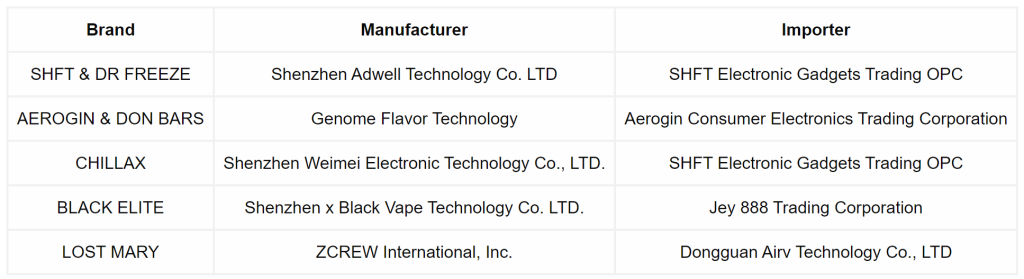
Formal charges have been filed against these brands for violating the section of the Republic Act No. 11900, known as the Vaporized Nicotine and Non-Nicotine Products Regulation Act, related to the internal revenue fiscal marking requirements for vape products manufactured and imported in the Philippines. The penalties for selling or trading these products are ₱2 million (US$36,000) for the first offense, ₱4 million for the second offense (US$72,000), ₱5 million (US$90,000) and cancellation of licenses for the third offense. Moreover, the Philippine Standard (PS) Licenses of Shft & Dr Freeze, Aerogin & Don Bars and Chillax have also been suspended.
July 2024: The Philippines suspends online sale of vape products
The Department of Trade and Industry (DTI) issued an order suspending the sale, advertising and distribution of vape products online effective immediately6. The order was prompted by the need to prevent the sale of vape products to minors and ensure that those being sold online meet the safety standards set by law. “This is a temporary suspension until the e-marketplaces are able to convince us of their compliance with their obligations under Republic Act No. 11900, or the vape law, and other laws and related issuances,” stated the Trade Secretary.
DTI is monitoring close to 90,000 online and bricks & mortar companies engaged in the vape business in the Philippines – including whether these businesses have the proper certifications, such as the Philippine Standard (PS) mark and the Import Commodity Clearance (ICC) sticker, are in place. As of June 1, 2024, importation and manufacturing of vaporized nicotine and non-nicotine products and novel tobacco products (including heated tobacco) must now undergo the DTI certification process – in compliance with the Vape Act, which entered into force in July 2022. This means that products must have the Philippine Standard (PS) mark and Import Commodity Clearance (ICC) sticker first before they are placed on the market. There is a 6-month transition period to allow all firms to deplete the existing inventories and comply with the new regulations. From January 5, 2025, DTC will now not allow any product to be sold without a PS license and ICC sticker.
April 2024: Tobacco industry supports the plan to ban disposable vapes in the Philippines
According to the local media sources, the Tobacco Industry expressed their support for the Department of Finance’s proposal to ban disposable vapes7. The Department of Health also indicated support for the proposal; however, the Department of Trade and Industry (DTI), the chief enforcer of the Republic Act No. 11900 (“Vaporized Nicotine and Non-Nicotine Products Regulation Act”), as well as the Department of Agriculture and National Tobacco Administration have yet to take a stance on the proposal.
The proposal was made due to the rise of vaping among the youth, the detrimental environmental impact of single-use vapes and the eroding tax revenues of the National Government. Based on a similar list of reasons, several countries in Europe – including the United Kingdom, France Ireland and Belgium – are considering to impose a ban on disposable vapes.
March 2024: Sale of the popular vape brand, Flava suspended
The Department of Trade and Industry (DTI) pulled the popular vape brand Flava off the shelves in the Philippines amid allegations of illegal marketing to minors and tax evasion8. The DTI’s Fair Trade Enforcement Bureau (FTEB) ordered Flava Corporation to cease all commercial activities related to the Flava vape. Once the Sampaloc, Manila-based business receives the preliminary order issued by DTI-FTEB, it will have to cease all of Flava’s commercial activities immediately.
Flava was the respondent to formal charges alleging Republic Act No. 11900 violations, or the Vaporized Nicotine and Non-Nicotine Products Regulation Act, filed before the DTI-FTEB in March 2024. Consequently, the DTI-FTEB gave a preliminary order to confiscate Flava products that violate RA 11900 to prevent the disposition or tampering with evidence and the continuation of the acts being complained of.
The DTI is the lead implementing and enforcement agency of RA 11900, the landmark law aimed at protecting minors from vaping. The House Ways and Means Committee (“House”)estimated as much as ₱728 million (US$1.3 million) in foregone tax revenues from the alleged technical smuggling of ₱1.4 billion (US$ 2.5 million) worth of illicit Flava devices last year. Following laboratory testing, the House panel uncovered that Flava had not declared the vapes it imported from China. Flava allegedly mislabeled its ingredient as freebase nicotine, which has a lower excise tax than nicotine salt – the type of nicotine used in Flava products.
The House committee also discovered Flava’s aggressive marketing of its flavored vapes to minors, most especially on social media – a violation of RA 11900. Moreover, the Bureau of Internal Revenue (BIR), which is responsible for collecting taxes in the Philippines, will file criminal tax evasion charges against Flava following a recent raid and seizure of illicit Flava vapes with tax deceleration deficiencies. The BIR plays a critical role in supporting the Government’s goal to eradicate illicit vape products.
The DTI also confiscates vape products with flavor descriptors, with cartoon characters that are appealing to minors and that use social media influencers. DTI encountered or confiscated vapes with cannabis oil and “kush,” a potent strain of marijuana – which are now proliferating in the Philippines market.
For further details on the Flava Brand: Flava Philippines
References:
- https://www.dti.gov.ph/osmv ↩︎
- https://business.inquirer.net/498653/dti-eyeing-to-accredit-up-to-10-vape-firms-by-year-end ↩︎
- https://www.abante.com.ph/2024/10/22/dti-sinuspinde-11-vape-product/ ↩︎
- https://www.bworldonline.com/economy/2024/10/02/625477/vape-industry-says-compliance-burden-forcing-sellers-to-close ↩︎
- https://www.dti.gov.ph/news/dti-warns-consumers-vape-brands-trading-suspension ↩︎
- https://newsinfo.inquirer.net/1962806/dti-suspends-online-sale-of-vape-product ↩︎
- https://www.philstar.com/business/2024/04/19/2348696/tobacco-industry-supports-plan-ban-disposable-vapes ↩︎
- https://tribune.net.ph/2024/03/18/dti-stops-flava-sales-vape-brand-faces-tax-evasion-case ↩︎

