


October 2026: Connecticut’s Cannabis Market Sees Falling Prices and Cooling Sales in 2026
Connecticut’s legal cannabis market is experiencing a notable shift as retail prices hit new lows and overall sales cool following summer peaks, according to state data. The average price per gram of cannabis in Connecticut has dropped by just over a dollar since the beginning of the year. In January, marijuana averaged $7.63 per gram, but prices slid down to $6.57 per gram by September. For comparison, prices peaked significantly higher during the market’s early maturity in March 2024, when a gram averaged $12.51. Aside from a minor nine-cent bump between April and May, the trajectory throughout 2026 has been consistently downward.
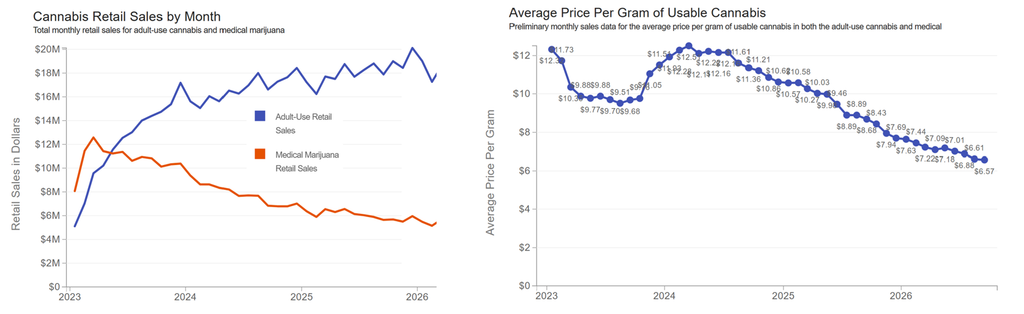
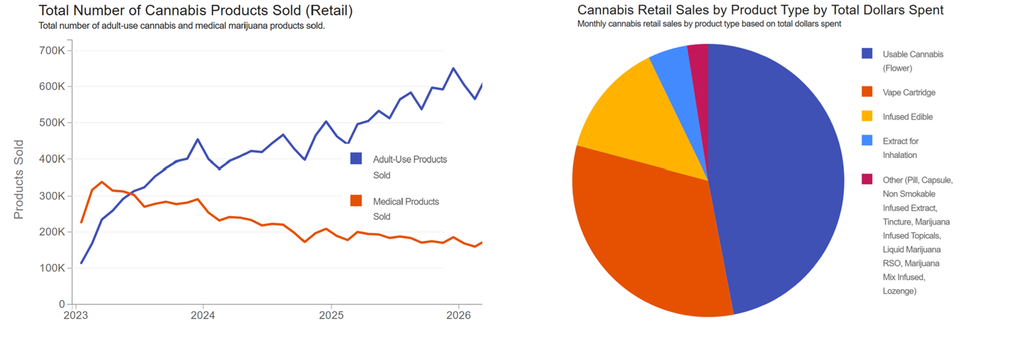
Product-level costs reflect this broader per-gram deflation. In the adult-use market, the average price per product dropped to $27.24 in September, down from $28.09 the month prior. Medical marijuana products experienced a much more modest shift, dipping slightly from $31.52 in August to $31.50 in September. Medical cannabis products have remained more expensive than adult-use options since September 2025, maintaining a distinct pricing tier for registered patients. Retail offerings span various categories across the state, ranging from raw usable flower, pre-rolls, and concentrate vapes to edibles and THC-infused beverages. Usable flower continues to drive standard per-gram benchmark rates, while specialty product categories maintain higher average price points.
Alongside dropping prices, retail sales across both medical and adult-use sectors have contracted after peaking during the summer months. In July, adult-use sales hit a record high since legalization, with roughly 729,300 products sold totaling around $21 million. By September, however, sales volume pulled back to just over 701,000 products, generating roughly $19 million. The medical market has mirrored this contraction, with September recording approximately 166,300 medical products sold to continue a multi-month cooling trend in overall state retail activity.
Connecticut’s market trends closely mirror its neighbors in New England, though regional pricing gaps remain stark. Massachusetts continues to dwarf Connecticut in overall volume, though cannabis is substantially cheaper there. Like Connecticut, Massachusetts saw adult-use sales pull back in September to $94.3 million, down from $144.9 million in August. Rhode Island also experienced a minor month-over-month dip, recording $10.2 million in September sales compared to $10.58 million in August.
As supply stabilizes and regional competition exerts downward pressure on rates, Connecticut consumers are enjoying lower costs than at any point since the recreational market’s inception, even as regulators monitor how shifting sales volumes impact state revenues.
October 2026: Illinois Cannabis Sales Surge Following Legislative Reform and Expanded Limits
Legal cannabis sales across Illinois are on a steady upward trajectory, backed by strong consumer demand and continued market expansion according to state data. Fresh figures from the state’s annual cannabis reports illustrate a robust marketplace, highlighted by calendar year 2025 total legal retail sales (combining adult-use and medical) reaching $2.17 billion, representing a 3% increase from the previous year. This substantial economic activity pushed total cumulative state tax revenue past $2.37 billion since legal adult-use sales first launched, with 2025 alone generating about $465 million in state tax revenue. Notably, the state’s latest findings also highlight that average retail prices for consumers reached their lowest levels since legal adult-use sales began.
Monthly totals continue to demonstrate heavy engagement, led by a record-breaking July 2026 performance where adult-use recreational sales hit $126 million and surpassed five million individual adult-use items sold in a single month for the first time. Momentum carried into August 2026 with adult-use sales reaching $122.7 million and nearly 4.9 million items sold, marking a 9% increase in unit volume compared to the same period a year prior.
Much of the recent uptick can be attributed to Senate Bill 3222, a major reform package signed into law by the Governor. The legislation notably doubled legal possession and purchase limits for adult consumers – raising the threshold for state residents to 60 grams of flower, 10 grams of concentrate, and 1,000 milligrams of THC edibles – while also doubling limits for out-of-state visitors. Beyond purchasing limits, the updated rules streamlined retailer operations by permitting drive-thru and curbside pickup options, subject to local approval, and allowing extended late-night dispensary hours.
The state added 29 new operational dispensary licenses over the fiscal year, bringing the total number of active licensed retail locations to roughly 245 statewide while supporting an estimated 30,800 full-time equivalent jobs across cultivation, manufacturing, and retail sectors. Combined with stronger state oversight targeting illicit sales and unregulated hemp products, these modernized updates have positioned licensed Illinois dispensaries to capture sustained consumer demand through the end of the year. Additionally, state regulatory authorities emphasized an increased focus on public health tracking, youth prevention programming, language accessibility for industry licensing exams, and long-term evaluation of consumer safety and social equity goals.
September 2026: Minnesota Cannabis Sales Surpass $250 Million After One Year of Legal Retail Market
The Minnesota Office of Cannabis Management (OCM) announced that combined statewide cannabis sales surpassed $250 million following the first full year of the legal market’s launch. According to data released by the agency, the total is divided between approximately $150 million in adult-use recreational cannabis products and roughly $100 million in medical cannabis purchases across 1.2 million combined transactions. State officials noted that the state’s 90,000 registered medical cannabis patients contributed significantly to the medicinal total. When combined with sales of lower-potency hemp edibles and beverages (LPHEs), the broader sector generated $45.6 million in tax revenue for the state over a 10-month period spanning September 2025 to July 2026, based on the latest figures from the Minnesota Department of Revenue (DOR).
The milestone figures follow an initial market rollout that faced early supply constraints. Cultivation capacity has since expanded, with permit-holding growers operating hundreds of thousands of plants. Regulators also highlighted the composition of the state’s 369 licensed cannabis businesses, noting that verified social equity applicants hold 43% of total licenses. A social equity applicant is an individual prioritized in the licensing process due to being disproportionately impacted by past cannabis prohibition laws. Additionally, nearly three-quarters of cultivation license holders are classified as microbusinesses, underscoring a market structure heavily weighted toward small-scale operators.
Major structural changes to Minnesota’s regulatory framework are scheduled to take effect on January 1, 2027, following the passage of the state’s Omnibus Cannabis Bill. These upcoming modifications include the replacement of old medical cannabis combination business licenses with a new “macro-business” license category – capped at eight statewide until 2030 with rules regulating indoor canopy size and location requirements – alongside the official legalization of specific ratio hemp-infused products containing regulated balances of cannabinoids alongside maximum thresholds of 10 milligrams of THC per serving.
August 2026: U.S. Marijuana Use Holds Near Record Highs as Public Remains Divided on Impact
American marijuana consumption continues to hover at historic levels, driven primarily by younger demographics, even as public perception of the drug’s overall effect remains sharply split. According to recent Gallup survey data, 17% of U.S. adults report smoking marijuana – more than double the 7% recorded in 2013 when tracking began, and tying the record high set in 2023. Edible consumption has experienced a similar upward trajectory, with 15% of adults now reporting use, up from 14% in 2022 and 12% in 2024.

Age remains the strongest predictor of use. Adults under 50 report the highest rates of smoking, led by those aged 30 to 49 (25%) and 18 to 29 (23%). Usage drops significantly among older age groups, falling to 10% for adults aged 50 to 64 and just 5% for those 65 and older. Edible consumption follows a similar age progression, though the drop-off among older adults is less pronounced.
Beyond age, several distinct demographic and economic patterns emerge:
– Lifestyle Factors: Consumption of both smoked and edible marijuana is higher among adults who are less educated, less religious, and who also consume alcohol.
– Income Disparities: Marijuana smokers report lower household incomes on average than non-smokers, an economic gap that does not appear among edible consumers.
– Gender Nuances: Women are slightly more likely than men to use edibles, whereas gender differences are virtually non-existent among marijuana smokers.

As usage stabilizes near peak numbers, Americans remain almost evenly split over marijuana’s broader impact on users. Currently, 47% of adults view its effects as positive (9% very positive, 38% somewhat positive), while 46% view them as negative (16% very negative, 30% somewhat negative). This close balance reflects a ongoing divide in public sentiment, shifting back toward a middle ground after leaning slightly positive (53%) in 2022 and slightly negative (51%) in 2024.
July 2026: U.S. Cannabis Sales Record First-Ever Annual Decline Driven by Price Compression Crisis
For the first time on record, the U.S. legal cannabis market experienced a year-over-year drop in overall sales, falling from $32 billion to $29.9 billion. However, market analysts emphasize that the revenue drop does not stem from shrinking consumer interest or falling demand. Instead, the primary cause of the decline is severe price compression – a scenario where consumers continue to buy record volumes of product, but at significantly lower prices.
Several structural drivers are pushing prices down across the industry:
– Regulatory Over-Licensing and Oversupply: State and local regulators have issued licenses driven primarily by political goals, tax revenue targets, and job creation rather than economic demand. In most legal states, licensed cultivation and retail capacity vastly exceed actual consumer demand, creating a flooded marketplace where too many operators are chasing the same customer base.
– Market Saturation in Mature States: The surge in growth historically driven by state-level legalizations is tapering off. In mature Western and Midwestern markets, the transition of consumers from the illicit market to legal dispensaries has largely tapped out, slowing the influx of new shoppers needed to absorb excess inventory.
– Aggressive Retail Discounting: To stay competitive in crowded markets, retailers have turned to deep discounts and price cuts. While aggressive promotions move higher physical unit volumes, they severely erode profit margins and reduce overall cash register totals. In states like Michigan, for example, retailers sold significantly more physical units year over year, yet brought in less total revenue.
– Competition from Hemp-Derived THC: The rise of intoxicating hemp-derived products has siphoned market share from licensed dispensaries. Operating under fewer regulatory hurdles and lower compliance costs, hemp-derived alternatives have added another layer of competition to the adult-use market.
Unless state regulators slow or pause license issuance to rebalance supply and operators pivot from price-slashing tactics to long-term growth strategies, a resolution to the U.S. cannabis market crisis remains out of reach.
June 2026: The Rise and Slowdown of Legal Cannabis Tax Revenues Highlight More Than a Decade of U.S. Market Evolution
Since Washington and Colorado launched the nation’s first adult-use cannabis markets in 2014, the commercial landscape has undergone a massive transformation. Over the past decade, legalizing cannabis for adults age 21 and older has generated more than $28 billion in cumulative state tax revenue. In 2025 alone, U.S. states brought in a record-high $4.57 billion from recreational sales, a massive leap from the $69 million collected during the industry’s first year. Currently, 24 states have legalized cannabis possession for adults, and all but Virginia have established active, regulated, and taxed retail markets.

States have allocated these windfall revenues to a diverse mix of public needs. While some direct the funds straight into their general state budgets, many others earmark the money for specific community services. These include funding public school construction, repairing local infrastructure, supporting substance abuse prevention, and investing in communities disproportionately affected by the war on drugs.
The historical surge in tax collections was primarily driven by a steady domino effect of new states joining the legal market. However, this rapid upward trajectory has flattened significantly since 2021. This deceleration stems from two main market pressures. First, the legislative momentum has matured, meaning the pace of new states passing legalization measures has slowed down. Second, in established markets, retail prices have plummeted under the weight of severe over-supply and intense competition. While consumers benefit from lower retail prices, these compressed margins mean that overall state tax revenue growth is no longer rising at its previously exponential rate.
| State | Sales Launch Year | State Tax Structure (Excise + Sales) | 2025 Adult-Use Tax Collection ($ Millions) |
|---|---|---|---|
| California | 2018 | 15% retail excise tax + standard state sales tax | $1,049 |
| Illinois | 2020 | 7% wholesale tax + tiered retail tax by THC % (10% to 25%) + standard sales tax | $553 |
| Michigan | 2019 | 10% retail excise tax + 6% standard sales tax | $507 |
| Washington | 2014 | 37% retail excise tax + standard sales tax | $496 |
| Massachusetts | 2018 | 10.75% retail excise tax + 6.25% standard sales tax | $291 |
| Arizona | 2021 | 16% retail excise tax + 5.6% transaction privilege tax | $247 |
| Colorado | 2014 | 15% wholesale excise tax + 15% retail excise tax + standard sales tax | $221 |
| New York | 2022 | Potency-based THC tax + 9% state retail tax + 4% local tax | $173 |
| Nevada | 2017 | 15% wholesale excise tax + 10% retail excise tax | $158 |
| Oregon | 2015 | 17% retail excise tax | $144 |
| Missouri | 2023 | 6% retail excise tax + standard sales tax | $137 |
| Ohio | 2024 | 10% retail excise tax + standard sales tax | $131 |
| Maryland | 2023 | 9% retail sales tax | $90 |
| New Jersey | 2022 | Social Equity Excise Fee ($1.10–$2.50/oz) + 6.625% sales tax | $78 |
| Montana | 2022 | 20% retail excise tax | $75 |
| New Mexico | 2022 | 12% retail excise tax + standard gross receipts tax | $75 |
| Maine | 2020 | Weight-based cultivation tax ($335/lb flower) + 10% retail tax | $43 |
| Connecticut | 2023 | THC-potency tax (ranges by product type) + 6.35% state tax + 3% local tax | $42 |
| Vermont | 2022 | 14% retail excise tax + 6% standard sales tax | $30 |
| Alaska | 2016 | Weight-based cultivation tax ($50/oz mature flower) | $25 |
| Rhode Island | 2022 | 10% retail excise tax + 7% state sales tax + 3% local tax | $17 |
| Delaware | 2025 | 15% retail sales tax (Sales launched August 2025) | $3 |
| Minnesota | 2025 | 10% retail gross receipts tax (Sales launched September 2025) | $2 |
May 2026: Fiscal Stabilization Follows Regulatory Reshaping in California
The California Legislative Analyst’s Office (LAO) projects total cannabis tax revenues to reach $633 million for the 2025–26 fiscal year, climbing slightly to $642 million in 2026–27. This steady fiscal outlook is supported by recent baseline data: for cannabis excise tax returns filed in the first quarter of 2026, the total amount of tax due reached $144 million. Industry stakeholders should note that these preliminary Q1 figures represent reported tax obligations rather than finalized cash-in-hand; actual revenues typically vary modestly from initial totals due to routine administrative factors, such as processing lags or late filings.
This revenue landscape marks a mature phase of a market established a decade ago. In November 2016, California voters passed Proposition 64, legalizing nonmedical adult-use cannabis and introducing a dual-tax architecture consisting of a 15% retail excise tax and a weight-based cultivation tax. To relieve supply-chain pressures and lower the tax burden on the legal market, the state reshaped its fiscal strategy via Chapter 56, Statutes of 2022 (Assembly Bill 195). This legislation permanently eliminated the cultivation tax on July 1, 2022, streamlining California’s cannabis tax structure into the singular retail excise framework driving current collections.
May 2026: Alabama Medical Marijuana Sales Finally Begin After Years of Delays
Alabama is preparing to launch medical marijuana sales nearly five years after legalizing medical cannabis, with the state’s first dispensary expected to open within days. The rollout follows years of litigation, licensing disputes, and regulatory delays that repeatedly stalled the program. Under Alabama law, the state can issue up to four dispensary licenses, with each license holder permitted to operate as many as three retail locations, allowing for up to 12 dispensaries statewide. Additional “integrated facility” licenses could eventually expand the number of dispensing sites further.
Approved medical cannabis products in Alabama include tablets, tinctures, oils, patches, gummies, and topical products, while smokable cannabis remains prohibited under state law. State officials say only a limited number of dispensaries will open initially, though additional locations are expected over time. As of this week, Alabama has just over 40 certified physicians authorized to recommend cannabis treatments.
May 2026: Michigan Cannabis Market: Sales Stabilize While Prices Continue Long-Term Downtrend
Michigan cannabis sales totaled $258.6 million in April, declining 4.3% year-over-year but increasing 1.2% sequentially. Adult-use continue to dominate the market with $258.2 million sales in April. Medical cannabis remained marginal, with sales of $0.4 million, down 24.1% year-over-year, reflecting the continued shift of demand toward the recreational segment.
The broader historical context shows a market that expanded rapidly following legalization but has since moved into a more mature phase. Total Michigan cannabis sales rose 82.1% in 2021 to $1.79 billion, followed by 27.9% growth in 2022 to $2.29 billion and another 33.3% increase in 2023 to $3.06 billion. Growth then slowed sharply, with a 7.6% increase in 2024 to $3.29 billion, followed by a 3.5% decline in 2025 to $3.18 billion. In 2026 year-to-date, sales are down 5.9%, indicating continued normalization after the initial post-legalization expansion phase.

A key structural factor behind this shift has been sustained price compression in the adult-use flower market. Since legalization, average wholesale flower prices have fallen sharply from roughly $8,000 per pound in early 2020 to around $945 per pound in April 2026. Prices reached a record low near $900 per pound in late 2025 before stabilizing modestly at slightly higher levels. While the pace of decline has moderated in recent periods, the overall trajectory remains firmly downward, reflecting persistent oversupply and intensifying competition across the state’s cultivators.
Taken together, Michigan cannabis market is transitioning from high-growth legalization dynamics to a more mature environment characterized by price deflation, slowing revenue growth, and increasing reliance on efficiency and scale.
April 2026: Cannabis Sales Decline in Washington and Michigan Amid Price Compression
Cannabis sales in both Washington and Michigan continue to trend downward from pandemic-era highs, reflecting a maturing market increasingly pressured by falling prices and oversupply. In Washington, monthly sales reached approximately $92.8 million in March 2026, marking a 4% year-on-year decline. Despite some short-term volatility, the broader trend points to a cooling market, with lower average prices – around $11.95 per item- highlighting ongoing price compression as competition intensifies. Michigan is experiencing a more pronounced slowdown. Cannabis sales totaled $226.8 million in January 2026, down 8.3% year-on-year and nearly 16% sequentially from the prior month. On an annual basis, the market has also softened, with total sales declining from $3.29 billion in 2024 to $3.18 billion in 2025.

The primary driver across both states is price compression, as expanding supply and intensified competition push retail and wholesale prices lower. In Michigan, for example, average flower prices have dropped close to 90% over the past six years, reflecting excess production capacity and supply. Overall, the decline in both markets appears less about weakening demand and more about structural industry dynamics – particularly oversupply and declining prices – signaling a transition from rapid growth to a more competitive, margin-constrained phase.
February 2026: Michigan Cannabis Sales Drop to 3-Year Low After New 24% Wholesale Tax
Legal marijuana sales in Michigan fell to $226.4 million in January 2026, marking the lowest monthly total since February 2023 and an 8.2% decline from January 2025. The slump coincided with the start of a new 24% wholesale marijuana tax on January 1, 2026, part of a state road-funding package; this levy is in addition to the existing 10% retail excise and 6% sales taxes.
Market participants warn that putting the tax on growers’ transfers to retailers has pushed up costs in an already oversupplied, highly competitive market, contributing to the sales drop and even prompting some dispensaries to close. Amid falling sales, employment pressures and legal challenges, they worry that higher prices could drive consumers back to the illicit market and undermine the state’s regulated cannabis sector. Cannabis advocacy groups have sued to block the tax as unconstitutional, arguing it alters the voter-approved 2018 cannabis law without the required legislative support, though courts have thus far allowed the tax to take effect.
February 2026: Nevada Cannabis Market Sees Declining Legal Sales as Illicit Trade Persists
Annual legal cannabis sales in Nevada fell 8.6% in the 2024–25 fiscal year, declining to $758 million from $829 million in the prior period, according to data from the state Cannabis Compliance Board. The contraction reflects mounting pressure on the regulated market, including price compression at dispensaries and the continued strength of unregulated sellers. Industry observers note that the decline in reported revenue appears to stem primarily from lower prices rather than reduced unit volumes, suggesting retailers are competing aggressively on price.
The downturn was particularly visible in Clark County, where cannabis retailers generated $567.6 million in sales, down 10% from $628.4 million a year earlier. The slowdown broadly mirrors a modest decline in Nevada’s tourism sector. Clark County, which includes Las Vegas, accounts for approximately 70% of the state’s population and remains the center of cannabis retail activity. State data show Nevada has 356 operational licenses, including one medical cannabis dispensary, 107 retail cannabis stores and two cannabis consumption lounges in Las Vegas.
Longer-term trends highlight the challenges facing the legal sector. Nevada recorded nearly $965 million in annual cannabis sales during the 2021–22 period, but revenues have since moderated as the market matures and competitive pressures intensify. At the same time, the illicit market remains resilient, weighing on licensed operators. Cannabis sales in Nevada are subject to a 15% wholesale excise tax and a 10% retail excise tax. Policymakers have signaled openness to potential adjustments, including possible tax reductions, as part of broader efforts to strengthen the competitiveness of the regulated market against unlicensed sellers.
January 2026: Illegal cannabis seizures top $1.2 billion in California
Since the launch of the Unified Cannabis Enforcement Task Force (UCETF) in 2022, California has seized more than $1.2 billion in illegal cannabis. The $609 million seized in 2025 represents an 18 fold increase compared to $33.6 million in 2022. In 2025, law enforcement officials conducted 48 operations across 23 counties in California, executing more than 250 search warrants with more than 60 partner agencies. These efforts led to the seizure and destruction of 188 tons of illicit cannabis. In 2025, UCETF operations addressed a range of illicit cannabis activities, including those associated with outdoor and indoor cultivation, manufacturing facilities, retail storefronts, and unlicensed delivery services. During these operations, investigators frequently identified additional criminal and civil violations beyond illegal cannabis cultivation, such as the use of banned and hazardous pesticides, labor trafficking, water-related violations, and other regulatory infractions.
January 2026: California Cannabis Market Hits a Turning Point as Vape Sales Overtake Flower
California cannabis consumers are now spending more on vape products than on traditional flower at licensed dispensaries – a first for the state’s regulated market. Vapes became California’s top-selling cannabis category in July 2025, generating $117.8 million in monthly sales versus $113.2 million for flower, according to data from the California Department of Cannabis Control (DCC). The gap continued to widen through the rest of the year. By December 2025, vape sales exceeded flower sales by c.$17 million for the month, reaching $124.4 million compared with $107.6 million for flower. Other product categories trailed behind, with pre-rolls posting $64.7 million in sales, edibles $45.6 million, and concentrates and extracts $29.2 million.

This shift occurred despite a contracting overall market. Total licensed cannabis sales in California declined 5.2% year over year, from $4.66 billion in 2024 to $4.41 billion in 2025. Within that downturn, vape sales proved notably resilient, edging up by c.0.6%, while flower sales fell sharply by 12.6%. The growing dominance of vape products is largely driven by generational change, particularly the rise of Gen Z consumers. In 2025, Gen Z shoppers in California allocated 45.7% of their cannabis spending to vapor pens, compared with just 22.9% to flower. As more Gen Z consumers turn 21 each year, vape brands continue to gain access to a growing and highly receptive customer base. This generational contrast is especially clear when compared with older consumers. Gen Z now accounts for a larger share of U.S. cannabis spending than Baby Boomers, who have traditionally favored flower and edibles. In California, Baby Boomers devoted 37.6% of their cannabis spending to flower in 2025, but only 14.4% to vapor pens.
California’s declining flower sales are part of a longer-term trend that began after a pandemic-driven peak in April 2021. That month, flower sales hit a record $214.8 million, accounting for 44.3% of all licensed cannabis sales, far ahead of vapes at 21.5%. By September 2025, monthly flower sales had fallen to $104.2 million – their lowest level since February 2020 – paving the way for vapes to become the state’s largest category for the first time. While flower remains the leading category in many newer adult-use markets, California’s experience is not unique, particularly on the U.S. West Coast. In Washington, vapor pen sales overtook flower in late 2025, capturing 29.8% of the market in December compared with 28.5% for flower. In Oregon, vape and flower sales are nearing parity, each accounting for roughly 30% of total cannabis sales.
January 2026: Minnesota’s Adult-Use Cannabis Market Begins to Gain Momentum
Minnesota’s adult-use cannabis market is showing clear signs of traction after a slow and uneven rollout. Since non-tribal recreational sales began in September 2025, licensed retailers have generated more than $31 million in revenue from roughly 466,000 transactions through the end of December 2025, according to the Minnesota Office of Cannabis Management (OCM). Over the same period, medical cannabis sales reached $31.7 million. Notably, December marked a turning point: adult-use sales totaled $9.4 million, surpassing medical marijuana sales of $8.8 million for the first time. This crossover is widely seen as a milestone in markets transitioning from medical-only to full adult-use frameworks.
The initial rollout, however, was constrained by significant supply-chain and licensing challenges. A shortage of licensed cultivation capacity left many retailers with limited inventory in the early months. As cultivation activity increased, another bottleneck emerged: a lack of licensed transporters prevented product from reaching stores efficiently. Of the state’s licensed cannabis businesses, only four are dedicated cultivators, while just 13 of the 95 approved “microbusinesses” are authorized to grow cannabis. Licensing delays compounded these issues. As of late 2025, only 59 adult-use retail licenses had been issued, despite more than 1,400 applications awaiting final approval. This imbalance fueled a speculative secondary market for licenses, with permits that originally cost less than $10,000 reportedly being offered for more than $1 million. Similar dynamics have been observed in other newly legalized states where limited-license regimes initially restrict market entry.
On the supply side, adult-use cannabis plantings peaked at around 18,000 plants in October 2025 before stabilizing at c.14,000 in November and December. Because cannabis cultivation typically requires several months from planting to harvest, much of the product grown in the fall is only now reaching consumers. At present, an estimated 66,000 marijuana plants are actively being cultivated statewide.
Supply constraints have helped keep prices relatively firm. The median retail price is about $13.54 per gram, or c.$48 for an eighth before taxes. While this is lower than prices in neighboring Illinois, it remains nearly three times higher than in Michigan, where an oversupplied market has driven prices sharply down and squeezed operator margins. As more cultivation comes online and licensing backlogs ease, increased product availability and gradual price moderation could be expected. For now, Minnesota’s adult-use cannabis market appears to be moving past its most difficult early phase and into a period of steadier growth.
January 2026: U.S. Cannabis Policy at a Crossroads: Federal Rescheduling, Hemp Regulatory Shake-up and State Dynamics
The U.S. cannabis industry is entering an inflection point defined by significant federal policy signals, tightening regulation of hemp products and mixed reactions at the state level. In late 2025, President Trump issued an executive order directing federal agencies to accelerate the rescheduling of cannabis under the Controlled Substances Act from Schedule I to Schedule III — a classification that acknowledges accepted medical use and a lower potential for abuse. Although the executive order itself does not immediately change federal law, it revives a stalled federal rule-making process and, if completed, could reduce onerous research barriers and eliminate the punitive Internal Revenue Code §280E tax treatment that has long burdened state-legal cannabis businesses.
Parallel to rescheduling momentum, federal lawmakers have acted to tighten the definition and regulation of hemp. The new federal law, part of 2025 appropriations legislation, narrows the definition of “legal hemp,” basing it on total THC content and effectively re-criminalizing many intoxicating hemp-derived cannabinoids such as delta-8 and delta-10 THC. These provisions, set to take effect in late 2026, close the loophole that previously allowed a broad market for psychoactive hemp products and will likely eliminate most of that sector unless compliance strategies are developed.
State-level developments reflect a mixed picture. While a large majority of states have adopted some form of medical or adult-use cannabis legalization, anti-legalization forces have gained traction by reframing opposition around concerns over corporate dominance and regulatory gaps, contributing to defeats of ballot initiatives in states such as Florida and the Dakotas. Courts are also shaping market structures: a 2nd Circuit ruling struck down New York’s residency-based licensing preferences on Dormant Commerce Clause grounds, creating uncertainty for state licensing regimes, while a conflicting 9th Circuit decision deepens legal ambiguity.
Looking ahead, the federal rescheduling effort — if concluded through the required notice-and-comment rule-making process — could materially alter tax and research landscapes for cannabis operators, but it stops short of full descheduling or automatic legalization. At the same time, hemp market contraction due to tightened federal definitions, ongoing state regulatory innovation, and organized political resistance position the sector at a complex intersection of expansion and retrenchment. The coming months will be critical in determining whether momentum toward a more coherent national cannabis framework continues or whether regulatory and legal obstacles reset industry expectations in 2026.
January 2026: Connecticut Cannabis Market Reports Record Volume but Flat Revenue in 2025
In 2025, Connecticut’s cannabis market saw a nuanced performance: although total sales revenue slipped slightly to about $290 million from $293 million in 2024, the industry set several notable volume records. Retailers sold 8.6 million distinct cannabis items, nearly 1 million more than in 2024, and 650,503 individual sales in December 2025 alone, marking the highest monthly total since legalization. Despite this heightened unit activity, price declines driven by increased supply – with the average product price falling from $39.70 in 2023 to $33.67 in 2025 – contributed to dampened revenue growth and competitive pressure from neighboring Massachusetts, where prices remain lower. Tax data also reflected mixed results: $20 million in cannabis tax revenue in 2024 fell to $19.3 million in 2025 (excluding the final quarter), partly influenced by the fact that medical cannabis sales are not taxed.
Much of the shift in the market stems from changes in consumer behaviour and product segmentation. Recreational sales increased by $17.6 million with transactions rising from 5.1 million to 6.4 million, while medical sales declined by $21 million and medical transactions fell from 2.6 million in 2024 to 2.2 million in 2025 as patients appear to favor adult-use products. The number of licensed dispensaries has grown sharply – from nine hybrid stores at the launch of recreational sales in 2023 to 61 licensed retailers in 2025, including 29 hybrid medical/recreational outlets – yet efforts to retain medical patients have not fully stemmed the decline. Affordability challenges and cross-border competition are visibly influencing where and how Connecticut consumers purchase cannabis.
January 2026: U.S. Cannabis Prices Decline as Legalization and Oversupply Drive Market Competition
Across the United States, average cannabis flower prices are continuing a downward trajectory as legal markets mature, supply expands and competition intensifies. States such as Michigan and California reported some of the lowest cannabis prices in 2025–2026, with dispensary prices for dried flower reaching all-time lows — Michigan’s average retail flower price dipped from $14.79 per gram in 2020 to $2.22 per gram in 2025, and California reported retail flower prices at historic lows of $2.36 per gram by late 2025. These declines reflect a broader national trend where well-established markets with high license counts and abundant cultivation capacity have shifted into oversupply, pushing prices down despite gradually increasing demand.

The primary driver behind falling prices is structural oversupply. States that adopted liberal licensing frameworks allowed hundreds of cultivation permits, leading to rapid capacity expansion. As these markets matured, inventory accumulation outpaced demand growth, forcing wholesale and retail prices lower. For instance, Michigan, a state with over 1,000 cultivation permits, had more than 1.4 million pounds of flower stockpiled at the end of 2025. This dynamic has been reinforced by declining production costs, improved cultivation efficiency, and intense competition for dispensary shelf space, all of which continue to pressure margins across the value chain.
Price trends, however, differ sharply between mature and newer legal-use markets. In newer recreational or recently expanded medical markets — such as Ohio, Maryland and parts of the Northeast — cannabis prices remain materially higher, often exceeding $6 per gram at retail1. These states typically have fewer licensed growers, tighter supply controls and underdeveloped distribution networks, which constrain supply in the early years of legalization. As a result, demand initially outstrips legal production, supporting higher prices until additional cultivation capacity comes online.

Regulatory and tax structures further amplify price disparities across states. High excise taxes, complex compliance requirements and local license caps tend to keep prices elevated, while states with simpler tax regimes and open licensing models experience faster price erosion. Illinois, for example, continues to post some of the highest average retail prices in the U.S. due to limited licenses and layered taxation, while Michigan’s low-cost environment reflects both abundant supply and relatively moderate taxes. Nevertheless, Michigan’s average dispensary prices could increase for the first time in 2026 with the state’s new 24% adult-use cannabis wholesale tax going into effect on January 1, 2026; taxes are often passed down to the consumers.
Wholesale market indicators reinforce this bifurcation. In mature markets, wholesale flower prices have dropped below $2.50 per gram, signaling continued oversupply, while newer markets still transact at significantly higher wholesale levels due to scarcity and regulatory bottlenecks. Over time, history suggests that most newer markets will follow the same trajectory as early adopters: high initial pricing, followed by gradual compression as licensing expands and competition intensifies.
In sum, falling U.S. cannabis prices are a predictable outcome of legalization-driven supply growth and competitive market forces. While newer markets continue to support premium pricing in the short term, the long-term industry trend points toward lower prices, tighter margins and increasing pressure on operators to scale efficiently, differentiate products and manage costs in an increasingly commoditized market.
October 2025: Crackdown on illegal cannabis grows across California
A major crackdown on illegal cannabis grows across California has led to the seizure of 66 tons of cannabis plants, worth $222 million, in 17 multi-agency operations between July and September 2025. According to the state officials, California United Cannabis Enforcement Taskforce (UCETF) has seized 325 tons of illicit cannabis products, worth $913 million, and eradicated more than 1 million cannabis plants since it was established in 2022.
Meanwhile, California Governor signed a legislation that expands the cannabis excise tax by amending the definitions of “cannabis” and “cannabis products” sold in California, effective January 1, 2026.
October 2025: Recreational cannabis prices continue to fall in Connecticut
The price per gram of cannabis in Connecticut reached a new low in September 2025, falling by nearly 20 cents to $8.68. The average price per gram of cannabis peaked at $12.51 in March 2024 and has been mostly in a decline trend since. The average price per product has also fallen since the beginning of 2025, peaking at $37.24 in January and falling to $32 in September. This marks the lowest average price per product since adult-use marijuana became legal in January 2023. The adult-use (recreational) cannabis product has been consistently more expensive than the medical cannabis product; but, with adult-use product prices falling, they are now roughly equal.
The sale of adult-use products continues to far outpace the sale of medical marijuana. In September, retailers sold roughly 538,000 adult-use products and 171,000 medical marijuana products. The total number of products sold declined in both categories. Cannabis flowers remain the most popular cannabis product, making up 46% of sales in September and 48% of sales since January 2023 in both adult-use and medical markets.
Total adult-use retail cannabis sales also fell in September, from $18.8 million in August to roughly $17.9 million. Total sales have shown ups & downs throughout 2025 as the price per gram fell. Connecticut’s adult-use market continues to lag behind Massachusetts, where retailers sold $64.4 million in adult-use products in September. The average price per gram was also half Connecticut’s price in September, at $4.09, the lowest price the state has recorded. However, Connecticut continues to outpace adult-use sales in Rhode Island, where retailers sold $8.45 million in adult-use products.
September 2025: Cannabis stocks surge after Trump posts a video touting medical use of CBD
President Trump posted a video touting the health benefits of hemp-derived cannabidiol (CBD), promoting CBD use in elderly care and backing Medicare coverage for CBD. Shares of cannabis stocks rallied after the President’s video: AdvisorShares Pure US Cannabis ETF, MSOS, closed the day 28% higher. Tilray added 61%, while Curelaf was up 37%.
September 2025: California reverses 25% tax hike on cannabis
The California Governor signed a bill canceling a planned 25% tax hike on legal cannabis and locking in the state’s excise tax rate at 15% through 2028. The new law is designed to help licensed growers and retailers stay afloat and better compete with the illegal market. Supporters argue that lowering the tax burden is essential to stabilizing the legal cannabis industry, which has been struggling with declining sales, widespread business closures, and shrinking tax revenue.
Critics claim that the tax cut will strip away funding from programs that rely on cannabis revenue – including the childcare for foster kids and emergency childcare for low-income families. Since January 2018, California has collected more than $7.3 billion in cannabis tax revenue. The law change comes as a special state task force continues to crack down on illegal cannabis. Since 2022, enforcement efforts have destroyed nearly $900 million worth of illegal products.
June 2025: Pre-rolled cannabis sales tops $3 billion in the U.S.
More than 316 million pre-rolls (“joints”) were sold in 2024 in the U.S., grossing $3.1 billion in sales (at around $10 per piece) and capturing more than 15% of the total legal cannabis market. Infused pre-rolls (joints enhanced with concentrates like hash, oil or kief) drive the category growth, making up 44.4% of the category sales in 2024. Potency, price and brand identity are named as the top drivers for consumers, 80% of whom consume cannabis multiple times per day. Consequently, multi-pack formats, like five- and ten-packs, make up nearly half of all sales.

The pre-roll market is highly fragmented with Top-10 players owning less than a quarter of the total market. With $245 million in sales, California-based Jeeter emerges as the distant market leader – more than doubling the second-placed, STIIIZY in terms of sales. Known for its diamond-and-oil-infused Baby Jeeter five-packs, often rolled in kief and packed in collectible glass jars, Jeeter has built a cult following and a premium reputation in the four states it operates. The brand’s bold packaging, flashy collaborations (from Bob Marley to Dwyane Wade), and flavor-forward drops helped Jeeter charge an average price of $24.6 per unit and capture 8% of the national market share despite ranking second in units sold (9.96 million). Dragonfly Cannabis emerged as the national volume leader with 12.3 million units sold – at an average price of $2.4 each – despite operating solely in Michigan2.
June 2025: California cannabis market posts biggest sales drop in legalization history
California’s struggling legal cannabis market is shrinking faster than ever, according to new tax data. Taxable sales at California’s legal cannabis stores amounted to $1.088 billion in Q1 2025, the lowest figure in five years and an 11% drop in sales compared to Q1 2024. This marks the largest drop in the history of legal cannabis sales in California. Nevertheless, the reported figures are under constant revision and the falling retail selling prices could be the main driver behind the retail US$ sales decline as the retail sales volume and production volume are on the raise.
In California, the legal market is under pressure as the legal operators face high regulatory fees, taxes and competition from the unlicensed (illegal) market. Legalization has also increased competition within the legal market, which has dropped wholesale prices, reduced profit margins and made it harder for legal businesses to survive. Moreover, on July 1, 2025, the state excise tax rate on cannabis will increase from 15% to 19% – which could further reduce total statewide pre-tax sales of cannabis products in the licensed market by 6%.
Illegal cannabis stores are still rampant in California, where customers can purchase tax-free marijuana and operators can run their businesses without paying the state’s expensive fees. The licensed market is estimated to supply only 38% of the cannabis consumed in California in 2024.
May 2024: Daily marijuana use surpasses daily alcohol use for the first time in the US
According to a recently published research3, on daily & near daily (DND) basis (21+ days a month), the number of Americans who smoke marijuana (17.7Mn) now exceeds those who drink alcohol (14.7Mn). In the 1992 survey, DND alcohol users were 10 times as many as DND marijuana smokers (8.9Mn vs. 0.9 Mn).
However, the underlying research data is based on self-reporting and the willingness to self-report has likely increased in parallel to the normalization (decriminalization & legalization) of cannabis. Thereby, the changes in actual use could be less pronounced than changes in reported use.

Nevertheless, researchers conclude that long-term trends in cannabis use in the US mirror the changes in policy with declines during periods of greater restriction and growth during periods of liberalization. Four distinct periods are identified:
– Liberalization during the 1970s (i.e. 1972 publication of the Shafer Commission report, 11 US states decriminalizing or otherwise reducing penalties, appointment of a pro-decriminalization head to the federal Office of Drug Abuse)
– Decline: More conservative policies from 1980 to 1992 (i.e. the “Reagan-Bush drug war”)
– Slow growth: A 15-year period of state-led liberalization (primarily of medical marijuana and in contradiction to the federal policy) from 1993 to 2008
– Explosive growth: A period of explicit non-interference by the federal government and decriminalization & legalization (of recreational use in addition to the medical use) in many US States (from 2009).
Nov 2023: Americans are increasingly smoking marijuana than cigarettes
According to a recent Gallup poll4, the percentage of US adults smoking marijuana has surged to 17% (+10pp since 2013) while the percentage of those who have ever tried now stands at 50%. The poll also reveals that 70% of Americans support marijuana legalization: up from 12% in 1969 and 58% in 2012 (when Colorado and Washington became the first states to legalize recreational cannabis use).
According to the latest CDC figures (2021)5, the percentage of US adults smoking cigarettes is down to 11.5% – which is in-line with Gallup’s regular Tobacco & Smoking publication6. Nevertheless, 18.7% US adults (46Mn people) use a tobacco product (cigarettes, e-cigarettes, cigars, pipes & smokeless tobacco) – making nicotine #1 recreational substance of choice among US adults, slightly ahead of THC. However, considering the current trends, THC is set to de-throne nicotine by the end of this decade.

Maybe it already did among the young adults (18-29 years old): more than twice as many young adults say that they smoke marijuana (26%) as smoke cigarettes (12%), even based on outdated data (2019-22)7. However, vaping is the most preferred means of nicotine consumption in this age group: 19% vapes, 12% smokes and 4% does both (adding up to 27%). Moreover, Gallup doesn’t have data for the other nicotine products: we know that nicotine pouches are relatively popular among the young adults. Modernization of the delivery means (NGP/RRPs) is providing some support to the old “nicotine franchise” by offsetting a part of losses incurred by the dying cigarette business. Nevertheless, the trend is clearly in favor of marijuana whose prevalence among young adults up is from 17% in 2013-15 to 26% in 2019-22.

What does this mean for the tobacco business? US is the single most important tobacco market in the world (ex-China) – generating 43% of the operating profit of the 5 Tobacco Majors (PMI, Altria, BAT, Japan Tobacco & Imperial Brands). The US nicotine market is worth more than $150Bn even based on the depressed multiples of the tobacco companies. Meanwhile, all US Cannabis companies combined have less than $10Bn market cap – including Curaleaf ($2.2Bn), Green Thumb Industries ($2.2Bn) and Trulieve ($0.9Bn). As the legalization (federal-level), regulation and enforcement of the marketing rules will still take many years (if not, a decade or two), we are not close to a normalized, fully-functional US (recreational) cannabis industry. Nevertheless, considering the value at stake and the mega trends in place, it is reckless for a tobacco company not to get its foot in the door and establish a LT call option: that is to say, a well-thought-out, meaningful exposure that can be pieced together and scaled up when the time is right.
References:
- https://www.cannabisbusinesstimes.com/business-issues-benchmarks/sales-trends/news/15814457/how-much-does-a-gram-ounce-of-cannabis-flower-cost-in-2026 ↩︎
- https://www.forbes.com/sites/javierhasse/2025/06/26/americas-31-billion-cannabis-pre-roll-habit-316-million-joints-smoked-last-year-heres-who-cashed-in ↩︎
- https://onlinelibrary.wiley.com/doi/full/10.1111/add.16519 ↩︎
- https://www.forbes.com/sites/dariosabaghi/2023/11/09/gallup-poll-reveals-70-record-support-for-marijuana-legalization/ ↩︎
- https://www.cdc.gov/tobacco/data_statistics/fact_sheets/fast_facts/index.htm ↩︎
- https://news.gallup.com/poll/1717/Tobacco-Smoking.aspx ↩︎
- https://news.gallup.com/poll/405884/cigarette-smoking-rates-down-sharply-among-young-adults.aspx ↩︎

