


The Haypp Group spearheads the global transformation from smoking to smoke-free alternatives. With origins in Scandinavia, Haypp Group is at the intersection of two mega consumer trends: the shift from offline to online interactions and the transition from smokable products to smoke-free products. Haypp Group is present in seven countries and served more than 1,100,000 consumers in 2024. Being the global leader in the e-commerce of smoke-free products, Haypp is a disruptor in the broad tobacco/nicotine industry. We met with Gavin O’Dowd, CEO of Haypp Group to hear more about the Haypp Group and the nicotine pouch category.
Tobacco Insider: Thank you very much for the opportunity to discuss Haypp Group and the nicotine pouch category, Gavin. Let’s start with the most basic question: business model of Haypp Group, an online retailer of smoke-free nicotine products – foremost, the nicotine pouches. Nicotine pouches, or tobacco products in general, are known as convenience store products; they’re mainly sold in c-stores, grocery stores, supermarkets, etc. Wherever there is legal clarity on the product, the product is available in every c-store and, in that regards, it is very convenient to reach the product. What is the role of e-commerce in this category and is this role sustainable in the long-term?
Gavin O’Dowd: Thank you. It’s a pleasure to be here today. Maybe let me first contextualize the marketplace. We operate, at this point, across Sweden, Norway, German-speaking Europe, the UK and the US. If you take a look at these markets, we’ve been in some of them a lot longer than others. And the longer we’re in a market, the more we see online succeed. Sweden is probably the most advanced market on Earth in the nicotine pouch category, successor of snus [tobacco pouches], when it comes to the consumer – in terms of understanding the origins of the product and the quality of the product. It’s also where a lot of new innovation tends to come first. Let’s say, if you can make it there, you can make it anywhere.
Now, if we take a look at Sweden, the most competitive country in the world when it comes to selling nicotine pouches, we’re talking about online or offline for a couple of reasons. Firstly, every convenience store, every grocery store, every petrol station and many other stores are selling nicotine pouches in Sweden. So, the vast majority of people are living within a couple hundred metres of a pouch selling store. Secondly, snus was historically a monopoly in Sweden for many years. Lastly, retail margins in Sweden are among the lowest in the world.
So, you have these underlying conditions which make it very hard for online to succeed in Sweden. Still, we have 31-32% share in the total online and offline Swedish market. About a third of the nicotine pouches, which are sold today in Sweden, are sold on our platforms and there are other online players. We reach out to our consumers and ask what drives this. The term PACS explains why people buy online: Price, Assortment, Convenience and Search. Consumers want the best product they can possibly get, a product that they recognize and they are comfortable with, and they want it at the best possible price. Because of our scale and our operating model, we can sustainably offer this even in a market like Sweden where there are tons of offline competitors operating with horrifically low margins for this category.
The second piece is Assortment. An assortment is a combination of two factors. Firstly, can you carry a sufficiently broad assortment? In a very advanced market like Sweden, well-stocked stores carry 60-70 SKUs. We carry over 1,000 SKUs. So, you can get a much broader choice of what is the right product for you. Secondly, we tend to carry a lot of SKUs three to six months before they make it out to the mainstream because the brand owners want to try the new products with us in advance. I’ll touch base on why they do that later. But, simply having the assortment in the store is not enough, because if you go to the guy behind the convenience counter and ask him what’s new, what’s right for me, etc. – and there’s so much change going on in the market -, he is not really equipped to be able to guide. We have sufficient data both around the product and around the consumer to be able to guide the consumer to what is the right product for them. And people really love trying new products in this space. But even more than that, they love trying new products that are right for them and e-commerce is perfect for this purpose.
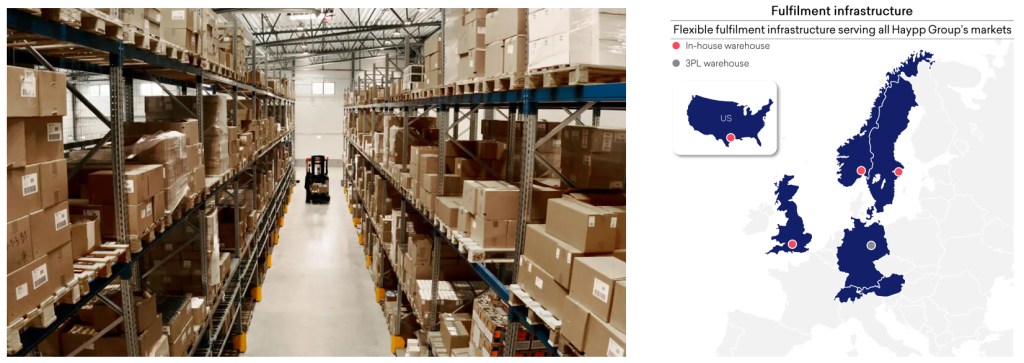
And, then of course, the third one: Convenience. I often joke that when you buy this product online, it’s not like buying a pair of shoes. A pair of shoes turns up a day late, you’ll be OK. If you’re nicotine pouch turns up a day late, you’ll be a little bit grouchy and you will remember that along the way. What people particularly want here is to know that when they have 10 pouches left in their can, it’s OK; their order of 20 cans is going to be with them soon enough and they still enough pouches left in that can. That’s why we actually get most of our orders in the hands of the consumer in under 24 hours.
We are rapidly growing in every market. Sweden is at the highest extent of 30% [share of the overall market]. In Norway, where we became present a number of years later, we’re now at 20%. We can see, in the likes of the UK, we’re closing in on 10% and we’re there only for a few years. In the US, we’re starting to build up our share as well. Consumers, what they really want is a good value offer: good price, well curated assortment, and convenience. The fourth one: Search. Let me talk about it later.
Tobacco Insider: Well, that is one part of the question. The second part of the question is: there is a common perception among people that it’s very easy to set up online stores and sell products online. What are the sustainable advantages of Haypp Group in terms of maintaining is its global leadership in the online retail of nicotine products?
Gavin O’Dowd: So, why do we win within e-commerce? I think there’s a few factors here which have given us a great head start in the form of first mover advantage. I’ve been in the industry for 16 years now and I was in the smoke-free category for a number of years before I joined here 7 1/2 years ago. We did have a good head start coming in and we got out at the very early days of nicotine pouches. We have prioritised scale knowing that as we get more scale, we can share those benefits with our consumers across multiple fronts and this cycle continues because of our size. Just to contextualize our size, not only are we the largest retailer of nicotine pouches in the world, either online or offline, we are 14 times larger than the second largest online player.
We have huge benefits of scale and that scale enables us to provide really good offers to the consumer. what we often see is that – because of the nature of our account – online is always much better at generating trial than offline. We often have double the share, in some cases three times the share. So if, for example, you take a market where we have 10% share, you will often find that we have 25% to 30% share in the trial of new products within that market. For that reason, many manufacturers often wish to promote their products on our platform and as they promote the products more extensively, that’s really good for the consumer because they get better pricing. But it’s also quite good for the manufacturer because it generates more awareness and more trial. That’s why we’re the preferred retailer for the brand owners in a digital universe.
You generally cannot advertise in the nicotine space and particularly digitally on the likes of Google, Facebook, etc. which have anti-nicotine [advertising] restrictions. What we have perfected over the years are our organic search rankings – so that when somebody types in anything around the category, our stores will be #1 in all markets and that tends to get the bulk of the traffic. This also explains why we have so big a share of the channel and there are hundreds of competitors that come and go on every given day. Even if they have their licences and their permits on a reasonably good website, if they don’t dominate the organic search channels like Google, then they cannot get the traffic. That’s why we tend to take the vast majority of the traffic in every market because this is where our core competency and the benefits of scale comes in.
Scale also enables us to build up our infrastructure to offer convenience, to offer an extensive assortment and to invest greatly in compliance. It is also important to note that compliance is generally not a variable cost. It’s a fixed cost because if you build the right infrastructure to be able to run the right processes on the right AI to be able to ensure the compliance, the actual incremental cost of each individual transaction – since they are digital transactions – are somewhere between nominal and 0 and decreases towards 0, as time goes by. So, the benefits of scale enables us to be able to keep all of our three stakeholders happy: consumers with great offers, suppliers both around the offerings and media insights, regulators when it comes to age verification, in particular, but also the other aspects of compliance in the space we operate – say, for the retailing of nicotine products.
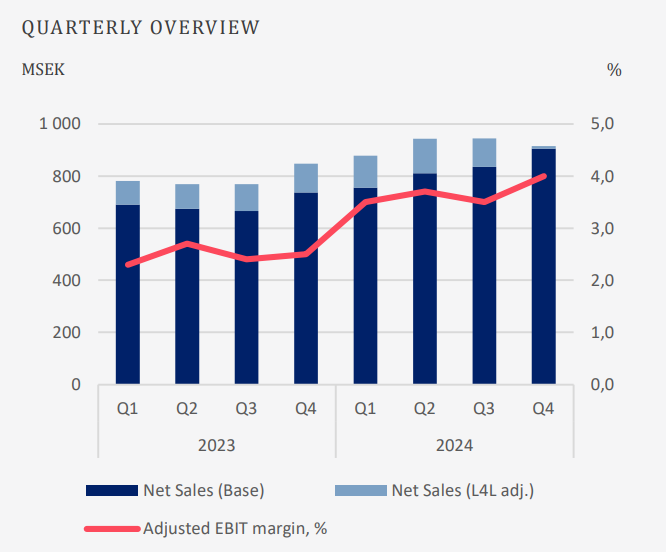
Tobacco Insider: Thank you very much, Gavin, for the explanations around the business model. The next thing on our mind is probably something every retailer on Earth has been questioned on: profitability versus growth. Haypp is on a very impressive trajectory of growth. The topline is growing around 20% per annum, but the operating margins are still very tight. Is Haypp overly prioritising growth over profitability? If so, is this the right strategy for both the category and Haypp at this stage?
Gavin O’Dowd: Well, we were loss-making when I arrived. The business moved into profitability about six weeks after I took it over. We were in the [highly profitable] nicotine industry, so we shouldn’t be losing money. The concept of losing money should be kept for the industries such as airlines. We are comfortable with the return we get on our money.
Maybe, there’s a part of our operating model which is not that well understood and which is quite key for why we have been able to maintain profitability and rapid growth over the past 7 to 8 years. I think everyone recognises that we are an e-commerce player and that we buy products from the brand owners and sell them directly to the consumers. What people don’t often recognise is that we also offer some significant services to the brand owners and we are also the largest provider of Media & Insights (M&I) to the industry at a global level in this space.
Let me start with explaining the Insights piece and provide a bit of detail. I spent nine years in BAT, including a couple of years as the General Manager for Sweden and Norway. I never had a concern to pay for good consumer research and good market insights. But my bugbear was always the quality of what I was getting back from agencies. When we stepped across into here [Haypp], I recognised that there was a great opportunity because of the level of data we have. We have about a million consumers a month coming to us across a multitude of markets. And those consumers create thousands and thousands of data points that we anonymise, right,? On the back of this, we have built up a piece called Haypp Lab, which is our Insights group. It’s quite a small team of about 15 people between data engineers, visualisation experts, data scientists on one side and pure research on the other side.
We break this down into what we call the quantitative research and the qualitative research. So, if I give a little bit of an explanation on the quantitative research, we put a front end on our data and we sell a licence per brand owner per market and then the brand owners can go in and take a look themselves in any given day based on either their own consumer segmentation keys or on ours. They can see which consumers are aware of their product, which consumers have considered it, which consumers have tried it, which consumers still have it in their portfolio, which consumers are loyal. And when consumers leave their product, they can see which products they have gone to. And this creates a huge level of granularity, which I could never get when I was in the analogue universe or the physical retail universe.
Quantitative research also feeds into the qualitative part. Why have the consumers behaved like that? For example, why consumers are leaving your brand A to go to competitor brand B? We can see this in three clicks; we can find a couple of thousand people who have behaved like that in recent weeks and we can start to run qualitative research across them. Was it because of the brand expression? Was it because of the flavour? Was it because of the nicotine strength? And then, you drill down even further; if it was flavour, was it the aroma? Was it that the flavour didn’t correspond to the flavour description? Was it that the flavour was too bitter? Did the flavour not last long enough? Did the flavour not start fast enough? And then we can really dig down and often work along with the brand owners to do prototype products of a couple of thousand cans each. We test those products out with those consumers again to see which products would have actually gotten them back to the brand or stop them from leaving the brand in the first place.
This is quite a significant part of our business that we started in 2020. It also started to become quite big in the business development space where our data was used for pretty much every M&A transaction that has occurred in the last four or five years in the industry. More recently, it moved into the regulatory space too – where we provide a lot of insights on: Who is actually using the product and how is their nicotine history? For example, in the US, 92% of our consumers are previously consumers of more harmful tobacco products. Was it the case that they started smoking at 19 with Pall Mall? Then, they moved to Marlboro at 25 and to Juul at 33 and to ZYN afterwards. Now they’re 35 and they haven’t touched a cigarette for the past 18 months. Because we track the nicotine history of our customers, we have all this data.
Data creates an incredible revenue stream for us and combined with our Media business, we can really send focused messages on our sites to consumers to create both awareness and trial for products. Together, M&I accounts for a high single digit share of our revenue and is highly profitable. So this creates an operating model which allows us to be very aggressive on our consumer offer while taking this side revenue to really support the business and support the offer that comes through.
When it comes to the balance between growth and profitability, once we get to a reasonable scale in a market, we start to realise a degree of profitability. In Sweden and Norway where we have been for a number of years, we are operating with high single digit, 8%-9% EBITDA margins. Much of these proceeds, we then invest in getting up to a critical mass in other markets. Now that markets like the UK and German-speaking Europe have moved into profitability as well, we are now heavily fuelling our efforts in the US market. The potential sits there and hence we believe this is the right thing to do. Our investors keep saying the same to us as well: don’t return the money in the form of dividend because the returns that we’ve been generating over the last six or seven years are so high, they are much happier with us investing it in further expansion.
However, I equally balanced that with my earlier statement of we’re in the nicotine industry. So we don’t expect to be loss-making as a company. We always expect to be self-financing. We are at that crossroads – that you described at the beginning – of the mega trends of risk reduction and of digital (online) sales.
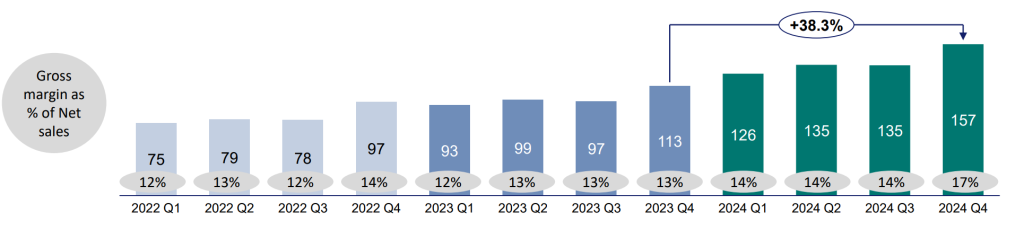
Tobacco Insider: Maybe I ask the same question a bit differently. Nicotine pouches are very profitable in the absence of excise taxes. Their retail price-to-cost [of manufacturing] ratio is even better than Louis Vuitton bags. This level of price-to-cost doesn’t exist elsewhere. The money is distributed among the retailers, distributors (wholesalers) and manufacturers. The essence of the question is: when there is such a profitable product and while Haypp is doing its fair share for heavy work – that you have described so far, is Haypp getting its fair share of profits? There is improvement in gross margins: from 13% to 17% in the fourth quarter. But, it still sounds low for a product that’s very profitable. Looking forward, to what extent can margins be improved and what would be the main levers of the improvement?
Gavin O’Dowd: I think the principle that we run on this is what we often refer to as the scale economies shared – that many benefit from our size, our infrastructure and our operating model. We share the benefits with our consumers and, to some degree, with our suppliers as well. We like to be in a position where everybody is benefiting; this strengthens our overall share in the market and builds our size of the pie. We are in the knowledge that over time, should we wish to release some of that down towards the bottom line, that will always be there for us.
If I was to give a couple of examples of this, perhaps first I will start off with the consumer. What you can see is that in our Core Markets segment, we’re operating with around a 20% discount versus brick & mortar retail. That is more than enough, not just to continue to maintain our consumers but to actually grow faster than the market. We continue to take share in those markets. However, if you look at our Growth Markets segment, which includes the US and the UK, we tend to operate with about a 40% discount to what you can get in brick & mortar. Now, we don’t need a 40% gap to get customers or to keep them. 20% would be more than enough. But what that 40% does is, it accelerates the migration from offline to online and it strengthens our position. It gets us faster to the scale benefits which we can utilise in the future. We know that, in many of these markets, reduced-risk products and nicotine pouches in particular are very much at their infancy. We can afford a degree of longer term vision before we start extracting extra profits.
Then, if I flip around the other side, because – I think the question from you is – if we get a fair share in terms from our suppliers; yes, I think we generally get quite good terms, which is a side effect of our size. We sold about $350 million worth of products last year. So that gives us a reasonable degree in negotiating terms. But, we are also very proud that all our suppliers say that we are the most profitable account on unit basis. And there’s a couple of reasons for that. First, they never get returns from us. You know, we turn our stock over every 14-15 days – or, maybe 21 days given the mix of markets. Hence they never get to a situation to have to take products back because – you know – they’re changing the brand essence or products have expired. Second, there’s no field force or any point-of-sale materials. There’s no need to go back and check whether the media is done in line with what they expected from us. They just open their phone and see what we have done. There’s a full digital audit kept there. Third, for every country, there’s one single point of delivery. So it’s not a case of filling little vans that go to little stores. What we get is 40-foot trucks that turn up at our warehouses. They’re offloaded with forklifts in 15 minutes. So, when you put all these together, we are very happy with being the most profitable account for the brand owners across the markets… because it means that whenever we want something done or we pick up the phone and ask for a favour, our phone calls get answered.

Tobacco Insider: One additional question on this before we move on to the next topic. Obviously to the extent you can answer, are there significant variations across the markets or brand owners in terms of gross margins? Then, the famous question is the one around ZYN; how does ZYN supply, or the absence of it, affect the overall margins?
Gavin O’Dowd: In general, when it comes to pure product margin, there’s not a huge gap across them. But then of course, when somebody is bringing a lot of new products to the market and they want to buy more of our media, then – if you group that together – they will have disproportionately more media relative to their sales. So, in total, they’re becoming a more profitable account on percentage terms.
About the ZYN shortage, which has been occurring in the latter part of 2024: in that sort of supply and demand imbalance, which was quite extreme, I can understand – but I am not saying I agree with – that a brand owner would chose to prioritise national key accounts of brick & mortar, where they had paid substantial amounts of money to get listings in, and the dealer stores, which carry a multitude of categories. If you’re not careful with how you work with these guys, your product may not be there in a couple of years. Some ZYN products came back into stock from the beginning of 2025 in the US, but then we blocked all sales in the US when the marketing granted orders came out.
Let me explain it a bit more. Marketing granted orders are fantastic news for the category. Obviously, first in itself, but also for online because it laid out very clear regulations on what you need to do as an online player to operate in the US. We were delighted to know that we had always been stating as the standard for age verification is what has now been incorporated by the FDA – you know, the national database structure. What it has also said is that you need to verify the consumer before they see the product in the US; you can bring them to your site and you can tell them about Haypp. You can’t necessarily show them a product until you’ve guaranteed that they’re over 21. So what we can do easily is to bring our current age verification, which is at the checkout, forward to an earlier stage. Yes, there will be a degree of inconvenience for some customers; but, we have that ready to go. However, in order for me to press that button, I would need confirmation that I have a sufficient ongoing supply of ZYN confirmed in what is a somewhat turbulent market. And, as of today, I don’t have that confirmation, but I envisage that all will be resolved in the not too distant future.
Link to Haypp Group: Interview – Part II

Chief Executive Officer (CEO), Haypp Group: Gavin O’Dowd
Also the 8th largest shareholder of Haypp Group with a 3.4% stake. At Haypp Group since September 2017. A chartered management accountant who trained in Accenture and PwC. Gavin spent 11 years in the nicotine industry, at BAT, in several key leadership roles, including Group Corporate Finance, CFO Iberian and General Manager for Sweden and Norway.
Company Profile: Haypp Group
Based in Stockholm, Sweden, Haypp Group is the world’s largest online retailer for smoke-free nicotine products. Present in seven countries with eleven e-commerce sites, Haypp Group had over 1 million active consumers in 2024. The Group’s e-commerce sites include haypp.com (and variants haypp.com/uk, haypp.com/de, haypp.com/se), nicokick.com, snus.com, snushjem.no, snusbolaget.se, snusmarkt.ch, northerner.com, snuslageret.no, snusnetto.com, nettotobak.com and vapeglobe.de.
Link to: Haypp Group Reports & Presentations

