


October 2026: U.S. Cigarette Market Holds at $50.8 Billion as Price Increases Counter Volume Drops
According to Circana data for the 52-week period ending August 9, 2026, total cigarette dollar sales in the U.S. convenience store channel remained flat year-over-year at $50.8 billion. A 5.0% contraction in unit sales volume down to 4.96 billion units was fully neutralized by a 5.3% increase in average price per unit, which reached $10.24.
| Product | Dollar Sales | 1-Year % Change | Unit Sales | 1-Year % Change | Unit Price | 1-Year % Change |
|---|---|---|---|---|---|---|
| Cigarettes | $50.8 B | 0.00% | 4.96B | -5.0% | $10.24 | 5.3% |
Price and volume dynamics differ significantly across product tiers. Premium cigarettes sustained the highest price increases and steepest volume declines, whereas discount and fourth-tier brands demonstrated greater volume resilience. Heightened inflation and elevated fuel costs have spurred widespread downtrading, as budget-conscious consumers migrate to lower-tier offerings to manage household spending without leaving the tobacco space entirely.
Simultaneously, changing consumer behavior is expanding demand beyond traditional combustibles. An increasing prevalence of poly-use – where consumers utilize multiple product formats – alongside a growing preference for lower-risk options is spilling market share into alternative categories. Cigarettes still generate the lion’s share of convenience store revenue, but category momentum is shifting: while traditional smokeless and vaping product sales are under pressure, modern oral nicotine has become the fastest-growing segment.
August 2026: U.S. Tobacco Prices Rise 6.7% Over Past 12 Months
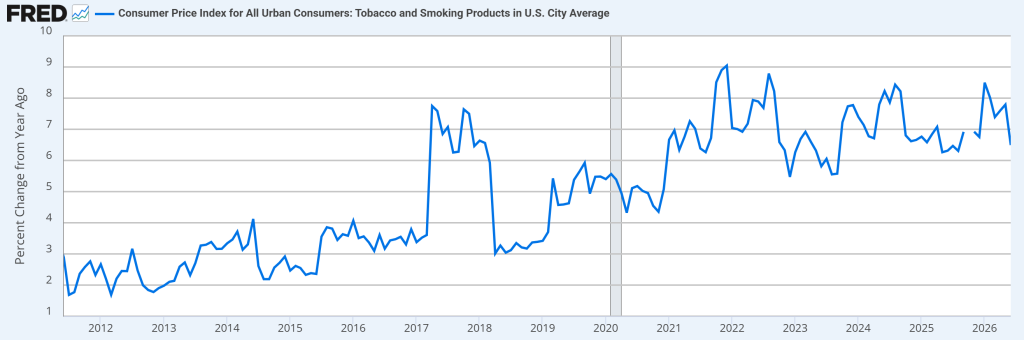
The price index for tobacco and smoking products increased 6.7% in the 12 months through July 2026, doubling the 3.4% rise in the overall Consumer Price Index (CPI). On a monthly basis, tobacco prices rose 0.5% in July 2026, while the overall CPI increased 0.1% on a seasonally adjusted basis.
Although tobacco price growth continues to outpace overall inflation, the annual rate has moderated. Following a 0.7% decline in June 2026, the latest 6.7% figure sits well below the 8.5% rate recorded in January 2026 and the peak of 9.1% reached in December 2021.
August 2026: U.S. Cigarette Market Maintains Flat Turnover as Price Increases Offset Volume Declines
The U.S. cigarette market is undergoing a notable structural transition driven by rising prices, broader economic pressures, and shifting consumer preferences toward non-combustible alternatives. According to Circana data for the 52-week period ending June 14, total cigarette dollar sales in the c-store channel held steady at $50.8 billion. A 5.3% contraction in unit sales volume was neutralized by a 5.6% increase in the average price per unit (to $10.2), keeping overall retail turnover flat year-over-year.
| Product | Dollar Sales: Current | Dollar Sales: 1-Yr % Change | Unit Sales: Current | Unit Sales: 1-Yr % Change | Price Per Unit: Current | Price Per Unit: 1-Yr % Change |
| Cigarettes | $50.8 B | 0.0% | 4.99 B | -5.3% | $10.18 | 5.6% |
Price and volume dynamics differ significantly across product tiers. While premium cigarettes saw the largest price increases and experienced the steepest volume declines, discount and fourth-tier cigarettes demonstrated far more resilient volume trends. Heightened inflation and elevated fuel costs have spurred widespread “downtrading,” with price-conscious consumers migrating to lower-tier offerings to manage budgets without leaving the tobacco space entirely.
Simultaneously, changing consumer behavior is expanding demand beyond traditional combustible cigarettes. An increasing prevalence of “poly-use” – where consumers utilize multiple tobacco product formats – alongside a growing preference for lower-risk options is spilling market share into alternative categories. While cigarettes remain the single largest dollar driver in the c-store space, traditional smokeless and vape products face headwinds, whereas modern oral nicotine offerings, particularly nicotine pouches, have emerged as the fastest-growing segment in the tobacco space.
June 2026: U.S. Tobacco Prices Rose 7.8% Over Past 12 Months
The price index for tobacco and smoking products increased 7.8% in the 12 months to May 2026, compared with a 4.2% rise in the overall Consumer Price Index (CPI) over the same period. On a monthly basis, tobacco prices rose 1.0% in May 2026, versus a 0.6% increase in the overall CPI.
Tobacco price inflation continues to outpace overall inflation and remains elevated by recent historical standards. While the latest annual rate of 7.8% is below the 8.5% recorded in January 2026, it remains close to the peak of 9.1% reached in December 2021.

May 2026: U.S. Tobacco Prices Rose 7.6% Over the Past 12 Months
The price index for tobacco and smoking products increased 7.6% in the 12 months to April 2026, compared with a 3.8% rise in the overall Consumer Price Index (CPI) over the same period. On a monthly basis, tobacco prices rose 0.5% in April 2026, versus a 0.9% increase in the overall CPI. In the previous two months, tobacco prices had risen by only 0.1% each month.
Tobacco price inflation therefore continues to outpace general inflation significantly and remains elevated by historical standards. Although the latest annual rate of 7.6% is almost 1pp below the 8.5% recorded in January 2026, it remains close to the multi-year peak of 9.1% reached in December 2021.
April 2026: Philip Morris USA Raises Cigarette Prices Across Key Brands
Philip Morris USA, an Altria Group subsidiary, has implemented another round of price increases across its cigarette portfolio, continuing a long-standing strategy of offsetting declining shipment volumes through pricing gains. Recent industry reports indicate a 25-cent per pack increase on Benson & Hedges, Merit, Parliament, and Virginia Slims, alongside a 20- to 25-cent per pack hike on Marlboro and a 20-cent increase on L&M cigarettes. L&M continues to serve as a lower-priced tier within the portfolio.
The adjustments come amid sustained structural contraction in the U.S. cigarette market, where declining smoking rates and consumer down-trading have driven persistent volume declines. In this environment, manufacturers have increasingly relied on pricing power to support revenue performance despite falling shipments. Overall, the latest round of increases reflects a broader industry pattern in which incremental price adjustments help partially offset volume erosion in a mature but still highly cash-generative category.
April 2026: U.S. Tobacco Prices Rose 7.4% Over the Past 12 Months
The price index for tobacco and smoking products increased 7.4% in the 12 months to March 2026, compared with a 3.3% rise in the overall Consumer Price Index (CPI) over the same period. In contrast, March 2026 saw only a modest 0.1% monthly increase in tobacco prices, versus a 1.0% rise in all items.
Tobacco price inflation therefore continues to significantly outpace general inflation and remains elevated by historical standards. Although the latest annual rate (7.4%) is over 1 percentage point below January 2026 (8.5%), it is still close to the multi-year peak of 9.1% recorded in December 2021.
March 2026: U.S. Tobacco Prices Rose 8% Over the Past 12 Months
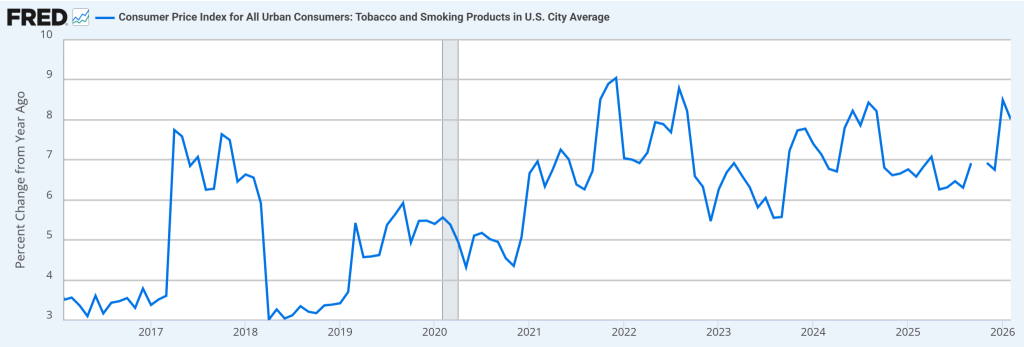
The price index for tobacco and smoking products increased 8% in the 12 months to February 2026, despite a minimal 0.1% rise in Feburary 2026. Over the same period, the Consumer Price Index (CPI) increased 2.4%. Price increases for tobacco products therefore continue to significantly outpace general inflation and remain elevated by historical standards. Although the latest annual rate (8%) is 0.5 percentage points below the January 2026 figure (8.5%), it remains close to the multi-year high of 9.1% recorded in December 2021.
March 2026: OTP Gains Ground as Cigarette Profit Gap Narrows in Convenience Stores
The convenience industry has become accustomed to a familiar pattern over the past decade (with the notable exception of 2020): cigarette sales are declining, while other tobacco products (OTP) continue to gain ground. Over the last ten years, cigarettes’ share of inside sales at convenience stores has fallen sharply – from 30.9% in 2015 to 18.8% in 2024. During the same period, OTP’s share has increased by more than three percentage points, rising from 4.2% to 7.6%.
The steady decline in cigarette sales reflects a combination of structural pressures, including higher state excise taxes, declining smoking prevalence, smoking restrictions, and broader regulatory constraints. By contrast, OTP growth has been fueled by several factors. Poly-use among adult nicotine consumers – who use both cigarettes and alternative tobacco products – has supported demand, while continuous product innovation, particularly in modern oral nicotine, has expanded the category’s appeal. These dynamics have reinforced convenience stores’ role as the primary retail channel for OTP consumers.
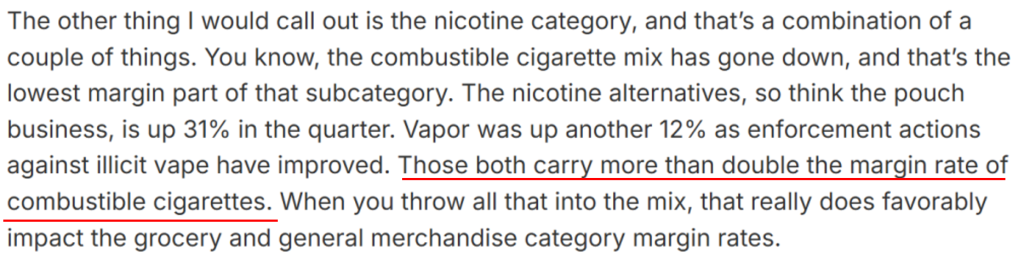
Although a significant sales gap remains between cigarettes and OTP, the difference in profitability has been narrowing. In 2024, cigarettes generated an average of $6,389 in monthly gross profit per store, compared with $5,801 for OTP. By mid-2025, that gap had tightened further, with cigarettes generating $5,664 in monthly gross profit versus $5,328 for OTP. The primary driver of this convergence is margin. OTP products deliver significantly higher profitability, with average margins reaching 29.5% in 2024, more than double the 13.76% average margin recorded for cigarettes. As a result, even as cigarette volumes decline, OTP is rapidly closing the profitability gap in the convenience channel1.
As a reference, during the Q3 2026 Earnings Call (March 2026), Casey’s General Stores CEO underlined that vapes and nicotine pouches carry more than double the margin rate of combustible cigarettes. Moreover, nicotine pouch and vape sales are up +31% and +12% in the quarter, respectively, while the combustible cigarette sales are lower. Casey’s operates c.2,900 convenience stores in 19 states.
February 2026: Tobacco prices increased 8.5% in the U.S. over the past 12 months
Tobacco and smoking products price index increased 8.5% in the 12 months to January 2026, including a whopping 2.1% increase in January 2026 alone. The Consumer Price Index (CPI) increased 2.4% in the same period. Price hikes in smokes continue significantly exceed the general inflation level and remain at elevated levels in historic terms; the latest annual inflation rate (8.5%) is 1.7pp above the December 2025 figure (6.8%) and within the vicinity of the December 2021 high of 9.1%.

December 2025: Tobacco prices increased 6.9% in the U.S. over the past 12 months
Tobacco and smoking products price index increased 6.9% in the 12 months to November 2025. The Consumer Price Index (CPI) increased 2.7% in the same period. Price hikes in smokes continue significantly exceed the general inflation level and remain at elevated levels in historic terms; the latest annual inflation rate (6.9%) is above the 6.0%-6.5% range reported in mid-2025, but well below the December 2021 high of 9.1%.
August 2025: Tobacco prices increased 0.3% in the U.S. in July 2025
Tobacco and smoking products price index increased 0.3% in July 2025 and 6.5% over the last 12 months. The Consumer Price Index (CPI) increased 0.2% in July and 2.7% over the last 12 months. Price hikes in smokes continue significantly exceed the general inflation level and remain at elevated levels in historic terms; the annual inflation rate (6.5%) in July 2025 is 0.2pp above the June 2025 figures (6.3%), but well below the December 2021 high of 9.05%.
Last 10 year average: CPI – tobacco & smoking products: 5.8% p.a.; CPI – all items: 3.1% p.a.
Last 20 year average: CPI – tobacco & smoking products: 6.1% p.a.; CPI – all items: 2.5% p.a.
August 2025: Fourth-tier cigarette sales continue to grow in the U.S.
The cigarette market in the U.S. is commonly segmented into four tiers, primarily based on price, marketing support, and the nature of the manufacturers: Premium, Value (branded savings) and Discount are the first three tiers. These cigarettes are mostly produced by 4 major tobacco companies: Philip Morris USA (Altria), Reynolds American (BAT), ITG Brands (Imperial Tobacco) and Japan Tobacco. Fourth-tier cigarettes are the lowest-price cigarettes in the U.S. with minimal marketing & distribution support and produced by smaller, regional manufacturers. Sold at the lowest retail price possible, lower-cost ingredients, like higher tobacco stem content, are typically used in fourth-tier cigarettes.
As increasing cigarette prices continue to put pressure on consumer spending budget, many smokers downtrade to fourth-tier cigarettes, where they feel they can get more value for their money. According to the NACS State of the Industry Report, fourth-tier cigarettes account 4.2% of cigarette sales in 2024, up 0.5pp from 3.7% in 2023. By comparison, premium cigarettes (led by Marlboro) declined from 78.9% to 78.4% of overall category sales during the same time period. Fourth-tier cigarettes also contributed some of the highest gross profit margin to cigarette sales at 21.6% in 2024, compared to 12.9% for premium brands. Despite yearly incremental declines, cigarettes are still the top in-store merchandise contributor to convenience stores, bringing in an average of $46,437 per store per month.
July 2025: Tobacco prices increased 0.5% in the U.S. in June 2025
Tobacco and smoking products price index increased 0.5% in June 2025 and 6.3% over the last 12 months. The Consumer Price Index (CPI) increased 0.3% in June and 2.7% over the last 12 months. Although the price hikes in smokes continue significantly exceed the general inflation level and remain at elevated levels in historic terms, the annual inflation rate (6.3%) in June 2025 is well below the December 2021 high of 9.05%.

June 2025: Cigarette imports to the U.S. is on the rise
U.S. International Trade Commission data show that cigarette imports to the U.S. jumped more than 23% to 8.4 billion sticks (420 million packs) in 2024. The growth is driven by a 2015 law change that allows international tobacco firms to get a refund, called a drawback, of the $1.01 a pack federal excise tax, when they import cigarettes into the U.S. as long as they export the same amount. Exported cigarettes are exempt from the federal tax. Consequently, exports from the U.S. rose nearly as much in 2024 to match the imports so that the drawback is triggered to the full extent.

British American Tobacco’s R.J. Reynolds, Japan Tobacco, Imperial Brands and a number of small companies (operating in the discount segment) are taking benefit of the federal tax refunds. Consumers can now easily spot Mexican-made packs of Pall Mall, Camel and Lucky Strikes in the U.S. market. With no international presence, Altria cannot benefit from the refund: in 2024, Altria paid $3.5 billion in federal taxes for the roughly 3.5 billion packs it shipped from the Philip Morris USA Manufacturing Center on Interstate 95 in South Richmond. Altria projects that imports are on track to jump by more than 70% in 2025.
Joint Committee on Taxation estimates that the double drawback on cigarettes could cost the federal government more than $12 billion over the next decade, prompting the House of Representatives to propose ending the program. Altria supports the move while R.J. Reynolds opposes it.
June 2025: Tobacco prices increased 0.8% in the U.S. in May 2025
Tobacco and smoking products price index increased 0.8% in May 2025 and 6.3% over the last 12 months. The Consumer Price Index (CPI) increased 0.1% in May and 2.4% over the last 12 months. Although the price hikes in smokes continue significantly exceed the general inflation level in May 2025, annual inflation rate slowed down from 7.1% to 6.3% due to the baseline impact.
May 2025: Cigarette sales volume declined -9.1% in the U.S. over the past 12 months
In the U.S. multi-outlet and c-store channel, cigarette volume declined -9.1% to 5.31 billion packs in the 52 weeks ending April 20, 2025 (Circana data). Raising cigarette prices and consumer shift to new nicotine products (i.e. disposable vapes and nicotine pouches) continue to put pressure on the cigarette category. The decline is especially steep in the premium segment (i.e. Marlboro, Newport, Camel and others); discount segment holds up relatively better on the back of consumer downtrading (i.e. switch to lower priced brands). A pack of 20 cigarettes now costs $9.54 on average; or, +5.4% more than a year ago. In terms of dollar sales, the cigarette category grossed $50.6 billion in this period; or, -4.2% less than a year ago. Multi-outlet and c-store channel represents roughly three quarters of the total cigarette sales in the U.S. The rest is sold in the independents and speciality stores.

May 2025: Tobacco prices increased 0.3% in the U.S. in April 2025
Tobacco and smoking products price index increased 0.3% in April 2025 and 7.1% over the last 12 months. The Consumer Price Index (CPI) increased 0.2% in April and 2.3% over the last 12 months. Inflation in smokes continue significantly exceed the general inflation level.
March 2025: Inflation is running hot for tobacco products in the USA
According to the February 2025 CPI report, prices for tobacco products raised 6.6% year-on-year basis and 0.6% sequentially (versus the previous month). A pack of cigarettes (for a mainstream brand) now costs $10.25 on average, or $9.75 based on a volume-weighted average. For cigarette prices across the USA: USA: Cigarette Prices.
February 2025: Marlboro solidifies its leadership in premium American smokes
Marlboro remains as the best-selling, premium cigarette brand in the US. In 2024, Altria’s Marlboro held 59.3% share in the US premium cigarette category – ahead of the second-placed Newport (with 15.5% share) and third-placed Camel (with 9.7% share). Both brands are owned by Reynolds American, the US affliate of British American Tobacco. Moreover, Marlboro’s category share improved by +2.3pp in the last five years whereas the category shares of Newport and Camel declined by -1.6pp and -1.5pp, respectively.
Three premium brands owned by ITG Brands, the US affliate of Imperial Brands, Winston, Kool and Salem, collectively, owned 6.6% share in the US premium cigarette category with no gain or loss in the last five years. Reynolds American’s third premium brand, Natural American Spirit, is the only other gainer with its category share reaching 4.7% in 2024 (up +0.9pp in the last five years).

February 2025: Marlboro Black offers a cheaper alternative to the smokers
As Marlboro gets even more pricier in the USA, Malboro Black offers a cheaper “Marlboro” alternative to the smokers under discretionary budget contraints. The price gap between Marlboro and discount cigarettes reached a record high of 49% in the last quarter of 2024. However, the price gap between Marlboro Black, the lowest-priced member of the Marlboro family, and the leading discount brand is a more reasonable 20%. Moreover, Marlboro-owner, Altria selectively reduces the Malboro Black’s retail selling price in certain states and certain stores to further improve the affordability. For instance, in Missouri, a state with sizeable deep discount segment and a large number of price-sentitive consumers, the price gap between Marlboro Black and the the leading discount brand is as low as 5% in some stores.

Smokers usually find Marlboro Black to have a slightly milder (smoother) taste with less intensity compared to Marlboro Red. Marlboro Black also has Gold and Green (menthol) variants. Similarly, Black Gold is claimed to have a slightly sweet and milder profile with strong hints of vanilla and Turkish tobacco on the nose. Consumers predominantly think that Malboro Black presents them a cheaper alternative without much of a compromise from the Marlboro quality.
February 2025: JT expects the cheap cigarettes to continue to take market share in the USA
Japan Tobacco (JT) expects the share of the discount segment in the US cigarette market to reach more than 40% by 2027 as US smokers continue to trade down from premium brands like Marlboro and Newport2. JT, maker of (low-priced) LD cigarettes, acquired Vector Group, maker of (low-priced) Montego cigarettes, in 2024 and now holds 40% share in the deep discount category.
JT projects the value (branded discount) and deep discount segment to account for 42% of the market by 2027, up from around 32% in 2022 – in line with the trend observed in other markets where large price gaps beween the premium and dicount brands emerge. Meanhile, Altria, maker of Marlboro cigarettes, estimates the discount segment’s share at 30% in 2024 and expects the downtranding trend to ease as the macroeconomic conditions ameliorate.
JT and Altria compete in the fast-declining US cigarette market, but partner in the yet-to-be-established US heated tobacco market. In October 2022, Altria and JT announced a global partnership in smoke-free products and set up a joint-venture for the commercialization of heated tobacco products in th US.
February 2025: BAT offers more affordable Newport cigarettes
Newport is the second largest brand in the US cigarette market, after Marlboro, and is the largest menthol brand in the market. BAT’s US subsidary, Reynolds American, introduced the Newport Soft Pack at a lower price point than Newport Box to reach more price-sentitive smokers in the US. The product is available in key investment states, with a higher proportion of menthol smokers and lower-income demographic, and allows tiered-pricing in Newport portfolio. Newport Soft Pack typically retails at a US$1 discount to Newport Box.

Newport Soft Pack reached 3.5% market share in December 2024, up from 0.5% in July 2022. Moreover, soft pack launch helped improve Newport’s volume share in the premium segment from 24.0% to 25.6% in the same period (- yet the premium segment weight in the overall market is down -4pp). However, considering the minimal increase in Newport’s overal volume share (+0.15%), it seems like 95% of new Newport Soft Pack smokers are existing Newport Box smokers (i.e. massive amount of cannibalization by a lower-margin product).
It is also important to note that some smokers notice a taste difference between Newport cigarettes in Soft Pack and Box. The perceived difference is most commonly attributed to:
– Packaging Material: The Soft Pack, made from a different type of material than the Box, might be less effective in retaining the moisture, flavor and freshness of the cigarettes.
– Storage: Soft Packs are less rigid and might be more susceptible to environmental factors, like humidity and temperature changes, possibly influencing the cigarette’s taste over time.
– Personal Bias: Personal expectations and psychological factors could also play a role in perceiving a taste difference between different packaging types.
January 2025: Kretek International launches a new nicotine-free, non-tobacco menthol smokes
Kretek International launched a new nicotine-free, tobacco-free Splash menthol-filtered smokes at the end of 2024. Designed as an excise-tax-free, legal alternative in restricted markets, Kretek will assess the consumer demand in California and Massachusetts in the first six months of 2025.
Splash menthol smokes are be available in 20-pack king-sized flip-top boxes. Crafted to deliver a familiar menthol smoking experience, Splash Classic and Splash Smooth features a unique botanical blend that balances smoothness and satisfaction, closely mirroring traditional menthol cigarettes. They are manufactured in Indonesia by PT Djarum, whose products Kretek has exclusively imported and distributed in the U.S. since 1983.
With the Splash launch, Kretek bets on the loyalty of menthol smokers to taste and claims that some of the usual smoking satisfaction come from menthol’s neuro-calming effect rather than nicotine alone. Kretek’s own consumer research prior to the launch of Splash and non-tobacco, nicotine-free Djarum cloves found that menthol flavored smokes (without nicotine) could make up 9% of cigarette category with about 20% of the respondents being pleased that nicotine was removed.


