


August 2026: Unauthorized Products Dominate U.S. E-Cigarette Retail Sales
According to a newly published study, as of December 2025, 69.4% of e-cigarette product sales (in US$ terms) in the U.S. convenience and grocery channels were estimated to be unauthorized (4,421 products in total). The study analyzed point-of-sale retail scanner data across tracked outlets to determine the market share of products that have received marketing granted orders from federal regulators compared to unauthorized products. Authorized e-cigarette products (146 products in total) accounted for only 30.6% of total dollar sales.
The vast majority of unauthorized products sold were disposable devices and non-tobacco flavors. Disposable e-cigarettes made up 97.6% of unauthorized sales within that product category, and 100% of non-tobacco and non-menthol flavored sales – such as fruit, sweet, or mint options – were unauthorized. In contrast, tobacco-flavored products had a high authorization compliance rate, representing 93.1% of tobacco-flavored dollar sales, while menthol-flavored sales were 26.1% authorized.
The findings indicate that disposable e-cigarettes in flavors appealing to young people continue to dominate brick-and-mortar retail sales despite existing regulatory requirements. The study highlights that limited publicly available information regarding legally marketed tobacco products creates compliance hurdles for retailers and complicates monitoring efforts, underscoring the need for more transparent reporting to support public health enforcement.
July 2026: States Step Up Illicit Vape Crackdown Through Federal Court Victories and Dedicated Units
States across the nation are escalating efforts to curb the sale of unauthorized e-cigarettes, combining state-level product registries with dedicated enforcement teams to clear retail shelves of illegal vapes. Recent rulings from federal appellate courts have further emboldened state officials by creating crucial legal precedents that safeguard local tobacco enforcement.
In a major endorsement of state-level tobacco regulation, federal appeals courts have repeatedly rejected legal challenges brought by vape manufacturers and trade groups against state directory laws.
Most recently, the U.S. Court of Appeals for the Fourth Circuit issued a 2-1 ruling upholding North Carolina’s Session Law 2024-31 (House Bill 900). The Court affirmed that the federal Family Smoking Prevention and Tobacco Control Act’s savings clause leaves states “free to prohibit the sale” of unapproved vape products within their borders. Under the law, manufacturers must certify that their products meet Food and Drug Administration (FDA) standards or qualify for limited exceptions to be included on the state’s official sales directory. Products missing from the registry cannot legally be sold in the state, and non-compliant retailers face state fines.
The Fourth Circuit ruling mirrors a landmark decision by the U.S. Court of Appeals for the Eighth Circuit, which unblocked Iowa’s e-cigarette registry law, House File 2677. Passed in 2024, Iowa’s statute similarly requires annual FDA-compliance certifications filed with the state Department of Revenue. A lower federal court had initially enjoined the law over federal preemption concerns, but the Eighth Circuit confirmed that federal tobacco statutes preserve state police powers to regulate local retail sales and penalize non-compliant manufacturers.
Together, these rulings from the Fourth and Eighth Circuits establish a solid federal judicial consensus, validating state-level directories and providing a legal blueprint for states seeking to police the e-cigarette marketplace. Hand in hand with directory laws, states are building dedicated enforcement mechanisms to ensure compliance on the ground. In Virginia, the Attorney General recently launched the Regulated Products Enforcement Unit, a specialized task force targeting illicit vapor products and unregulated intoxicants.
Operating under Virginia’s Vape Enforcement Act, the centralized unit oversees civil enforcement, retail compliance checks, directory administration, and public outreach. The team specifically targets illegal liquid nicotine vapes, synthetic THC, hemp-derived intoxicants, and products using deceptive packaging that appeals to minors. Under Virginia’s framework, non-compliant retailers and distributors face civil penalties of up to $1,000 per product per day for offering items not listed on the state directory. Enforcement is carried out in coordination with local Commonwealth’s Attorneys and the Virginia Alcoholic Beverage Control Authority.
These combined developments mark a pivotal shift in state-level tobacco control. As federal appellate courts consistently uphold state regulatory authority against preemption claims, states are aggressively deploying registries and task forces to reclaim control of retail shelves and dismantle the market for illicit, unapproved e-cigarettes.
July 2026: Fiserv, BP, and Major Service Station Operators Warn US Stores Over Illegal Vape Sales
Financial technology platform Fiserv, through its subsidiary CardConnect, and major service station operators including BP, Marathon Petroleum, and Valero have issued strict notices warning their U.S. store owners and retail partners to stop selling unauthorized or illegal e-cigarettes. Retailers face severe financial and operational risks if they process transactions for illicit vaping products. According to the internal notices, store owners risk losing their card-processing capabilities entirely or facing mid-six-figure fines for a single violation.
The move comes amidst a broad enforcement effort by a coalition of U.S. state and city law enforcement officials, including attorneys general from California, Illinois, and Arizona, alongside authorities in New York City and Washington, D.C. The coalition has been pressuring payment networks, shippers, and e-commerce platforms to choke off the illegal trade, following a recent vape ban by Shopify and increased merchant warnings from Mastercard1.
The illicit vape industry is a booming market, estimated to bring in nine billion dollars or more in annual sales. Although the U.S. Food and Drug Administration (FDA) has legally authorized only 45 specific vaping products to be marketed, unauthorized, illicit brands remain widely available in gas stations, convenience stores, and bodegas nationwide.
July 2026: Indiana Enacts Strict Ban on Illicit, Foreign-Sourced Vaping Products
A sweeping new law aimed at wiping out the sale of illicit, foreign-manufactured vaping products officially took effect across Indiana on July 1, marking a significant escalation in the state’s enforcement against unregulated electronic cigarettes. Senate Enrolled Act 185 targets the supply chain of unauthorized disposable vapes flooding the market. The legislation explicitly bans the manufacture, distribution, and sale of any e-liquid or vapor products containing ingredients sourced from defined “foreign adversaries” – a designation that includes China, Russia, North Korea, and Iran. The law passed with unanimous, bipartisan support in both chambers of the Indiana General Assembly during the 2026 legislative session before being signed by the Govenor.
For state lawmakers and public safety officials, the primary objective of SEA 185 is to sever the supply chain of unauthorized vaping devices originating from China. Over the last several years, federal agencies have repeatedly issued warnings regarding a deluge of cheap, disposable vapes entering the U.S. from overseas manufacturing hubs, which often bypass federal regulatory review. Advocates for the tighter restrictions have noted that many of the disposable devices imported into the U.S. utilize chemical formulations and flavorings that are restricted or banned within their own countries of origin. Beyond health and safety concerns, the legislation is framed as a measure to prevent revenue from being funneled to hostile nations through illicit trade networks.
Under the newly active law, the Indiana Alcohol and Tobacco Commission (ATC) is granted broader oversight to regulate both closed and open vapor systems. To enforce the ban at the source, the law overhauls the application and renewal processes for e-liquid manufacturing permits in Indiana. Manufacturers must now submit an official affirmation – under the penalties of perjury – stating they will not use any ingredients or e-liquids originating from a recognized foreign adversary.
Furthermore, the law tightens restrictions on the retail and wholesale sectors:
– Certification Requirements: Businesses are strictly prohibited from distributing or selling tobacco and electronic cigarette products without a valid sales certificate issued by the commission.
– Enhanced Penalties: The ATC now has the authority to suspend or revoke certificates for retailers who repeatedly fail compliance checks or identification audits.
As the state transitions into full enforcement in July 2026, local vape shops and convenience stores are required to clear their shelves of any non-compliant inventory. State officials have signaled that inspections will be ramping up to ensure compliance across all Indiana retail locations.
June 2026: Shopify to Ban Vape Sales as U.S. Crackdown on Illegal E-Cigarettes Expands
Shopify is set to prohibit the sale of all vape products on its e-commerce platform, following sustained pressure from a bipartisan coalition of 25 U.S. state attorneys general seeking to curb the online sale of illegal e-cigarettes. The move marks one of the most significant actions yet targeting the infrastructure that supports the illicit U.S. vape market, rather than focusing solely on manufacturers and retailers.
The ban is expected to apply to all vape products sold through Shopify in the United States, regardless of whether they have received U.S. FDA marketing authorization. While this could affect a small number of authorized manufacturers, the impact is expected to fall primarily on sellers of unauthorized disposable vapes, which rely heavily on e-commerce channels and account for a large share of the estimated US$9 billion illicit U.S. market.
The development comes amid broader efforts to disrupt the illegal vape supply chain. Separately, Mastercard has instructed its financial partners to strengthen oversight of merchants selling vape products and warned that facilitating unlawful vape sales could lead to investigations and penalties. Together, these measures signal increasing regulatory scrutiny not only of vape manufacturers and importers but also of the digital platforms and payment networks that enable online sales2.
May 2026: Operation Red Mist Targets Illegal Vape Imports
U.S. Customs and Border Protection (CBP), alongside the FDA and U.S. Coast Guard, announced a major enforcement action called “Operation Red Mist,” resulting in the seizure of more than 18 million illegal e-cigarettes valued at over $175 million. The operation focused primarily on maritime cargo shipments originating from China and aimed to disrupt the illicit importation and distribution of unauthorized vaping products.
Authorities said the seized products lacked FDA premarket authorization, making them illegal to market in the United States. Investigators also identified cases involving hazardous material misclassification, improper labeling, and efforts to evade taxes, duties, and regulatory oversight.
CBP stated that the operation is part of a broader federal crackdown on illicit vape products, with officials emphasizing concerns around public health, youth access, counterfeit imports, and broader criminal activity linked to noncompliant goods.
May 2026: Indiana Enacts Ban on Chinese-Made Vapes as “Origin-Based” Restrictions Spread Across U.S. States
Indiana has formally enacted legislation banning the sale of vaping products manufactured in China and other “foreign adversary” countries, marking a notable escalation in state-level efforts to curb illicit vape imports. The measure, ceremonially signed by the governor, prohibits the sale of vaping products produced in countries viewed as hostile to U.S. interests. The stated rationale is to protect consumers from potentially unsafe products and to address concerns around unregulated imports entering the market.
The law comes amid growing political and regulatory focus on the influx of low-cost disposable vapes – almost all of which are manufactured in China and are often alleged to bypass U.S. regulatory requirements. Policymakers argue these products raise both public health and enforcement challenges, particularly around youth access and product safety. Indiana’s move aligns with a broader emerging regulatory model in the United States that targets the origin of vape products, rather than just flavors or marketing practices.
Texas is often cited as the first state to implement a clear “origin ban,” specifically targeting Chinese-made disposable vapes while allowing domestically produced alternatives to remain on the market. Its 2025 law (SB 2024) bans the sale of vape products manufactured in China or other designated “foreign adversary” countries, alongside broader restrictions on certain vape categories.
This “origin-based” regulatory framework represents a shift from earlier U.S. state policies, which primarily focused on flavor bans or retail restrictions. Instead, states like Indiana and Texas are increasingly attempting to restrict supply chains directly – particularly those linked to Chinese manufacturing -reflecting concerns that illicit imports dominate a significant share of the U.S. vape market. Overall, Indiana’s law underscores a growing trend toward trade- and enforcement-driven vape regulation, with other states potentially considering similar measures as policymakers seek to address the persistent challenge of unauthorized disposable vape products.
April 2026: Multi-State Coalition Presses Payment Firms to Block Illegal Vape Sales
A coalition of U.S. attorneys general is urging major payment networks and fintech platforms to take stronger action against unlawful e-cigarette sales, reflecting escalating enforcement pressure on the vape supply chain. In letters sent to leading payment companies – including credit card providers and digital payment platforms – the coalition called for measures to prevent their systems from being used to process transactions for unauthorized vaping products. The focus is on curbing a large and persistent illicit market, where many products lack authorization from the U.S. Food and Drug Administration and are often sold online in violation of federal and state laws.
The attorneys general argue that payment processors are a critical chokepoint in the distribution chain. By cutting off financial services to non-compliant sellers, they believe illegal sales – particularly those targeting youth – can be more effectively reduced. The initiative builds on broader enforcement efforts, including litigation against distributors and increased regulatory scrutiny of online vape sales. The coalition includes a wide group of states and jurisdictions, highlighting the breadth of support for stricter enforcement. Participating states are: Arizona, California, Connecticut, Delaware, Hawaii, Illinois, Indiana, Maine, Maryland, Massachusetts, Michigan, Nevada, New Hampshire, New Jersey, New Mexico, North Carolina, Oregon, Pennsylvania, Rhode Island, Tennessee, Vermont, Washington, and Wisconsin, alongside Puerto Rico and the City of New York.
The effort signals a shift toward targeting the financial infrastructure underpinning illegal vape sales, complementing existing regulatory and legal actions aimed at restricting unauthorized products in the U.S. market.
April 2026: White House Push for Flavored Vapes Stalls Amid FDA Leadership Resistance
The U.S. administration is seeking to broaden access to flavored vaping products as part of a harm-reduction strategy aimed at adult smokers, but the effort has been slowed by internal resistance at the Food and Drug Administration (FDA). The situation highlights a growing policy divide between the White House and the FDA’s top leadership over how to balance smoking cessation goals with youth protection concerns3.
At the center of the dispute is FDA Commissioner Dr. Marty Makary, who has intervened to delay or block the authorization of several flavored e-cigarette products, including menthol and fruit varieties such as mango and blueberry. This is notable because FDA scientific reviewers had reportedly supported the authorization of some of these products, citing evidence that flavored options can help adult smokers transition away from combustible cigarettes more effectively than tobacco-flavored alternatives alone.
The White House position reflects a broader harm-reduction perspective. Officials are concerned that limiting legal flavored products may unintentionally strengthen the illicit market, where unauthorized flavored vapes – many reportedly imported from China – already dominate U.S. sales. From this standpoint, allowing regulated flavored products could provide adult consumers with safer, quality-controlled alternatives while also improving oversight of the category.
In contrast, FDA leadership remains cautious, emphasizing the agency’s mandate to protect public health at the population level. A central concern is that flavored products, while potentially beneficial for adult smokers, also carry a higher risk of attracting underage users. One example involves a U.S.-based vaping company that received authorization for its device but is still awaiting decisions on its flavored variants. Despite submitting data suggesting these products could support smoking cessation, the applications remain under extended review, reflecting the agency’s more conservative stance.
The result is a regulatory environment marked by uncertainty and limited visibility for market participants. While there is increasing recognition within parts of the government that flavored vaping products may play a role in reducing smoking rates, the lack of alignment between policymakers and regulators continues to delay clear and consistent pathways for product authorization.
April 2026: Coalition of Attorneys General Targets Payment Networks Over Illegal Vape Sales
A coalition of 13 state attorneys general has called on major payment processors and credit card networks to stop facilitating transactions for illegal vape products, arguing that financial channels are enabling widespread access to unauthorized products, particularly among youth. The group emphasized that illegal vapes – overwhelmingly manufactured in China – now dominate the U.S. market, accounting for more than 80% of total vape sales. U.S. vape market is estimated to generate over $11 billion in annual retail sales, underscoring both the scale of the issue and the challenge facing regulators.
The attorneys general highlighted the role of payment systems in supporting online sales of illicit e-cigarettes, many of which bypass U.S. regulatory requirements while continuing to reach consumers through digital platforms. Cutting off payment processing is viewed as a critical enforcement lever that could significantly disrupt the supply chain. The initiative is part of a broader, coordinated effort by state authorities to curb illegal vape distribution and reduce youth exposure to unregulated nicotine products.
April 2026: U.S. Struggles to Contain Illegal Vape Market Despite Enforcement Efforts
A new government report from the Government Accountability Office (GAO) highlights a significant gap between the scale of illegal e-cigarette sales in the U.S. and the federal response to combat them. While both recent administrations have pledged crackdowns – particularly on youth-appealing flavored disposable vapes – enforcement by the Department of Justice (DOJ) remains limited relative to the size of the market.
The report shows that most DOJ actions between 2022 and 2025 were administrative – such as adding sellers to warning lists – rather than more aggressive legal interventions. Although agencies like the FDA and U.S. Customs have seized millions of illicit products, these efforts represent only a small fraction of the total volume entering the market, underscoring the scale of the challenge. The imbalance is further illustrated by market data: around 6,000 e-cigarette products were available in the U.S. as of June 2024, yet only 41 have been authorized for sale by the FDA. This leaves a vast majority of products operating outside regulatory approval, many of which are flavored and marketed in ways that appeal to minors.
A key driver of this illicit market is international supply. Most illegal vapes are manufactured in China and smuggled into the U.S., before being widely distributed through convenience stores, gas stations, and tobacco shops. The scale of this trade is substantial – Chinese e-cigarette exports to the U.S. exceeded $10.6 billion in 2025, highlighting the entrenched and highly commercialized nature of the gray market.
Public health experts and policymakers warn that enforcement shortcomings risk undermining regulatory objectives, particularly efforts to reduce youth vaping. While usage rates among teens have declined in recent years, an estimated 1.6 million U.S. minors still use e-cigarettes, with many drawn to unauthorized flavored products. The GAO report concludes that stronger coordination and more assertive federal enforcement will be required to meaningfully curb the illegal vape trade.
April 2026: Pennsylvania Introduces Vape Product Registry to Curb Youth-Oriented Vapes
Pennsylvania has enacted a new law establishing a statewide “vape directory” (or registry) that will determine which e-cigarette products can legally be sold, targeting the rapid growth of disposable vapes – particularly those marketed to minors. The law requires the state Attorney General to create and maintain a list of approved nicotine vaping products and manufacturers. Only products included in this directory – those authorized by, or under review with, the U.S. Food and Drug Administration – can be sold in the state. Retailers and distributors are prohibited from selling non-listed products once enforcement begins.
A central aim of the legislation is to crack down on the influx of cheap, flavored disposable vapes – many of which are imported and seen as appealing to youth. Lawmakers argue the registry will help remove illegal or unregulated products from shelves and reduce underage access. However, the measure is expected to significantly narrow the market. Because relatively few vape products currently have FDA authorization – mostly tobacco- or menthol-flavored reusable vapes – the law could effectively exclude a large share of disposable and flavored offerings.
The framework also imposes compliance burdens on manufacturers, including certification requirements, fees, and potential penalties for retailers selling non-compliant products. Enforcement will include fines and possible license revocation for repeat violations. While positioned as a youth-protection measure, critics argue the law may have unintended consequences, including pushing consumers toward unregulated markets and limiting access to preferred products without necessarily reducing demand.
April 2026: U.S. Vape Companies Turn to “Made in America” Credentials Amid Tariffs & Crackdown
U.S. vape companies are increasingly marketing products as “Made in America” in response to higher tariffs on Chinese imports and a broader regulatory crackdown on unauthorized devices. The shift reflects both political pressure and commercial strategy, as companies attempt to align with domestic manufacturing narratives while navigating a tightening enforcement environment.
However, the underlying supply chain remains deeply tied to China. The U.S. vape market – valued at roughly $12 billion – continues to rely heavily on Chinese production, particularly for hardware components such as batteries, chips, and casings. While some companies highlight domestic assembly or e-liquid filling to justify “Made in USA” claims, these steps represent only a limited portion of the overall manufacturing process. In several cases, brands presented as American retain direct or indirect links to Chinese or Hong Kong-based firms4.
A major structural issue is the dominance of illicit products. Around 70% of vape sales in the U.S. are unauthorized, with many of these products entering the market through informal or non-compliant channels. These devices – often flavored disposables – are typically manufactured in China and continue to reach U.S. consumers despite regulatory restrictions. Trade data further highlights the persistence of Chinese supply. Chinese vape exports to the U.S. exceeded $4 billion in 2025, and shipment patterns suggest little meaningful slowdown. In fact, export data indicates that volumes have surpassed prior-year levels in most months since August 2025, pointing to continued resilience in cross-border flows despite tariffs and enforcement actions. This suggests that supply chains are adapting rather than contracting, including through rerouting and relabeling practices.

Regulators, particularly the U.S. Food and Drug Administration (FDA), have emphasized that compliance – not origin – is the key issue. The Agency maintains that any vape product lacking proper authorization is illegal, regardless of whether it is manufactured domestically or abroad. As a result, the “Made in America” positioning may offer reputational or political benefits, but it does little to address the core challenges of regulatory approval and widespread illicit market activity.
March 2026: Reynolds American Appeals ITC Ruling in Disposable Vape Patent Case
British American Tobacco’s U.S. subsidiary, Reynolds American, has appealed a recent decision by the U.S. International Trade Commission (ITC) that dismissed its patent complaint against numerous disposable vape manufacturers and distributors. The ITC ruled in March 2026 that there was no violation of Section 337 after determining that key claims of Reynolds’ patent covering certain disposable vape technologies were invalid as obvious (see below for further details). The decision overturned an earlier finding by an administrative law judge that had concluded some companies infringed the patent and could have led to an import ban on the products. By appealing to the U.S. Court of Appeals for the Federal Circuit, Reynolds is seeking to reverse the ITC’s determination and revive its efforts to restrict imports of the contested disposable vaping devices.
March 2026: Reynolds American Loses Patent Fight but Escalates with Sweeping ITC Probe into Illicit Vape Supply Chains
A major patent dispute between British American Tobacco (BAT)’s U.S. subsidiary, Reynolds American and dozens of vape manufacturers has ended in defeat for the tobacco firm, but the broader regulatory battle over the U.S. vape market is intensifying. While the U.S. International Trade Commission (ITC) dismissed Reynolds’ patent claims against disposable vape devices, a new investigation launched in early 2026 could prove far more consequential by targeting regulatory compliance across the entire vape supply chain.
The original case – ITC Investigation 337-TA-1410 – was filed in 2024 and accused 35 companies of infringing a Reynolds patent covering structural features used in disposable vaporizer devices. The respondents included manufacturers, distributors, and retailers, many of them based in China or Hong Kong. In an earlier stage of the case, an administrative law judge found that several companies infringed the patent and recommended remedies including a general exclusion order that could have blocked imports of certain disposable vapes into the United States.
However, the Commission ultimately overturned those findings. In its final determination, the ITC concluded that the key patent claims asserted by Reynolds – particularly those linked to U.S. Patent No. 11,925,202 – were invalid because they were “obvious” in light of existing technology. With the patent claims invalidated, the investigation was terminated with no violation of Section 337 and no resulting import restrictions.
Despite this setback, Reynolds quickly opened a second legal front that may have broader implications for the industry. In early 2026, Reynolds and related companies filed a new complaint that prompted the ITC to institute Investigation 337-TA-1486. Unlike the earlier patent case, the new probe focuses on alleged unfair competition tied to regulatory violations in the vape market.
The complaint targets a group of manufacturers and distributors – including companies in China and U.S. importers – accused of selling disposable vapes that fail to comply with multiple U.S. regulatory requirements. According to the filing, the alleged violations include non-compliance with the Prevent All Cigarette Trafficking Act (PACT Act), failure to pay or properly report state excise taxes, sales that violate state and local flavor bans, and the marketing of products without authorization from the U.S. Food and Drug Administration.
If the ITC ultimately finds violations, it could impose powerful trade remedies such as exclusion orders blocking imports of the targeted devices or cease-and-desist orders against distributors operating in the United States. Such orders would take effect rapidly after issuance, subject only to a short policy review period by the Office of the United States Trade Representative.
The shift from patent litigation to regulatory enforcement reflects a broader strategic change in how large tobacco companies are attempting to reshape the U.S. vape market. Patent cases typically focus on specific device technologies and can be defeated if the patent is invalidated or narrowly interpreted, as happened in the Reynolds case. Compliance-based Section 337 complaints, by contrast, focus on whether imported products violate U.S. laws governing sales, marketing, taxation, and distribution.
That distinction is particularly important in the current U.S. vape landscape. Only a limited number of products have received formal marketing authorization from the FDA, yet the market remains dominated by flavored disposable vapes that regulators consider unauthorized. Because many of these products are manufactured overseas and imported into the United States, the ITC provides a powerful enforcement mechanism. Unlike traditional regulatory enforcement – which typically targets retailers or individual shipments – Section 337 allows companies to seek sweeping import bans against entire product categories.
For Reynolds American and its parent company British American Tobacco (BAT), whose certain VUSE products have received FDA marketing authorizations, this strategy serves both regulatory and competitive objectives. By framing unauthorized disposable vapes as unfair imports that violate federal and state laws, a successful ITC case could remove large segments of the gray-market supply chain that currently dominate U.S. sales. BAT has previously indicated that a positive outcome in the investigation could potentially eliminate roughly one-third of illicit vape products currently sold in the United States.
As a result, although the patent defeat closed one chapter of litigation, the new compliance-focused investigation could have far wider implications. If the ITC ultimately issues exclusion orders, the case could reshape the disposable vape market by restricting imports of products that fail to meet U.S. regulatory standards – effectively turning trade law into a powerful enforcement tool in the battle over illicit vaping products.
March 2026: U.S. FDA Signals Possibility of Authorizing Some Flavored Vapes
The U.S. Food and Drug Administration (FDA) has issued new draft guidance clarifying how it will evaluate applications for flavored e-cigarettes, outlining the evidence manufacturers must provide to obtain authorization in the United States. While the agency continues to treat sweet and fruity flavors cautiously because of their appeal to youth, the guidance suggests some non-tobacco flavors could potentially be approved if companies can demonstrate clear public-health benefits for adult smokers.
Under the proposed framework, manufacturers must show that flavored vaping products help adult smokers switch away from combustible cigarettes and that the benefits outweigh the risks of youth uptake. The FDA indicates that the strength of evidence required will vary by flavor category, with fruit, candy, and dessert flavors facing the highest regulatory hurdle due to their association with youth vaping.
The agency also signals that it may be more open to authorizing certain flavors viewed as less attractive to teenagers, such asmint, coffee, tea, or spice-type profiles. This approach reflects the FDA’s ongoing attempt to balance two objectives: reducing youth nicotine use while preserving potentially less harmful alternatives for adult smokers who might otherwise continue smoking5.
The shift could also reflect broader concerns about the rapid growth of illicit vaping products in the United States. Unauthorized or illegal disposable vapes now account for roughly 70% of the U.S. market -the world’s largest vape market – undermining the regulated system. By clarifying a pathway for some flavored products to receive authorization, the FDA may be seeking to make the legal market more competitive and attractive, potentially drawing consumers away from illicit products that currently dominate store shelves.
Download U.S. FDA Draft Guidance Document – Flavored Vapes
March 2026: U.S. Lawmakers Urge Government to Crack Down on Illicit Chinese Vapes
A group of 71 members of the U.S. House of Representatives has called on federal authorities to take stronger action against the influx of illicit e-cigarettes and disposable vapes entering the United States from China. In a letter to the government’s treasury and trade agencies, the lawmakers warned that large volumes of unauthorized vaping products are being imported and sold across the country without clearance from the U.S. Food and Drug Administration (FDA). According to the letter, many of these products bypass the FDA’s premarket authorization system and enter the U.S. through smuggling or misdeclared shipments, allowing them to reach retailers despite existing regulatory restrictions.
The lawmakers argued that the issue extends beyond regulatory compliance and now raises broader concerns related to public health, youth access, national security, and organized crime. They urged the administration to elevate the crackdown on illicit vapes to the level of international trade policy, including incorporating the issue into ongoing and future trade discussions with China. Specifically, they called for measures that would require Chinese authorities to curb exports of illegal vaping products destined for the U.S. market and strengthen enforcement against supply chains that circumvent U.S. regulations.
February 2026: U.S. ITC Institutes Section 337 Investigation of Certain Vapes
The U.S. International Trade Commission (ITC) voted to institute an investigation of certain disposable and other closed-system electronic nicotine delivery systems (ENDS) devices. The investigation is based on a complaint filed on behalf of Reynolds American affliates. The complaint alleges violations of Section 337 based upon the importation into the United States and the sale of certain disposable and other closed-system electronic nicotine delivery systems (ENDS) devices by reason of unfair methods of competition and unfair acts based on (1) violations of the Prevent All Cigarette Trafficking Act (“PACT Act”), (2) violations of state and/or local flavor bans, (3) violations of state directory requirements, and (4) non-compliance with state and/or local excise taxes, the threat or effect of which is to destroy or substantially injure an industry in the United States.
The complainants request that the Commission issue a general exclusion order, or in the alternative a limited exclusion order, and cease and desist orders. The ITC has identified 16 U.S. and China-based respondents in this investigation. The ITC’s Chief Administrative Law Judge will assign the case to one of the ITC’s administrative law judges (ALJ), who will schedule and hold an evidentiary hearing. The ALJ will make an initial determination as to whether there is a violation of Section 337; that initial determination is subject to review by the Commission.
The ITC will make a final determination in the investigation at the earliest practicable time. Within 45 days after institution of the investigation, the ITC will set a target date for completing the investigation. ITC remedial orders in Section 337 cases are effective when issued and become final 60 days after issuance unless disapproved for policy reasons by the U.S. Trade Representative within that 60-day period.
February 2026: U.S. Import Block on Vapes Could Cut Illegal Sales
A potential U.S. government move to block imports of disposable vapes could materially reduce the size of the unregulated e-cigarette market, according to the CEO of British American Tobacco (BAT), parent company of Reynolds American. BAT estimates that unauthorized products currently account for roughly 70% of vape sales in the U.S. – the world’s largest market for smoking alternatives. If a general exclusion order is granted by the U.S. International Trade Commission (ITC), BAT believes that share could fall to around 50%, implying a reduction of approximately one-third in the illicit segment.
The ITC’s final decision is expected in March 2026 and, if issued, would be followed by a 60-day presidential review period before taking effect. The cases, brought by BAT subsidiaries, primarily target Chinese-made disposable devices that the company alleges infringe intellectual property rights and circumvent regulatory authorization. BAT’s leadership expects the practical impact of any import restrictions to take time to materialize, likely not before 2027, due to lengthy U.S. supply chains and existing inventories of unregulated products. The company also anticipates broader regulatory developments from the U.S. Food and Drug Administration (FDA), which may explore alternative frameworks for vape product oversight, including potential approval pathways for certain flavored products after years of rejecting most flavored new nicotine product applications.
February 2026: Virginia HB 308 Proposes Vape Registry and Overhaul of Tobacco/Nicotine Rules
Virginia House Bill 308 would significantly change how tobacco, nicotine, and vaping products are regulated in the state. A central feature of the bill is the creation of a state-managed vape product registry called a “white list.” Under this system, the Virginia Attorney General would maintain a directory of all manufacturers and specific nicotine or vapor products that meet compliance standards. Only products listed in the directory could be legally sold, distributed, or imported in Virginia. Products not on the list would be treated as contraband, subject to seizure, and retailers could face civil penalties until the products are either listed or removed. The Attorney General would have the authority to remove non-compliant products from the registry and provide manufacturers a short period to meet compliance before removal. Retailers may also be required to notify purchasers and issue refunds for removed products.
In addition to the vape registry, HB 308 would shift enforcement of tobacco and nicotine rules from the Department of Taxation to the Virginia Alcoholic Beverage Control Authority, introduce retail tobacco permits for each store, strengthen age verification requirements, and ban vending machine sales of these products. The bill also includes a three-strike penalty system for violations, with potential permit suspension or revocation, and allows local governments to enforce zoning restrictions on new shops near schools or child care centers. Overall, the vape registry is designed to ensure that only compliant, approved vaping products are legally available in Virginia.
January 2026: Indiana and Kansas Aim to Bar Foreign-Made Vapes, With China in Spotlight
Indiana lawmakers have advanced Senate Bill 185 which would ban the sale of vaping products manufactured in foreign countries classified as adversarial, with China implicitly at the center due to its dominance in global vape production. The measure cleared the Senate Committee on Public Policy unanimously and is now headed to the Senate Appropriations Committee. Supporters argue that the measure is intended to protect consumers by addressing concerns over unregulated ingredients, product safety, and the prevalence of illicit disposable vapes, while also encouraging a shift toward domestically manufactured alternatives. Critics, however, warn the proposal could significantly disrupt the state’s vape retail market, given the heavy reliance on imported products.
Meanwhile, Kansas lawmakers are advancing Senate Bill 355, which would impose new regulations on electronic cigarette manufacturers and distributors by requiring them to obtain a state license before selling products in Kansas. Supporters of the bill say the licensing requirement would help prevent unsafe and illicit e-cigarette products – especially those imported from China – from entering the state and strengthen oversight of the supply chain. However, opponents argue the added regulation and costs could disadvantage small businesses and potentially push independent retailers out of the market. The proposal was recently heard in a Senate committee, but no final vote has yet been taken as lawmakers continue debating the measure.
January 2026: Chinese Vape Exports to the U.S. Increase Despite Heightened Enforcement
Vape exports from China to the U.S. increased by c.11%, rising from $3.7 billion in 2024 to $4.1 billion in 2025, despite intensified federal and state-level enforcement efforts targeting illicit vaping products.
The increase appears to be broadly in line with rising demand. Altria reported that the number of vapers in the U.S. grew by 10%, from 19.0 million at the end of September 2024 to 20.9 million by the end of September 2025. Consequently, despite month-to-month fluctuations, the U.S. market does not appear to have experienced a meaningful vape supply shortage over the course of 2025.
January 2026: New York Governor Launches Major Crackdown on Illegal Flavored Vapes
New York Governor announced a new enforcement push to crack down on the widespread sale of illegal flavored vaping products that continue to flood the state despite a ban on flavored e-cigarettes since 2020. Authorities estimate that up to 99% of vaping products on the market are flavored and therefore unlawful under both state and federal rules, with many imported from abroad and sold in unregulated outlets. To tighten enforcement, the Governor directed the New York State Department of Taxation and Finance to establish a Vapor Products Registry listing only products legally permitted for sale; anything not on the list will be treated as contraband and subject to seizure. The registry, already used in other states, is intended to help police and regulators quickly identify and remove illicit products, protect youth from appealing sweet and fruity vapes, and support legitimate retailers. This initiative builds on previous actions, including large criminal enforcement operations against online sellers and lawsuits against manufacturers and distributors accused of illegally marketing flavored vapes to minors, reflecting New York’s sustained effort to clamp down on the illegal vape market and its associated public-health risks.
January 2026: British American Tobacco Seeks ITC Action Against Elf Bar and Geek Bar Over Alleged Vape Compliance Failures
British American Tobacco (BAT)’s U.S. subsidiary, R.J. Reynolds Tobacco Co. formally requested that the U.S. International Trade Commission (ITC) initiate a Section 337 investigation into alleged regulatory and competitive violations by Heaven Gifts International — the China-based parent of popular disposable vape brands such as Elf Bar and Geek Bar — along with several of its U.S. distributors. The complaint, spanning 247 pages, frames the conduct as unfair competition that undermines lawful market participants and damages Reynolds’s domestic vape business, notably its VUSE product line.
At the core of Reynolds’s allegations is the claim that respondents have sold flavored vaping products in jurisdictions where such products are banned, failed to register products on required state directories at the time of sale, and engaged in practices that evade state and local excise taxes. According to the complaint, these tactics not only flout U.S. regulatory frameworks, such as the Prevent All Cigarette Trafficking (PACT) Act, but also allow the respondents to undercut prices and capture market share in ways unavailable to manufacturers complying with federal and state laws. Reynolds also notes that, as of January 2026, the U.S. Food and Drug Administration has authorized only 39 e-cigarette products for sale, including 16 from Reynolds and none associated with the Heaven Gifts network, highlighting alleged non-compliance with required marketing authorizations.
Reynolds is seeking powerful enforcement tools from the ITC, including a general exclusion order that would bar the importation of all identified Heaven Gifts products into the United States, or, alternatively, a limited exclusion order targeting specific offending products. The company is also requesting cease-and-desist orders against each respondent and the imposition of a bond during the ITC’s 60-day review period. The ITC has acknowledged receipt of the complaint and is currently accepting public comments on the matter.
This action reflects broader tensions in the U.S. vape market between established tobacco firms and rapidly growing importers of disposable e-cigarettes. Independent reporting indicates that firms like Heaven Gifts have rapidly expanded their U.S. footprint, in part by distributing products without U.S. regulatory clearance, drawing scrutiny from both regulators and domestic competitors.
Overall, Reynolds’s complaint underscores an escalating legal strategy to combine trade-law enforcement with regulatory compliance arguments in defense of its market position and to challenge what it describes as a sprawling illicit vape distribution network that disadvantages compliant manufacturers.
January 2026: Pennsylvania Enacts Law to Restrict Sales of Unauthorized E-Cigarettes
The Pennsylvania Governor signed into law a bill aimed at curbing the sale of unauthorized vaping products. The legislation establishes a statewide Electronic Nicotine Delivery Systems (ENDS) directory that will list which vaping products are legally permitted for sale in the state. Manufacturers must register their products and certify that they meet applicable legal and regulatory requirements to be included in the directory, and retailers will be allowed to sell only those listed products. Supporters of the law claim that the measure is intended to crack down on illegal and unregulated vaping products, improve consumer safety, and reduce youth access to unauthorized e-cigarettes, while providing clearer enforcement tools for state authorities.
December 2025: Chinese Vape Exports to the U.S. Increases 13% year-on-year as the U.S. Crackdown Falters
China’s e-cigarette exports to the United States remained exceptionally high in November 2025, reaching $549 million and following October’s record-breaking $591 million. Together, the two months accounted for $1.14 billion in shipments, reflecting an extraordinary late-year acceleration driven by a combination of reduced enforcement capacity in the U.S. and the release of pent-up demand after a weak mid-year period. A partial U.S. government shutdown in October – November 2025 constrained field enforcement and inspections, creating a temporary window for shipments to clear more easily, while manufacturers simultaneously moved to replenish inventories after unusually low export volumes, especially in May and June 2025.

On a year-to-date basis, China’s e-cigarette exports to the U.S. reached $3.72 billion in the first eleven months of 2025 – up 12.7% compared to the same period of 2024 and officially surpassing the entire 2024 full-year total of $3.7 billion. Monthly data illustrates how compressed this growth has been: shipments were relatively steady early in the year, fell sharply in late spring and early summer, and then rebounded forcefully from August onward. October’s $591 million marked a dramatic inflection point, more than doubling year-on-year levels, while November’s $549 million still represented a nearly 68% increase compared with the same month in 2024.
This back-loaded surge suggests that the autumn spike was not the result of a sudden expansion in U.S. consumer demand, but rather a convergence of delayed shipments, regulatory arbitrage, and inventory rebuilding. The mid-year slowdown left U.S. distributors understocked, prompting aggressive restocking once logistical and enforcement constraints eased. At the same time, the partial government shutdown reduced on-the-ground oversight, allowing a higher volume of goods to move through the supply chain in a short period. China’s export data has increasingly become a proxy for illegal vape sales in the United States as an estimated 80% of Chinese e-cigarette exports entering the U.S. are sold without FDA authorization (or without a pending FDA review), placing them outside the legal retail framework. Given the limited number of FDA-authorized vaping products and the dominance of unauthorized disposable vape brands on store shelves, official U.S. import and retail data significantly understates the true scale of the market. As a result, the surge reflected in Chinese customs figures closely mirrors the expansion of illicit supply rather than growth in the legal vape industry.
The concentration of $1.14 billion in exports over just 60 days has pushed U.S. illegal vape inventories toward a comfortable level after a period of short supply in mid-2025. However, as the temporary regulatory window closes and the enforcement activities reaccelerate, Chinese vape exports to the U.S. could face a sharp correction and the Chinese manufacturers could be exposed to heightened financial risk.
December 2025: Chinese Vape Exports Rebound as U.S. Crackdown Falters
President Trump’s push to curb Chinese vape imports initially showed results: Chinese export data indicate shipments to the U.S. fell sharply from 7.8 million kilograms in April 2025 to 2.2 million kilograms by June 2025, following leadership changes at the FDA. However, that trend quickly reversed. Beginning in July 2025, exports rebounded to 5.9 million kilograms and climbed steadily, reaching 14.8 million kilograms by October, one of the highest levels on record, despite new FDA initiatives aimed at tightening controls.
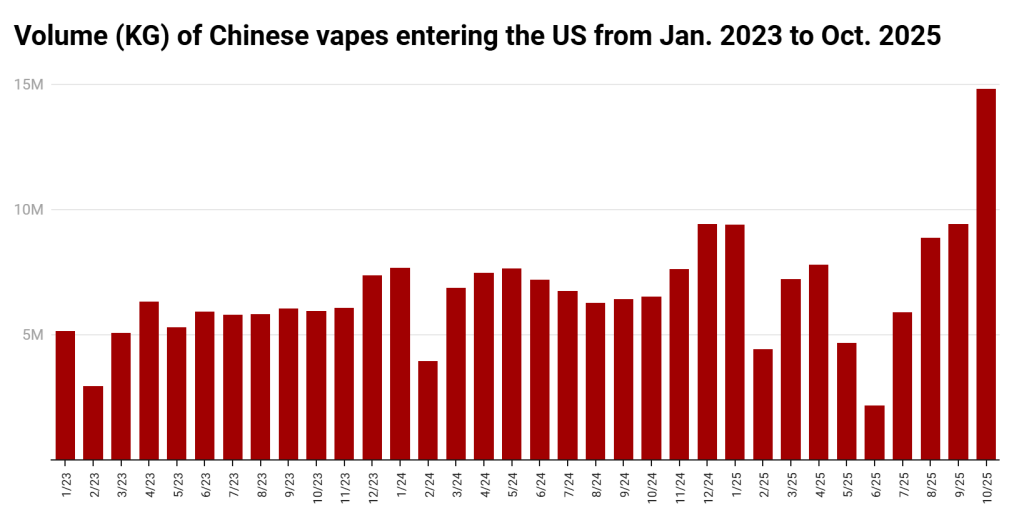
Lawmakers and public health groups have long criticized Chinese-made vapes for their popularity among minors, prompting years of enforcement actions by U.S. authorities. While Customs and Border Protection and the FDA report intensified coordination, seizures, and a sharp rise in import refusals, illegal flavored vapes continue to dominate retail shelves. A Truth Initiative report found illicit products accounted for more than 86% of vape sales in early 2024, highlighting the gap between enforcement efforts and market realities.
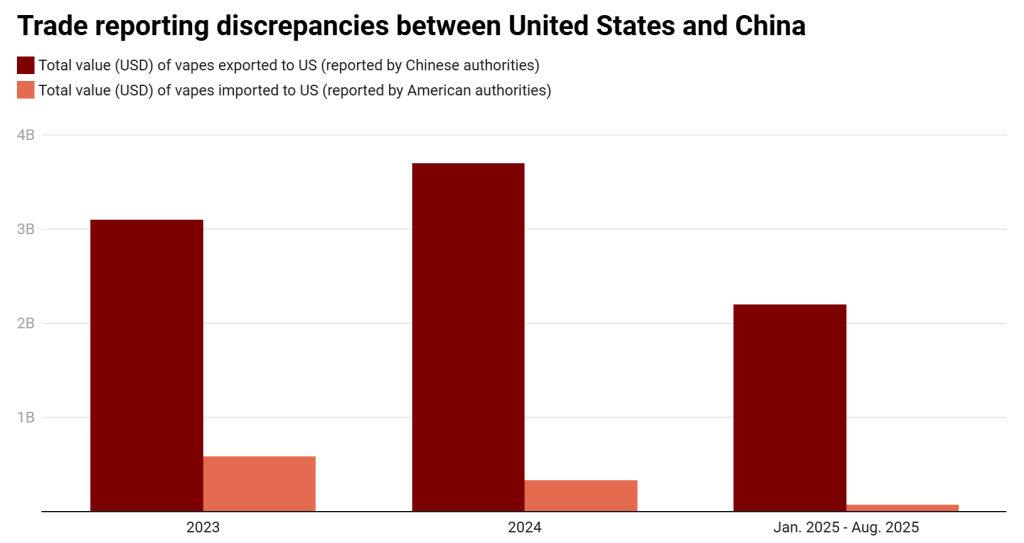
The gap is also evident in trade data. U.S. Census Bureau figures show the declared value of Chinese e-cigarette imports collapsing from $585.2 million in 2023 to about $333 million in 2024, before falling further to just $75 million as of August 2025. Chinese export statistics, however, point in the opposite direction, indicating that manufacturers shipped roughly $3.1 billion worth of vapes to the U.S. in 2023, $3.7 billion in 2024, and around $2.2 billion in the first eight months of 2025 alone. While discrepancies between national trade statistics are common, a gap of this scale is highly unusual – which could be driven by the widespread use of the U.S. de minimis exemption, which allows shipments valued under $800 to enter with minimal documentation and are excluded from official import data, as well as deliberate mislabeling and underreporting of quantities or values. An analysis by the Federal Reserve Bank of New York described de minimis shipments as having grown “explosively” in recent years, driven by direct-to-consumer shipping from China. Separate investigations have also detailed networks of U.S.-based intermediaries who manage customs clearance for Chinese vape makers, sometimes falsely declaring goods or disguising e-cigarettes as innocuous products such as toys or shoes, enabling billions of dollars’ worth of illicit vapes to reach the U.S. market despite intensified enforcement.
Nevertheless, U.S. officials cite progress, including more than $136 million in seizures over two years and a mandate for the FDA to spend at least $200 million on e-cigarette enforcement. Yet the scale of seizures remains small relative to the volume suggested by Chinese export data, underscoring the ongoing challenge of closing loopholes and aligning enforcement outcomes with the stated goal of stemming illicit vape flows.
November 2025: State Attorneys General Push Shopify to Crack Down on Illegal E-Cigarette Sales
A bipartisan coalition of 25 U.S. state attorneys general, led by California Attorney General, urged Shopify to intensify its efforts to stop the sale of illegal e-cigarettes on its platform. In a joint letter, they note that 29 unlicensed e-cigarette websites are currently hosted on Shopify and provide an annex listing over 200 more online shops suspected of illicitly selling tobacco products. Although Shopify has reportedly shut down some of these sites before, the coalition argues that the platform’s current actions are insufficient, and they propose a collaborative framework to help identify and block violators more effectively.
The attorneys general emphasized the serious public health risks posed by unregulated vaping, especially to young people. They highlighted that, under the U.S. law, only 39 e-cigarette products have received FDA authorization (limited to tobacco and menthol flavors), and that flavored disposables sold online are not approved. They called on Shopify to enter into a cooperative agreement in which the states would help flag offending sites – a step that, they believe, could significantly curb the flow of illegal and potentially dangerous vaping products.
November 2025: Ensuring the Necessary Destruction of Illicit Chinese Tobacco (END) Act is introduced
A trio of bi-partisan lawmakers introduced the Ensuring the Necessary Destruction of Illicit Chinese Tobacco (END) Act to strengthen enforcement tools to block illicit tobacco imports and protect U.S. consumers from unsafe and counterfeit products. The END Act authorizes the Secretary of Health and Human Services to destroy adulterated, misbranded, or counterfeit tobacco products that are offered for import into the United States. The legislation will update the Federal Food, Drug, and Cosmetic Act (21 U.S.C. 381(a)) to explicitly include tobacco products, ensuring they are treated the same as counterfeit drugs or medical devices when intercepted by federal authorities.
Lawmakers underlined China’s outsized role in flooding the U.S. market with illicit tobacco products (e.g. disposable flavored vapes). The Act is supported by 7-Eleven, Altria, the Campaign for Tobacco-Free Kids, the American Heart Association, the American Lung Association, the National Association of Convenience Stores, NATSO, Representing America’s Travel Centers and Truck Stops, and SIGMA: America’s Leading Fuel Marketers.
Link: Ensuring the Necessary Destruction of Illicit Chinese Tobacco (END) Act
October 2025: Court rules that Ohio AG cannot enforce FDA’s PMTA requirements
An Ohio Appeals Court ruled that the state Attorney General (AG) cannot use consumer protection laws to enforce U.S. FDA’s premarket tobacco product authorization (PMTA) requirements for e-cigarettes. The case arose after the Ohio AG sued a retailer for selling e-cigarettes without authorization from the U.S. FDA and failing to disclose that fact to consumers. The court dismissed the suit, finding that enforcement of premarket rules falls solely under the FDA’s authority as established by the Food, Drug, and Cosmetic Act and the Tobacco Control Act. It concluded that the state’s claim depended entirely on federal law and the state could not have brought the case without relying on federal rules; therefore, the state’s claim was pre-empted.
The ruling reinforces the FDA’s exclusive role in policing the authorization and legality of nicotine products, leaving states with little room to act against unauthorized e-cigarettes. While state attorneys general can still pursue cases involving deceptive marketing or youth access violations, they cannot bring actions based purely on a product’s lack of FDA approval. For the e-cigarette industry, this decision marks a clear reduction in legal exposure at the state level and a shift of enforcement power squarely back to the federal level. For state regulators, however, it weakens their ability to crack down on the growing market of unauthorized and illegal vape products that continue to evade federal oversight.
September 2025: DEA seized 2.4 million vaping products as part of Operation Vape Trail
The Drug Enforcement Administration (DEA) announced the results of a week-long operational enforcement action as part of a whole-of-government initiative aimed at removing dangerous and illegal vaping substances from communities across America. During the Operation Vape Trial, DEA seized 2.4 million vaping products (devices & pods), US$3.5 million cash and 115 firearms while making 106 arrests in one week6.
Although the vaping devices were originally designed for nicotine and marketed as a cigarette alternative, a significant portion of the vapes contain illegal and addictive substances such as synthetic marijuana, synthetic cathinones, and hydroxymitragynine, also known as 7-OH or synthetic kratom. DEA has also been investigating vape shops near military bases. The majority of these shops investigated by DEA are owned and operated by foreign nationals believed to be specifically targeting active military personnel. As a result of one joint operation, DEA and its partners seized 8,000 pounds of THC products, 70,000 marijuana plants, and nearly 21,500 pounds of processed marijuana, and arrested 20 people, including three Chinese nationals.
Operation Vape Trail is part of a larger collaborative enforcement effort between the U.S. Department of Justice, U.S. Department of Homeland Security, U.S. Department of Health & Human Services, and the U.S. Food and Drug Administration.
September 2025: U.S. FDA and CBP seized $86.5 million worth of illegal vapes in the largest-ever operation
The U.S. Food and Drug Administration (FDA) and U.S. Customs and Border Protection (CBP) announced the seizure of 4.7 million units of unauthorized vaping products with an estimated retail value of $86.5 million in the largest-ever seizure operation. The seizures were part of a joint federal operation in Chicago to examine incoming shipments and prevent illegal vapes from entering the country. Almost all the illegal shipments uncovered by the operation originated in China. FDA and CBP personnel determined that many of these shipments contained vague and misleading product descriptions with incorrect values, in an apparent attempt to evade duties and the review of products for import safety concerns.
All vaping products seized in the operation lacked the mandatory premarket authorization orders from the FDA and therefore cannot be legally marketed or distributed in the U.S. In addition to the product seizures, the FDA contacted 37 importers and import entry filers regarding their actions. These firms were responsible for importing these illegal vapes and were advised that it is a federal crime to make false statements or entries to the U.S. government. The FDA reminded the firms of their responsibility to ensure the products they import comply with U.S. requirements and that their import entries must contain complete and accurate information moving forward. The FDA requested the firms to respond to the letters within 30 days with the requested information.
So far in 2025, FDA and CBP have stopped more than 6 million unauthorized vapes worth over $120 million from entering the country. The enforcement action is part of the FDA’s broader aggressive strategy against illegal vapes. Additional activities include ending the practice of “port shopping,” by which illegal products repeatedly try to enter the United States; addressing the distribution networks of illegal vaping products; educating parents about dangers of vaping; and working with store owners nationwide to prevent the sale of illegal products.
September 2025: New York State Governor announces the largest criminal vape enforcement action the state history
New York State Governor announced the largest criminal vape enforcement action in the state history, targeting 12 businesses and resulting in over a dozen arrests and a total of 38 criminal charges for illegally shipping vaping products in violation of state law. The sweeping crackdown on the vape industry in New York, led by the New York State Department of Health in partnership with the New York State Police, targeted businesses and their owners that operate online vape shops and distribution networks located across the state, from Western New York to Long Island.
Following a months-long investigation by the Department of Health’s Bureau of Investigations that included undercover online buys, the New York State Police charged the vape dealers with Unlawful Shipment and Transport of Vapor Products, a class A misdemeanor. According to the Public Health Law, any second or subsequent unlawful shipment and transport of vapor products following a conviction would be a class E felony. Many of the illicit shipments included disposable vapes and flavored e-liquids, marketed through websites, social media and mobile apps. Some included disposable vapes that come equipped with digital display screens and other tech-savvy features similar to smart phones, handheld video games and other electronic devices popular among the youth.
August 2025: Arkansas and Wisconsin are getting ready to limit vape sales
Both Wisconsin and Arkansas are getting ready to limit vape sales to products authorized or under review by the U.S. FDA starting September 1, 2025.
Wisconsin: A new state law slated to take effect on September 1, 2025 – Labor Day weekend – will prohibit the sale of any vape products that are not FDA authorized or don’t have a pending application with the U.S. FDA. Currently, the FDA-approved list lacks any flavored vapes (except menthol), meaning that most vape products [currently on the market] are effectively banned. Vape shop owners have filed a federal lawsuit challenging the law. A judge heard the arguments and is expected to issue a ruling before the enforcement date. If the ban proceeds, retailers could face fines of $1,000 per day per product. Click here for the list of vape products authorized for sale in Wisconsin.
Arkansas: Act 590 will take effect on September 1, with full enforcement beginning November 1, 2025. The legislation restricts the sale of closed-system vape products and nicotine-containing e-liquids to only those that are FDA-authorized or under FDA review. Arkansas Tobacco Control will publish an approved products list – so far, only 39 products have been approved, with a few dozen more applications under review. The law also bans packaging that appeals to minors, prohibiting cartoons, candy-like names, and other child-friendly imagery, and authorizes seizure of non-compliant products, significant fines, and potential permit revocation.
August 2025: The U.S. Postal Service (USPS) started to crack down on distributors of illegal vapes using its services for business shipments
The U.S. Postal Service (USPD) started to crack down on distributors of illegal vapes using its services for business shipments, according to the letters reviewed by Reuters7. USPS blocked a major New York-based distributor from using its services after New York City’s Law Department provided evidence that the company shipped vapes lacking U.S. FDA authorisation and violated a local flavour ban. Under a 2021 law, USPS is restricted from mailing vapes directly to consumers, internationally and in most other circumstances – with limited exceptions include domestic shipments between businesses, which need a “mailing exception” and their shipments must comply with relevant laws. FedEx refuses to ship vapes while DHL only offers carriage for business shipments with prior approval. USPS has provided NYC’s Law Department with a list of other vape firms it has granted mailing exceptions so it can assess whether they should be challenged, in line with legal requirements, and this could further limit the number of carriers available to the unauthorised vape industry. Other options, such as using smaller carriers or handling freight directly, tend to be more costly.

Meanwhile, tariff uncertainity and more strict enforcement have its toll on vape shipments from China to U.S. In the first 7 months of 2025, FDA-registered vape shipments from China declined by 49% to 4,010 – causing some of the most well-known illegal vape products to become unavailable at the retail. After a strong start to the year with a 24% year-on-year increase in January 2025, monthly shipment volume is down by almost three quarters in the last two months.
July 2025: Tobacco companies are cautiously optimistic about the increased enforcement action against illegal vapes
Tobacco companies, Altria (parent company of Philip Morris USA) and British American Tobacco (BAT; parent company of Reynolds American), are cautiously optimistic about the increased enforcement action against illegal vapes in the U.S. Altria underlined the US FDA strengthening its importation policy (reducing the possibility of imported vapor products bypassing FDA review), tighter border controls (resulting in a higher percentage of rejections of inproperly declared vape shipments), FDA issuing warning letters to 24 importers (responsible for importing illicit vapes) and state attorneys general issuing warnings and bringing civil litigation (addressing illicit Chinese vape importers and distributors) as the key positive developments towards holding rule-breakers accountable. Altria also pointed out the need for an acceleration in product authorizations by the US FDA to establish a stronger legal vape market.

At the state level, BAT noted that 18 states have enacted vape directory/enforcement legislation, representing c.50% of the tracked vape industry volume. In 5 states where the active enforcement is in place (Alabama, Kentucky, Louisiana, Rhode Island and Utah), sales volume of BAT’s VUSE increased between +5% to +13% in H1 2025 – versus 13.8% volume decline at the nationwide U.S. in the same period.
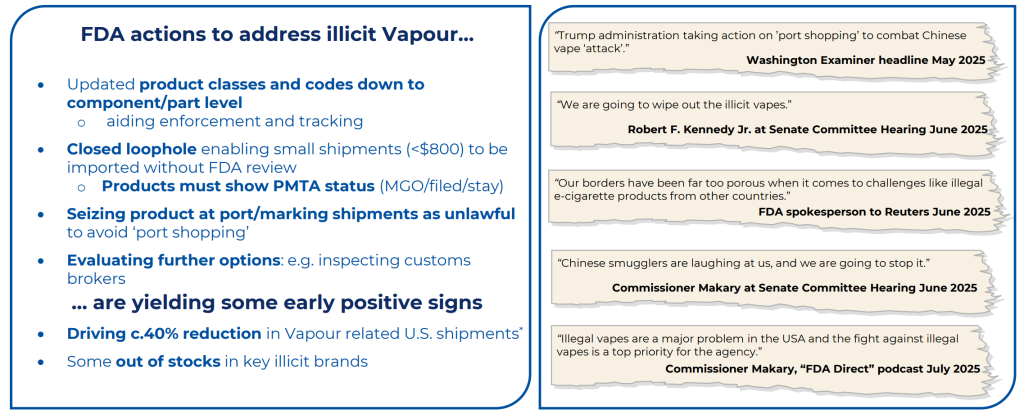
At the federal level, BAT sees some early evidence of a more proactive federal approach to illicit vapes: FDA’s updated product classes and codes down to component/part level (aiding enforcement and tracking), closure of the loophole on small shipments (<$800) to be imported without FDA review (i.e. products must show PMTA status, such as marketing granted order, PMTA filed or court/admistrative stay order), product seizures at ports, marking of shipments as unlawful to avoid “port shopping” and possible inspection of customs brokers are noted as the positive actions. As a result, BAT observed c.40% reduction in vape related shipments to the U.S. and some key illicit vape brands becoming out-of-stock at the retailers (- this is in line with our own observations; for further details: Geekbar: Shortage in the U.S.). BAT also highlighted various statements from the U.S. Administration as a sign of increased will to take a more decisive action towards illegal vapes.
July 2025: FDA Commissioner re-iterates commitment to fight illegal vapes
In interview with ABC News, FDA Commissioner stated that 85% of the vaping products sold in the vape stores are illegal according to the FDA’s list and what FDA has been doing so far against the illegal vapes is laughable. He also underlined that cracking down on illegal vapes is a “top priority” for the Agency moving forward and they are going to start confiscating & seizing in a serious manner. In the first six months of 2025, Customs and Border Protection (CBP) seized $60 million worth of illegal vapes – which is just a small fraction of illegal vape inflows to the U.S.
July 2025: U.S. Senate directs FDA to allocate $200 million budget to fight illicit vapes
As part of the Agriculture, Rural Development, Food and Drug Aministration, and Related Agencies Appropriations Bill, U.S. Senate Committee on Appropriations directs FDA to allocate a $200 million budget, in the fiscal year 2026, specifically for enforcement against illegal vapes. The dedicated budget will enhance inspection capacity, strengthen seizure efforts, accelerate the confiscation and destruction of unauthorized products at ports of entry. The $2 million multi-agency task force (formed in June 2024), comprising the FDA, Department of Justice (DOJ), and Department of Homeland Security (DHS), is slated to amplify coordination across federal agencies, tightening monitoring and interdiction at critical entry points.
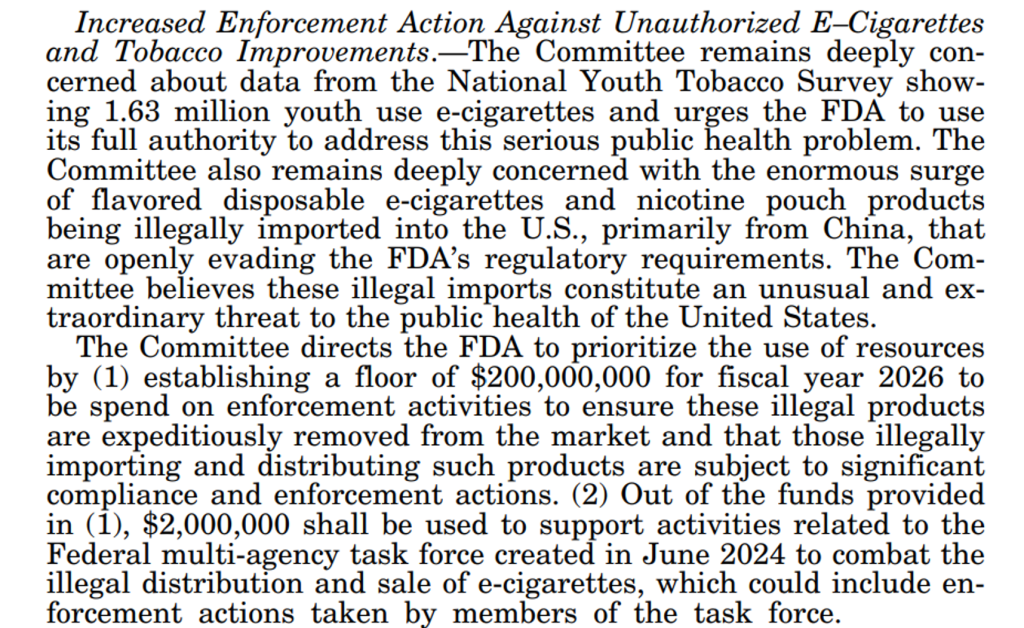
The request for increased enforcement action comes amid bipartisan pressure and public scrutiny regarding the illicit vape crisis. Lawmakers have repeatedly criticized both the FDA and DOJ for permitting thousands of unauthorized flavored, disposable vapes – mostly imported from China – to saturate the U.S. market, particularly targeting the youth. Simultaneously, the FDA is asked to accelerate the premarket tobacco product application (PMTA) reviews – reducing review timelines from a few years to a few months.
Key Developments & Implications:
– Enhanced enforcement authority: FDA is now empowered to seize and destroy unauthorized nicotine products at import, backed by a significant dedicated budget and a coordinated task force
– Market impact: In parallel to the acceleration of illicit product seizures, resilience of the illicit supply chains can be broken and legitimate manufacturers may gain a competitive edge
– Regulatory modernization: The FDA is ramping up its review efficiency and transparency via priority pathways and AI integration – which could assist its enforcement mission
– Political momentum: Persistent Senate oversight keeps pressure on the federal agencies to move swiftly on youth-targeting vaping products.
In summary, a dedicated budget marks a strategic shift toward enforcement-first regulation, enhancing interagency capabilities and balancing faster product approval with aggressive action against unauthorized nicotine products.
July 2025: FDA Commissioner names the fight against illegal vapes as a top priority for the Agency
In a recent FDA Direct episode, a podcast in which FDA leadership explains the current happenings at the U.S. FDA, Commissioner Dr. Martin A. Makary highlighted illegal vapes as a major problem in the USA and the fight against illegal vapes as a top prority for the Agency. Commissioner specifically mentioned four actions: Crackdown on the imports and destruction of illegal vaping products coming into the United States through the ports and across the border, crackdown on the distribution networks, providing clarity to retailers on the FDA authorized products and public education. We are disappointed to hear no reference to the authorization of a wider portfolio of vape products that can improve attractiveness of the legal products among the adult nicotine users and rival illegal vapes (i.e. strengthening of the legal product portfolio).
June 2025: More than 90% of Chinese vapes are imported illegally to the U.S.
China exported more than ¥26 billion ($3.62billion) worth of vape products to the U.S. in 2024. However, U.S. import data only recorded receiving about $333 million worth of vape products – implying a trade discrepancy of $3.3 billion for the category. This discrepancy is on pace to grow to about $3.6 billion in 2025. According to the media reports, more than 90% of all Chinese vape products imported to the U.S. in 2024 are not recorded in the American import data as Chinese companies smuggle vapes into the U.S. by mislabeling them as toys, electronics, and even shoes. Altough mismatches in custom data between the U.S. and its trading partners are not uncommon, a 90% difference is unheard of before. Moreover, several state attorneys general have warned that mislabeling is a commonly used tactic by the Chinese e-cigarette companies to avoid regulations and customs duties.
June 2025: Texas bans vapes made in China
Texas Governor signed Senate Bill 2024 (SB 2024) into law, banning “e-cigarette products” manufactured in China. An “e-cigarette product” is defined in the law as any substance [containing nicotine from any source that is] intended for use in an e-cigarette, regardless of whether the substance contains nicotine. The law will come into effect on September 1, 2025.
In addition, the new law also prohibits the sales of e-cigarette products that feature characters, trademarks or symbols that are primarily used in marketing to minors, an image or name of a celebrity and an image that resembles a food product. E-cigarette products that are designed to appear as an alternative product (such as school or office supply, smart phone, smart watch, cosmetic, toy, etc.) and that contain or are mixed with cannabinoids, alcohol, kratom, kava or mushrooms will also be prohibited. Violation of the law is classified as a criminal offense.
June 2025: Fight against illegal vapes as a top enforcement priority
The United States is experiencing a surge in the illicit trade of flavored and disposable vapes, fueled by soaring demand among youth and young adults, a booming gray market, and persistent loopholes in regulatory enforcement. Flavored disposable vapes are sold without FDA authorization and are often imported illegally or disguised with misleading packaging. Industry observers estimate that illicit and non-compliant vaping products now dominate more than 60% of the U.S. e-cigarette market, undermining both public health protections and legitimate market participants.
In response, enforcement efforts have intensified at both the federal and state levels. The U.S. Food and Drug Administration (FDA), armed with authority under the Tobacco Control Act, leads the federal campaign to restrict illegal e-cigarettes through a combination of warning letters, civil penalties, import alerts, and criminal prosecution. However, critics argue that FDA actions – while increasing – remain insufficient to fully stem the flow of illicit products into stores and online marketplaces.
Comprehensive FDA Enforcement Efforts (2021–2025)
| Enforcement Mechanism | Description & Notable Activity |
|---|---|
| Warning Letters | Over 50,000 letters sent to retailers and manufacturers selling unauthorized tobacco products, particularly flavored disposable e-cigarettes. Most commonly issued first-line enforcement tool. |
| Civil Money Penalties (CMPs) | Issued 87 times to manufacturers and 177 times to retailers since FY2021. Penalties range from $15,000–$250,000 per violation, with total liabilities potentially reaching $1M per case |
| Injunctions via DOJ | Eight civil injunction actions filed by the U.S. Department of Justice on FDA’s behalf to stop continued sales by repeat violators. |
| Import Alerts & Port Holds | FDA collaborates with U.S. Customs and Border Protection (CBP) to detain illicit vape shipments at entry ports. Multiple import alerts issued on major foreign brands |
| Seizures & Product Destruction | Courts have issued seizure orders for illicit goods, leading to physical product destruction. Notably, products worth $34 million in retail value were seized in Chicago in February 2025 |
| Criminal Prosecutions | DOJ brought criminal charges against parties importing and distributing adulterated or misbranded products. Penalties can include prison sentences of up to 3 years |
| Retailer Inspections & Online Surveillance | FDA regularly inspects brick-and-mortar and online retailers. Many receive “no-action letters” pending further investigation |
| Public “Red List” | Maintains a growing list of manufacturers and importers of unauthorized flavored vape products. Used to guide targeted actions |
Recognizing the federal-level enforcement gap, a growing number of U.S. states are taking legal action against the surge of illicit flavored e-cigarettes, with a bipartisan coalition of nine state attorneys general – California, Connecticut, Illinois, Hawaii, Minnesota, New York, New Jersey, Vermont, Ohio alongside the District of Columbia – actively pursuing a coordinated enforcement effort against manufacturers, distributors, and retailers of unauthorized vape products. These efforts are not limited to litigation; they also include warning letters, civil investigative demands, and settlements aimed at curbing youth-targeted marketing and unlawful sales practices.
State attorneys general are using a diverse mix of legal tools, from consumer protection statutes and youth tobacco prevention laws to local flavor bans and the federal 2010 PACT Act (Prevent All Cigarette Trafficking Act, significantly amended in December 2020 to include vapes), to hold violators accountable. Their actions target a wide range of entities, including online retailers, brick-and-mortar stores, national distributors, and even major e-commerce platforms such as Amazon. The violations cited are numerous and often overlapping. These include the sale of unauthorized flavored vape products, failure to conduct proper age verification, deceptive marketing practices (such as labeling mint flavors as “clear”), and operating without proper licenses or FDA authorization. Together, these state-led actions represent a sweeping, localized response to a national regulatory gap and signal the potential for even broader enforcement ahead.
| State / Jurisdiction | Targets | Legal Tools & Actions | Allegations & Details |
|---|---|---|---|
| California | 3 vape companies | Lawsuits under CA’s flavor ban (SB 793), PACT Act, UCL, False Advertising | Importing flavored disposables; remote sales without age checks; deceptive flavor names (e.g. “Clear” = mint) |
| Connecticut | ~12 retailers & 2 wholesalers | Civil Investigative Demands, warning letters | Selling illegal flavored imports; compliance investigation |
| Illinois | 3 vape companies | Lawsuit under Youth Prevention Vaping Act + Consumer Fraud Act; investigation | Marketing unauthorized flavored disposables to under-21 via social media; no authorization |
| Hawaii | Licensed retailers/distributors (~800) | Warning letters to retailers | Reminder not to sell unauthorized products |
| Minnesota | 2 vape companies | Lawsuit under consumer-protection & flavor ban laws; civil investigation | Disguised vapes as highlighters; online no age checks; deceptive marketing |
| New Jersey | ~11,000 licensed retailers; 19 vape stores | Warning letters; Notices of violation ($4.5K each) | Warning about flavored vape prohibition; civil penalties for violations |
| New York | 6 vape companies | Multiple lawsuits under banned-flavor laws & PACT Act; consent judgment; shutdown order | Sales of flavored products to minors, failure to verify age, illegal shipments; seeking injunctive relief & hundreds of millions in damages |
| Ohio | 3 vape companies | Warning letters to retailers; lawsuits under Consumer Sales Practices Act | Illegal marketing, misleading packaging, no FDA authorization |
| Vermont | Amazon & third‑party sellers | $400K settlement; assurance to ban remote sales | Products relisted as innocuous then changed to vape listings |
| Washington, D.C. | Distributors (including Swedish Match) | Settlement under CPPA; $1.2M penalty | Sold flavored nicotine pouches & vapes contrary to ban |
| Massachusetts | 1 vape company & 8 online retailers | $51M settlement; lawsuits under state youth-vaping law | Selling to minors, flavored products violations |
| Washington State | 1 vape company & 6 retailers | Judgment & settlement ($375K) under age‑verification laws | Online sales without age checks violated WA law |
To summarize, at a high level, federal efforts have focused on blocking supply at the source – through port seizures, manufacturer penalties, and legal injunctions – while state-level initiatives have emphasized retail accountability and direct consumer protection. This two-tiered enforcement model is still evolving, but it signals an increasingly coordinated national approach to a fragmented and fast-moving regulatory challenge.
June 2025: Louisiana conducts “Operation Vape Out”
As part of “Operation Vape Out”, Louisiana Office of Alcohol and Tobacco Control (ATC) suspended the licenses of six smoke shops, issued more than 140 citations statewide and made ten arrests. In total, the ATC and other agencies seized $1 million worth of illegal products – mostly vapes, but also CBD products and containers of nitrous oxide and other restricted products, including marijuana, psilocybin and tianeptine (known as gas station heroin). “The goal is to confiscate unauthorized and illegal vape products and to identify and arrest the people responsible at these retail and wholesale businesses,” stated ATC. The enforcement effort continues statewide and ATC encourages the public to report suspicious products or activity at local shops.
Earlier in June, at the Deutsche Bank Global Consumer Conference, British American Tobacco (parent company of Reynolds American) singled out Louisiana as a “blueprint state” in terms of legislation and enforcement against illegal vapes. In the U.S., 13 states have a vape registry bill (i.e. a mandatory list of vapes authorized for sale in the state) in place and more than 20 states are considering to implement a vape registry bill8.

Vape Registry Bill – Mississippi: Effective July 1, 2025, the law, enacted through HB 916, goes into effect in Mississippi to require all manufacturers to provide annual certifications and have their products listed on a state directory in order for their products to be sold in the state. The law creates separate directories for cigarettes, including roll-your-own (RYO) tobacco, and Electronic Nicotine Delivery Systems (ENDS) products (i.e. vapes). The ENDS directory requires manufacturers to certify the status of their premarket tobacco product applications (PMTAs) to be sold in Mississippi. The cigarette directory is associated to the escrow deposit statutes as Mississippi is one of the few states that did not join the 1998 Master Settlement Agreement (MSA).
Cigarette and ENDS product manufacturers must register their products in Mississippi by September 1, 2025. Both cigarette and ENDS directories will be made public on October 1, 2025. Once the directory is published, cigarettes and ENDS not included on the directory may not be sold for retail sale in Mississippi, either directly or through an intermediary. Starting October 1, 2025, cigarette and ENDS product retailers have 60 days (until November 30, 2025) to sell or remove unlisted products from their inventory and importers, distributors, and wholesalers have 60 days to remove unlisted products from their inventory. By September 1 each year, cigarette and ENDS product manufacturers must certify with the Commissioner of Revenue that each of their products for sale in Mississippi complies with certain requirements. Retailers, distributors, and wholesalers selling or distributing cigarettes or ENDS products are subject to at least two unannounced compliance checks each year. HB 916 establishes hefty penalties for selling products not listed on the directories, as well as authorizes the seizure, forfeiture, and destruction of such products.
June 2025: 100k-puff vapes are now available in the U.S. market
Chinese manufacturers are rushing to launch ultra high-capacity disposable vapes, delivering up to 100k puffs (equivalent to 5,000 cigarettes, 250 packs or about a year’s consumption based on 20-puff-a-cigarette conversion rate), in the U.S. market. One such device, HorizonTech 100K model, has a 40ml e-liquid capacity and aims to set a new benchmark in cost effectiveness. In Boost Mode (max 40W power output), the device delivers up to 60k puffs. In Regular Mode (max 30W), it delivers up to 100k puffs and claims to extract 2,500 puffs per ml of e-liquid. HorizonTech 100K is available in 12 different flavors of fruit, mint and fruit & mint fusions. The regular price of HorizonTech 100K on online retailers is $33.99, but it can be purchased for as low as $15.99 on various sites.

May 2025: Vape sales in convenience stores continue to decline in the U.S.
In the U.S. multi-outlet and c-store channel, vape sales declined 9.8% to $6.52 billion in the 52 weeks ending April 20, 2025 (Circana data) as the U.S. consumers continue to shift to illegal disposable vapes sold mostly in the independents and specialty stores (i.e. untracked channels). Altria, owner of Marlboro in the U.S., reported that number of vapers increased by 14% from 18 million to 20.5 million over the 12 months ending March 31, 2025. Number of vapers using disposable vapes increased 38% from 10.5 million to 14.5 million – now representing around 70% of the total vapers (vs. 58% a year ago). Consequently, U.S. multi-outlet and c-store channel is experiencing 13% sales volume decline in a category growing double-digit.
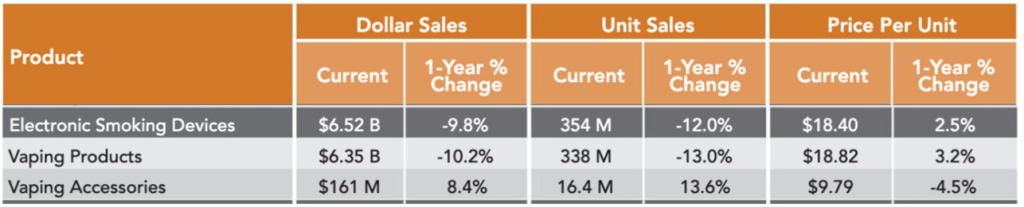
May 2025: Texas is on the way to ban vapes made in China
Texas House of Representatives passed Senate Bill 2024 (SB 2024) with a decisive 128–7 vote. The Bill broadens the definition of “e-cigarette” to encompass devices and substances used for vaporization, regardless of nicotine content (i.e. including the zero nicotine or nicotine-free vapes). It introduces stringent restrictions on marketing strategies aimed at minors, prohibiting packaging and designs that mimic cartoons, candies, school supplies, or include celebrity images. Notably, SB 2024 also seeks to ban the sale of e-cigarette products that
– is wholly or partially manufactured in or marketed as being manufactured China or a country designated as a foreign adversary by the United States Secretary of Commerce under 15 C.F.R. Section 14 791.4 (“Determination of foreign adversaries”)
– contain substances like cannabinoids, alcohol, kratom, kava, or mushrooms.
These measures aim to curb youth-targeted marketing and address public health concerns associated with vaping. The proposed legislation aligns with a broader national trend of tightening regulations on e-cigarette marketing and sales, reflecting growing concerns over youth vaping rates. If signed into law, SB 2024 would take effect on September 1, 2025, imposing criminal penalties for violations, including Class B misdemeanors. This development underscores the increasing scrutiny faced by the e-cigarette industry and signals a potential shift in market dynamics, particularly affecting products imported from China and those employing youth-appealing marketing tactics.
May 2025: FDA and CBP seizes $34 million worth of illegal e-cigarettes
The U.S. Food and Drug Administration (FDA) announced the seizure of nearly two million units of illegal e-cigarette products in Chicago, with an estimated retail value of $33.8 million. The seizures, which occurred in February 2025 in collaboration with U.S. Customs and Border Protection (CBP), were part of a joint federal operation to examine incoming shipments and prevent illegal vapes from entering the U.S.
Almost all of the illegal vapes were originated from China. FDA and CBP determined that, in an apparent attempt to evade duties and the review of products, many of these unauthorized e-cigarette shipments contained vague product descriptions with incorrect values. Upon examining shipments, the team found several illegal vape brands, including Raz and Snoopy Smoke. FDA observes an increased number of shipments of vaping related products mislabeled to avoid detection.
Most shipments violated the FDA’s Federal Food, Drug, and Cosmetic Act (FD&C Act), while some products were also seized for Intellectual Property Rights (IPR) violations for unauthorized use of protected trademarks. All of the e-cigarette products seized lacked the mandatory authorization orders from the FDA; therefore, they cannot be legally marketed or distributed in the United States.
FDA also sent, for the first time, import informational letters to 24 tobacco importers and entry filers responsible for importing these illegal vapes. The letters advise the recipients that it is a federal crime to make false statements or entries to the U.S. government, and the FDA seeks information on the steps they have taken to ensure compliance with applicable federal tobacco laws and regulations. Specifically, the letters advise the firms to ensure their import entries contain complete and accurate information moving forward. Failure to do so may also be viewed as an intentional attempt to circumvent the FDA’s review of the shipment. Firms are requested to respond to the letters within 30 days with the requested information.
Previous FDA-CBP joint actions include the seizure of $18 million of illegal e-cigarettes at a cargo examination site in Los Angeles International Airport in 2023, seizure of $7 million of illegal e-cigarettes at a warehouse in Miami, and operations in Chicago announced in June and October of 2024 resulting in the seizure of illegal e-cigarettes valued at more than $77 million. In addition to product seizures, the FDA has issued over 750 warning letters to firms for manufacturing, selling, or distributing unauthorized new tobacco (nicotine) products. It has also issued more than 800 warning letters to retailers for selling these products and filed civil money penalty complaints against 87 manufacturers and over 175 retailers for their distribution or sale.
May 2025: RFK Jr re-iterated his commitment to remove illegal vapes from the U.S. market
Before the congressional committee, Health and Human Services (HHS) Secretary Robert F. Kennedy Jr. (RFK Jr.) re-iterated his commitment to remove illegal Chinese vapes from the U.S. market: “We are gonna wipe them out. We are gonna get rid of all of them.”
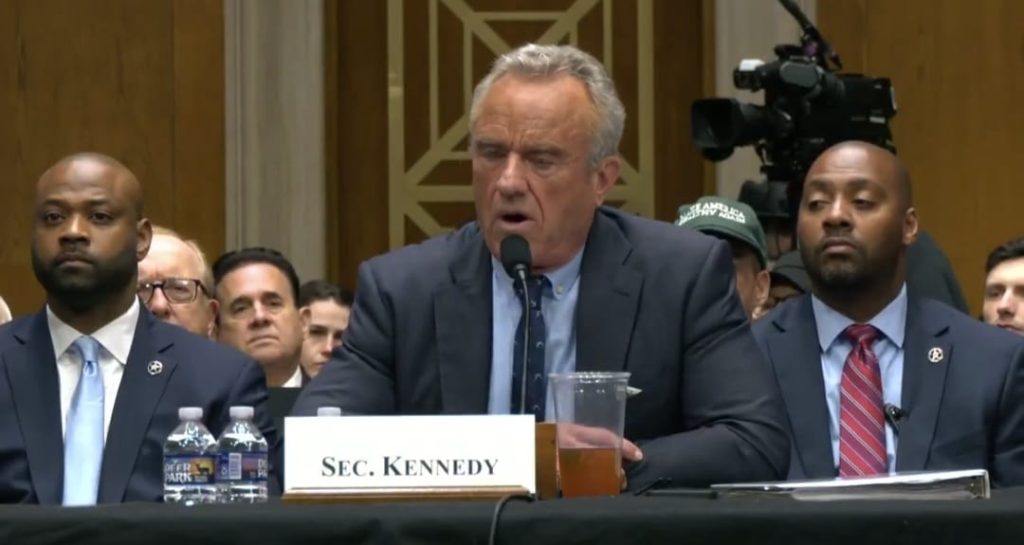
The HHS Secretary stated that U.S. vape companies are acting responsibly by equipping their devices with chips to prevent underage acess (presumably referring to the PMTA submission by Altria for a device that incorporates Bluetooth-enabled access restriction technology), providing good information on nicotine addiction and putting extensive labelling on vape packaging. RFK Jr. believes that U.S. vape companies are doing a good job in making vapes less atractive to the youth, but the U.S. FDA “slow-walked” the authorization proceess and effectively removed them from the market. The vacuum created by the absence of responsible U.S. vape companies are filled with illegal Chinese companies that flood the market with vapes in youth-attracting flavors, names and features. RFK Jr.’s comments are in line with the recent statements of the new U.S. Food and Drug Administration (FDA) Commissioner. Meanwhile, Dr. Bret Koplow is appointed as the Acting Director for the Center for Tobacco Products (CTP) of the U.S. FDA.
May 2025: U.S. FDA will focus on ending the “port shopping” for illegal vape shipments
“Port shopping” is a practice employed by the Chinese manufacturers to find a suitable U.S. port to disembark illegal vape shipments and clear customs. The new U.S. FDA Commissioner stated that the Administration is specifically looking into ending the “port shopping” for the incoming illegal vape shipments. The Administration will stop sending the blocked (illegal) shipments back to the manufacturers, who usually put them on a ship that will sail to the next U.S. port.
The Commissioner stated that FDA can only inspect 2% to 5% of the products that come into the U.S. ports and the U.S. has a “porous border” that lets in almost all of the illegal vape shipments9. He also re-iterated the Agency’s commitment to confiscate and destroy illegal vapes, going forward – rather than sending them back. As the bipartisan pressure mount on the Trump Administration to “set up an effective regulatory and enforcement framework”, a Presidential Executive Order – targeting illegal Chinese vapes – is more widely speculated.
May 2025: Monthly e-cigarette sales volume increased by ~250% in the U.S. since 2020, driven by illegal disposable vapes
According to a new study based on Circana retail sales data, from February 2020 to June 2024, monthly e-cigarette sales volume increased by +34.7% in number of units sold (from 15.7 million to 21.1 million units) and by +249.2% in amount of nicotine sold (i.e. volume in mL x nicotine concentration in mg/mL; from 2.7 billion to 9.4 billion milligrams) in the U.S. Growth in e-cigarette sales volume measured in nicotine amount is 7.2 times the growth in number of units – a phenomenon driven by the surge of illegal disposable vapes with high e-liquid volume. Between January 2017 and September 2022, average e-liquid volume in a disposable vape increased from 1.1 to 5.7 mL and average nicotine strength increased from 1.7% to 5%; thereby, average nicotine amount in a disposable vape soared from 1.9mg to 28.5mg. These bigger & cheaper vapes deliver nicotine at more accessible price points; most disposable vapes deliver nicotine levels equivalent to a carton of cigarettes (i.e. 200 cigarettes) or more in a single device which typically costs US$15-20.

From February 2020 to June 2024, disposable vape sales volume jumped by 201.3% in number of units sold and by 2,365% in nicotine amount sold. In the same period, pod sales volume declined by -23.8% in number of units sold and increased by just +1.3% in nicotine amount sold. Disposable vapes, favored by the youth, account for 74% of the nicotine amount sold and 58.1% of the units sold. As of June 2024, on average, a disposable vape contains 9.0 times more e-liquid than a prefilled pod (usually 1.5-2ml). The price per milligram of nicotine in prefilled pods is 3.7 times greater than that of disposable devices.
April 2025: Arkansas became the 12th U.S. state with a vape registry law
Senate Bill 252 is signed into into law by the Governor, making Arkansas the 12th U.S. state to pass a vape registry law. Accordingly, SB252 becomes Act 590.
Act 590 establishes a directory of vape products that can be legally sold in Arkansas. Manufacturers must apply to include their products in the directory, pay a fee for each product or family of products, and certify under penalty of perjury that each product submitted meets the requirements for inclusion. Similar to the other states with a vape registry law, requirements for a product to be listed in the Arkansas directory are:
– Must have been on the U.S. market as of Aug. 8, 2016 (i.e. popular, illegal disposable vapes are excluded by this clause)
– Manufacturer must have filed a premarket tobacco application (PMTA) with the FDA by Sept. 8, 2020
– Product must have either received FDA marketing authorization; or still be under review by the FDA; or have received a marketing denial order (MDO), but the MDO has been stayed by a federal court order or by the FDA.
Products must be submitted for inclusion in the directory by September 1, 2025, and sales of non-listed products will not be allowed after that date. Enforcement will begin once the directory is published on or after November 1 by the Director of Arkansas Tobacco Control. Retailers, wholesalers and manufacturers can face legal penalties for violating any part of the act, including fines and seizure of products. Arkansas Tobacco Control is empowered to inspect facilities, investigate, and charge violators.
Act 590 also prohibits personal possession and importation of products that don’t meet state standards. Arkansas is the second state to ban personal possession of illegal vapes after Louisiana.
Latest status on vape registries: The vape registry laws are in effect in 5 States – Alabama, Florida, Kentucky, Louisiana, and Oklahoma – and will become effective in 5 States during 2025: North Carolina (May 1, 2025), Virginia (July 1, 2025), Wisconsin (July 1, 2025), Arkansas (November 1, 2025) and Mississippi (November 30, 2025). Enactments in Utah and Iowa have been put on hold pending the outcomes of lawsuits. A federal judge issued a preliminary injunction to pause the enforcement in Iowa until the district court hears the challenging lawsuit; the Judge ruled that the Iowa registry law violated the U.S. Constitution’s Supremacy Clause, stepping on the FDA’s sole authority to enforce regulations enacted under the Federal Food, Drug and Cosmetic Act (FDCA).
Meanwhile, more than 20 States are currently mulling over a mandatory vape legislation. The registry bills are advancing in the legislature in Georgia, North Dakota, South Carolina, Tennessee and Texas. In North Dakota, House Bill 1003 seeks to limit the sales of electronic smoking devices only to products listed in the state-run directory starting January 1, 2026. In Alabama, House Bill HB8 passed the Senate Committee on Healthcare.
April 2025: NYC files lawsuit against nine major national distributors for illegally selling flavored disposable vapes
New York City (NYC) filed a federal lawsuit against nine of the largest nationwide distributors of disposable vapes. The defendants, all of whom have close relationships with e-cigarette manufacturers in China, are alleged to be distributing e-cigarettes with youth-appealing flavors in the city and violating nearly every applicable federal, New York state, and New York City law governing the sale of e-cigarettes.
Building on the previous lawsuits against vape distributors and wholesalers, the latest lawsuit seeks monetary damages and penalties and aims to block the “master distributors” from further sales of illegal vapes in New York City. In July of 2023, NYC filed a federal lawsuit against several distributors of illegal flavored vapes, including the nation’s largest vape distributor. In April 2024, NYC filed a second lawsuit against 11 local wholesalers, which has been transferred to federal court. In November 2024, NYC sued Price Point, a major distributor of e-cigarettes based on Long Island. All three actions target distributors for their part in the illegal sale of flavored disposable e-cigarettes. All three cases are pending. These lawsuits could lead to the bankruptcy of all “master vape distributors” in the U.S.
March 2025: Vape Registry Bill signed into law in Mississippi
Mississippi Governor signed Vape Registry Bill HB916 into law. The Bill passed the Mississippi State House in a 120-0 vote in January 2025 and the State Senate in a 48-0 vote in March 2025. The law will go into effect on July 1, 2025 and a state directory (registry) of legal vape products will be put in place by the Department of Revenue until October 1, 2025. The enforcement provisions will become operational 60 days after the directory is published – allowing retailers to sell any remaining non-certified products. After the 60-day transition period, all products not listed in the state directory will be subject to “seizure, forfeiture, and destruction by the department, the Mississippi Attorney General’s Office, or any law enforcement agency in the State of Mississippi”.
Similar to the other States with a vape registry legislation, once the law becomes effective in Mississippi, there will be three pathways for vape products to be legally allowed for sale:
– Authorized by the U.S. FDA through Premarket Tobacco Product Application (PMTA)
– Applied for authorization through PMTA and the application under consideration by the U.S. FDA
– Denied marketing by the U.S. FDA, but the denial order has been stayed or rescinded or vacated by a federal court or the U.S. FDA.
Vape registries are in effect in 5 States – Alabama, Florida, Kentucky, Louisiana, and Oklahoma – and will become effective in 3 States by the mid of 2025: North Carolina (May 1, 2025), Virginia (July 1, 2025) and Wisconsin (July 1, 2025). Enactments in Utah and Iowa have been put on hold pending the outcomes of lawsuits. Mississippi becomes the 11th State with a mandatory vape registry. More than 20 States are currently mulling over a mandatory vape legislation. The registry bills are advancing in the legislature in Arkansas, Georgia, South Carolina, Tennessee and Texas.
Tennessee: Senate Bill 763 passed the Senate Finance Committee in a 9-2 vote and the counterpart House Bill HB0968 passed the House panel with bipartisan support in Tennessee. If signed into law, the bill would ban the sale of vape products that are not approved or in the process of being approved by the U.S. Food and Drug Administration and impose a state tax of up to 10% on all vape products. The bill would also fine vape retailers $500 to $1,500 per product illegally sold. Critics underline that lawmakers sponsoring the Senate and House Bills are longtime recipients of campaign contributions from Reynolds American Political Action Committee (PAC). Reynolds American is the manufacturer of Newport, Camel, Pall Mall and Lucky Strike cigarettes.
Texas: Senate Bill 1698, currently tabled at the Senate State Affairs Committee, will establish a specific directory of FDA-compliant vape products and ban the sale of any unlisted products in Texas. Altria, maker of Marlboro cigarettes, testified in support of the Bill.
March 2025: Legal vape sales volume declined by 12.3% in 2024 in the USA
U.S. vape market has been further dominated by the illegal disposable vapes in 2024. Illicit vapes now represent more than 60% of the U.S. vape market, even up to 80% according to some estimates. As of December 2024, the Food and Drug Administration (FDA) had granted marketing orders to 34 vape products which collectively has only 2% share in the overall U.S. vape market. Enforecement of FDA’s rules remains a major challange in the market. More States set out mandatory registries of vape products allowed for sale; 24 registry laws were proposed so far with Governors signing the legislation into law in 6 of them. However, enactments in Utah and Iowa have been put on hold pending the outcomes of lawsuits. Moreover, additional flavor bans at the state and municipal levels, such as in the one in Columbus, Ohio, create further complications without necessarily bringing law & order to the marketplace.

According to the Circana sales data, vape market declined by 9.1% and 12.3% in value and volume, respectively, in traditional retail in 2024 – despite 17.6% growth in the number of vapers to 20 million. Fast-growing illegal vapes are sold mostly in (untracked) independent retailers and online. However, the vaping accessories subcategory experienced a strong growth in sales (+18.6% in value), presumably as a result of its use in cannabis vaping.
March 2025: Illegal vape seizures spiked by 744% in Massachusetts
Massachusetts pioneered the flavored tobacco ban in the USA. Both menthol cigarettes and flavored vapes are banned in the State since June 2020. Since the ban, State’s annual excise tax collection declined by a third from $526 million in 2020 to 354million in 2024. Altough the percentage of Massachusetts adults who currently smoke cigarettes has also consistently declined each year for the past decade, from 14.7% in 2014 to 9.8% in 2023, the number of nicotine (tobacco) users has most likely increased. Especially, the stagnant level of excise tax collection from vapes (ENDS: Electronic Nicotine Delivery Systems) despite the surging number of vapers is stunning (note: only one month of data available in 2020 for the 75% excise tax on the ENDS wholesale price that became effective on June 1, 2020).
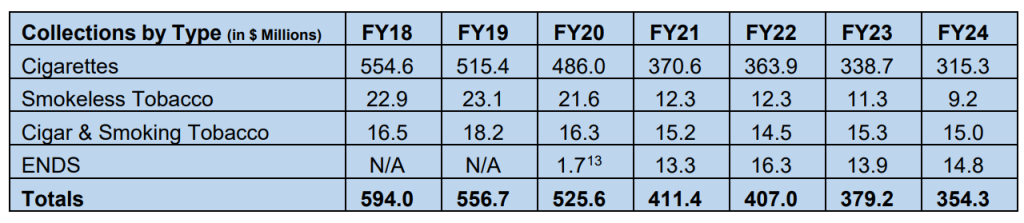
Meanwhile, Massachusetts is becoming the breeding ground for illegal vape sales. Both the (menthol) flavor ban and high tax rates relative to other states provide smugglers an incentive to import such products from other states and sell them to in-state buyers. In 2024, the vape seizures in Massachusetts exploded by 744% to reach 308,100 units. The Multi-Agency Illegal Tobacco Task Force notes that preventing the smuggling of menthol cigarettes and flavored vapes remains a major challenge as smugglers deveelop more sophisticated smuggling operations to counter the Task Force’s targeted investigations.

Download the Annual Report of Massachusetts Multi-Agency Illegal Tobacco Task Force
February 2025: Sales of unauthorised, flavoured disposable vapes in the USA amounted to $2.4 billion in 2024 in tracked channels only
Sales of unauthorised, flavoured disposable vapes in the United States amounted to $2.4 billion in 2024, or 35% of the $6.8 billion worth of e-cigarettes sold in tracked convenience stores and supermarkets, according to the private retail sales data from market research firm, Circana10. Unauthorised vape sales amounted to $3.2 billion in 2023 and $2.8 billion in 2022.

The private Circana data tracks around 11,000 unauthorised flavoured disposable e-cigarette products sold under hundreds of different brand names. However, Circana does not track vapes sales made online, in independent stores and in speciality vape outlets. The figures showed a 25% contraction in flavoured disposable vape sales in 2024. This is in contradiction to Altria’s estimates which reveal a 30% growth in the U.S. vape market in 2024, driven entirely by illegal products. It is clear that tracked channels are irrelavant in depicting the overall US vape market. A detailed overview of the US vape market (legal & illegal, tracked & untracked) is available in our “USA NGP/RRP Market: 2024-2030” report.
Nevertheless, US FDA’s efforts [to crack down illegal vape] seem to have some impact on the illegal brand mix. Previously best-selling brands, such as Esco Bars and Elf Bars, dropped out of the top 10 most sold vapes in 2024 while other brands, including Geek Bar, have taken their place.

February 2025: States are upping their efforts to crackdown on illegal vapes
As part of a coordinated coast-to-coast crackdown, 10 State Attorneys General (AGs) underscored the enforcement actions, including investigations and litigation to combat the illegal vape market. AGs from California, Connecticut, Illinois, Hawaii, Minnesota, New Jersey, New York, Vermont, Ohio and Washington D.C. announced that they are enforcing their respective licensing and consumer protection laws to go after the companies responsible for importing, distributing, selling, and marketing illegal flavored disposable e-cigarettes.

Specifically, Illinois AG filed a lawsuit on January 16, 2025 against the entities responsible for the distribution of one of Illinois’ bestselling disposable vape brands, Posh. Posh products come in various fruit and candy flavors, including Gummy Bear Ice, Ice Cream Cone and Jelly Berry. Illinois AG also initiated an investigation into Midwest Goods, one of Illinois’ largest e-cigarette distributors related to the company’s distribution, sales and marketing of vape products.

Moreover, on February 10, 2025, Trump-aligned Protecting America Initiative launched a new campaign urging state legislators to follow President Trump’s lead in cracking down against illegal vapes produced in China and sold in America. The five-figure ad campaign will run on digital platforms in targeted markets across the country and feature “Trump was Right” tagline. The ad reminds viewers that Trump in 2019 was right about the dangers of illegal Chinese vapes and of Biden’s failure to protect Americans from these unregulated illegal products. It also calls on States to stand with President Trump and take action against illegal Chinese vapes.
February 2025: New York State sued 13 major vape manufacturers, distributors and retailers
New York State filed a complaint in Manhattan federal court against 13 major e-cigarette manufacturers, distributors and retailers for their role in fueling the youth vaping epidemic. The State’s Attorney General11 stated that these companies are responsible for illegally distributing, marketing, and selling flavored disposable vapes – including popular brands such as Puff Bar, Elf Bar, Geek Bar, Breeze, MYLE, and more – which have become extraordinarily popular among minors.
The State is seeking hundreds of millions of dollars in civil fines and damages from the defendants for gross negligence and creating a public nuisance by selling fruit- and candy-flavored vapor products to impressionable children. The AG called the sales illegal under federal law and stated that the defendants did what they did despite knowing the health risks and despite a 2020 state law that bans sales of flavored vapor products and requires vape purchasers to be at least 21.

The defendants include Demand Vape, a Buffalo, New York-based distributor of Elf Bar, the most popular e-cigarette among middle and high school students according to the 2024 National Youth Tobacco Survey (NYTS). Another defendant is Puff Bar, a Glendale, California-based company whose namesake e-cigarette topped the 2022 NYTS survey.
February 2025: FDA creates a new product for nicotine pouches
US Customs and Border Protection announced that the Food and Drug Administration (FDA)’s Center for Tobacco Products (CTP) created a new product code for nicotine pouches as the Chinese exports to the US surge. In December 2024 alone, China’s nicotine pouch exports to the US amounted to almost twice the amount exported in the first 11 months of 2024. Although the China-sourced products still have negligible weight in the US nicotine pouch market, US FDA aims to prevent the emergence of an illegal market similar to the disposable, flavored vapes. In January 2025, US FDA authorized all 20 ZYN products, including the Mint, Cinnamon and Coffee flavored ones, in an attempt to provide a wide range of legal alternatives to the US consumers.

October 2024: US$76 Million of Illegal E-Cigarettes are Seized in Joint Federal Operation
U.S. Food and Drug Administration (FDA), in collaboration with U.S. Customs and Border Protection (CBP), seized 3 million units of unauthorized e-cigarette products, with an estimated retail value of $76 million. This is the largest illegal vape seizure to date.
The seizures are part of a July operation to examine incoming shipments and prevent illegal e-cigarettes from entering the country. In preparation for the operation, the team worked for several months to review shipping invoices and identify potentially violative incoming shipments. Upon examining shipments, all of which originated in China, the team found various brands of illegal e-cigarettes, including Geek Bar and others. In an attempt to evade duties and detection, most of these unauthorized e-cigarettes were intentionally mis-declared as items with no connection to vaping products and with incorrect values. Products that are seized and forfeited to the government will be disposed of in accordance with CBP authorities.
FDA stated that it is on high alert and collaborating with the federal task force partners to accelerate further enforcement actions and stop unauthorized e-cigarettes at the US borders. In June 2024, the FDA and the Department of Justice formed a joint federal task force to curb the distribution and sale of illegal e-cigarettes. For further details on the federal taskforce, see our note from June 2024 below.
October 2024: State-level enforcement against illegal vapes is gaining traction in the US
At the 2024 Capital Markets Day, BAT stated that illegal (flavored) disposable vapes represent two thirds of the £9Bn ($11.7Bn) US vape market. Nevertheless, the state-level enforcement against illegal vapes is gaining traction in the US with enforcement bills (“State Directory Bills”) already enacted in 3 states and to be enacted in the next 3-18 months in an additional 11 states. Thereby, 30% of the vapor industry is set to be covered by an enforcement legislation.
BAT believes that Louisiana sets the blueprint for a comprehensive regulation with dedicated funding and Vuse is set to win with effective enforcement. In Louisiana, legal e-vapor volume increased by +28% and illegal disposable e-cigarette volume in the tracked channels decreased by -91% post-enforcement. However, we should note that most of the illegal disposable sales take place in untracked channels, such as online, vape stores and low-tier retailers (e.g. bodegas). Vuse volume increased by+34% post-enforcement and Vuse’s category beating growth resulted in a +2.1ppts share gain.
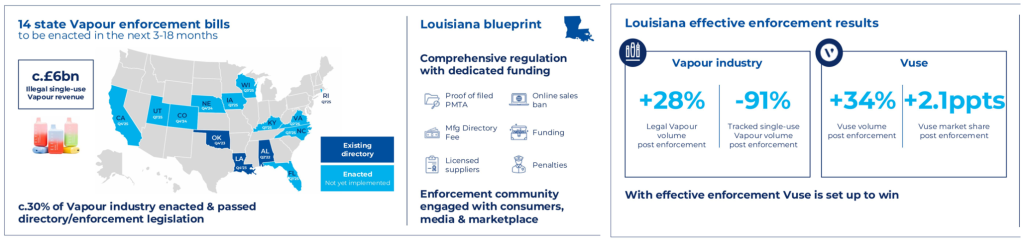
At the federal-level, BAT is actively supporting more effective US e-vapor enforcement. The proposed rule requiring submission of import tracking numbers, federal multi-agency taskforce and increased FDA enforcement actions are seen as positive developments to curb illegal vapes. With 50 pending e-vapor PMTAs and 22 smokeless marketing orders granted (PMTAs approved), BAT claims that its scientific capabilities will pave the way for success in a transformed US nicotine market.

September 2024: FDA takes action against unauthorized e-cigarettes promoted at Industry Trade Show
The US FDA becomes increasingly proactive and hands-on in identifying unauthorized e-cigarette products. Subsequent to observations made by Center for Tobacco Products (CTP) staff attending the trade show, FDA conducted investigations and has issued warning letters to six retailers and manufacturers for selling or distributing unauthorized e-cigarette products. The FDA states that it is illegal to sell and distribute unauthorized tobacco products, including at industry events such as trade shows or expos.
FDA also announced the issuance of warning letters to five online retailers for selling unauthorized e-cigarette products popular with youth, including products marketed under the brand names Breeze, Mr. Fog, and RAZ. These actions are part of FDA’s ongoing efforts to crack down on unauthorized e-cigarettes across the supply chain, including retailers. Throughout the last year, the Agency has conducted inspections of retailers to identify those selling unauthorized e-cigarettes and issued more than 690 warning letters and more than 140 civil money penalty actions to retailers for the sale of unauthorized e-cigarettes.
2024 National Youth Tobacco Survey results revealed that Breeze and Mr. Fog were among the top five most commonly used e-cigarette brands among youth. Additionally, RAZ Vape was identified as a popular brand through routine surveillance, with youth-appealing flavors such as sour mango pineapple and razzle dazzle. Read more about RAZ Vape: Raz Vape.
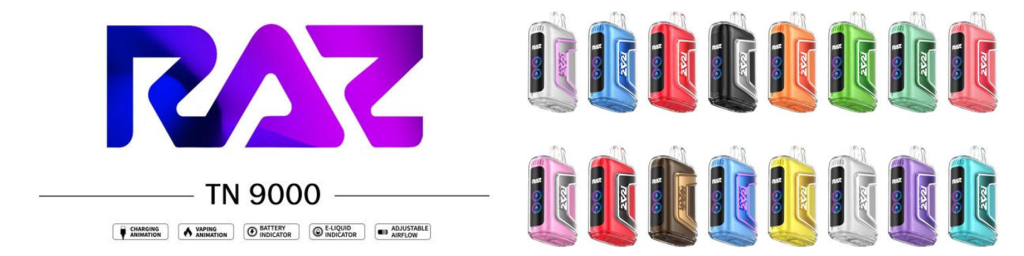
August 2024: Tracking Numbers for Imports of E-Cigarette Products
US FDA and the Department of the Treasury announced a proposed rule that would require an importer to submit the FDA-issued Submission Tracking Number (STN) of Electronic Nicotine Delivery System (ENDS) products into the electronic imports system operated by US Customs and Border Protection. This new requirement will help streamline the process of reviewing the admissibility of ENDS products into the United States12.
After an applicant submits a marketing application for a new tobacco product, FDA assigns a unique identifier called an STN. Under the proposed rule, if finalized, any ENDS product, including e-cigarettes, for which the STN is not submitted may be denied entry into the US. Requiring the STN to be entered into the electronic imports system and automating its review would result in a more effective and efficient import admissibility review process and allow FDA to more quickly identify ENDS products that may be associated with a greater public health risk.
The proposed rule, titled “Submission of Food and Drug Administration Import Data in the Automated Commercial Environment for Certain Tobacco Products,” will be open for public comment through October 15, 2024. This proposed rule is part of FDA’s ongoing effort to address illegal distribution and sale of unauthorized e-cigarettes as part of a coordinated all-of-government approach.
July 2024: Growth of Illicit Trade
“Illegal disposable vape” issue in the US is quickly spreading out to the other product categories, including the nicotine pouches. During the Q2 2024 earnings release, Altria stated that
– illegal flavored disposable vapes represent more than 60% of the e-vapor category
– established (illegal) supply chains and lack of enforcement that supports the illegal e-vapor market fuel increased illicit activity across other tobacco categories, including nicotine pouches and cigarettes
– they identified more than 350 illegal nicotine pouch products across both retail and e-commerce, with new brands launching every month, and the situation echoes the beginning of illegal e-vapor market several years ago
– they sent the data on the growing illegal nicotine pouch market to the US FDA and expect US FDA to direct enforcement actions against illegal nicotine pouch products in addition to illegal e-vapor products
– illegal cigarettes are becoming more prevalent in the US with more than 25% of discarded cigarette packs in California are non-domestic products, originating primarily from duty-free channels and China.
On the other hand, Philip Morris International (PMI) is calmer about the issue: PMI does not believe that the illicit nicotine pouch trade is anything meaningful or material at that stage. PMI is also not aware of US distributors buying ZYN products online from Scandinavia to try and fill the supply shortage at the retail. PMI restates that they are doing everything possible to ensure that the product flows are appropriate (as intended) and parallel flows do not happen.
July 2024: North Carolina – Vape Bill [North Carolina Vape Registry]
The State Directory Bill, added to the House Bill 900, is signed into law in North Carolina. The Bill received bipartisan support in the state legislature and passed with strong majorities in the House and Senate. Recall that North Carolina grows more tobacco than any other state in the US.
According to the Bill, North Carolina will create a registry of legal vaping products and stores won’t be allowed to sell the items not included in the list. Retailers, who sell products that aren’t on the registry, will be fined for initial violations. Subsequent violations can result in the suspension or cancellation of the license of the establishment. The changes will become effective on December 1, 2024.
June 2024: Federal Task Force
The US Department of Justice (DOJ) and the US Food and Drug Administration (FDA) announced the creation of a federal multi-agency task force to combat the illegal distribution and sale of e-cigarettes13.
Alongside with the FDA and DOJ, the task force will bring together multiple law enforcement partners to coordinate and streamline efforts to bring all available criminal and civil tools to bear against the illegal distribution and sale of e-cigarettes. These partners include the Bureau of Alcohol, Tobacco, Firearms and Explosives (ATF), the US Marshals Service (USMS), the US Postal Inspection Service (USPIS) and the Federal Trade Commission (FTC). Additional agencies may join the task force in the future.
The federal task force will focus on several topics, including investigating and prosecuting new criminal, civil, seizure and forfeiture actions under the Prevent All Cigarette Trafficking Act of 2009 (PACT Act), the Federal Food, Drug, and Cosmetic Act (FDCA) as amended by the Family Smoking Prevention and Tobacco Control Act (TCA) and other assigned authorities. Violations of these statutes can result in felony convictions and significant criminal fines and civil monetary penalties. They can also result in seizures of unauthorized products. Through their participation in the task force, USMS will help effectuate seizures of unauthorized e-cigarettes within the US.
The Justice Department is also collaborating with ATF and USPIS on potential criminal and civil enforcement actions. The PACT Act requires online sellers of ENDS products to register with ATF and to verify the age of purchasers both at the point of sale and the point of delivery, as well as to comply with tax collection provisions and state and local laws. The task force will support these actions and coordinate the enforcement strategies.
Finally, the Federal Trade Commission (FTC), which releases reports about cigarette, smokeless tobacco and e-cigarette marketing, and enforces various statutory and regulatory prohibitions on false and misleading advertising, will support the activities of the task force, including by sharing its knowledge about the marketplace for vaping products.
June 2024: BAT – Status Update on Illegal Disposable Vapes
[DB Global Consumer Conference] BAT claims that more than 60% of the £10Bn (retail value) US e-vapor market is made of illegal disposable vapes. 20% is open-system vapes whose status is unclear pending the definitive conclusion of the PMTA reviews. The remaining 20% is closed-system vapes (mostly, pods) in which BAT competes and achieves more than 50% share in terms of revenue (note that these figures are not completely in line with the independent retail audit / scan data).
BAT sees the clear conclusion of the PMTA review process (at some point this year) and public announcement of the products granted marketing orders (i.e. list of authorized products) as the key milestone based on the expectation that Key Accounts (selling 20% of the illegal vapes) will unanimously comply with the legitimate product list (once the uncertainty is removed). BAT also expects penalties to be put in place to address the violations at the vape stores and likes.
BAT highlights the State Directory Bills (see below for further details) as another turning point. In Louisiana, the first state to implement the Directory Bill in Nov 2023, BAT claims that illegal vape sale is declining in double-digits (instead of growing as in the rest of the US) and the most of this decline is captured by VUSE. BAT notes that only 3 out of the 20 states with enacted/pending bills have implemented the legislation so far and the vast majority is coming in early next year; thereby, together with the conclusion of the PMTA review process, a more noticeable improvement (in the “illegal vape issue”) is expected next year.
May 2024: State Directory Bills – Latest status
– Directory Bills are already in place in Alabama, Louisiana and Oklahoma.
– Directory Bill in Louisiana is re-enacted on March 18, 2024. Enforcement of the Bill was temporarily suspended following the filing of a lawsuit by a group of retailers in January 2024.
– Directory Bills are singed into law in Utah, Kentucky, Wisconsin and Virginia: the first two effective from January 1, 2025 and the latter two from July 1, 2025.
– Directory Bill is singed into law in Florida on April 26, 2024.
– The Legislature passed the Directory Bill in Iowa. The Bill is now awaiting state governors’ signatures to become law.
April 2024: Iowa – Vape Bill [Iowa Vape Registry]
State Directory Bill, HF 2677, clears the House of Representatives and the Senate in Iowa in a 90-4 and 42-4 vote, respectively. The Bill will now go to the Governor for a veto or signature. If signed into law, a directory of (permitted) products will be put in place by October 1, 2024. The Iowa Bill
– permits only the vapes that have received a marketing order from the US FDA (PMTA authorized) or have a pending PMTA (ongoing review)
– doesn’t permit the vapes that have appealed the marketing denial orders (MDOs) at court
– doesn’t permit vapes that contain synthetic nicotine
– foresees the formation of a system of fines for the violations by the retailers and wholesalers.
April 2024: South Carolina – Vape Bill [South Carolina Vape Registry]
The “Vape Registry” Bill (S.994) cleared the Senate in South Carolina and will next be tabled at the State’s House of Representatives. According to the Bill, retailers in SC will only be able to sell the vapes that have received a marketing order from US FDA or have a pending (PMTA or court-ordered) review.
March 2024: Kentucky – Vape Bil [Kentucky Vape Registry]
The State Directory Bill cleared the House on a 64-27 vote and the Senate on a 29-7 vote in Kentucky. The Bill will now go to the Governor for a veto or signature. The Legislature has the right to override the Governor in case of a veto. Opponents warn that the Bill promoted by Altria will lead to “monopoly” due to the long and expensive FDA approval process.
The Bill, which would take effect next year, limits vapes that can be sold in Kentucky to those that are FDA-authorized or have a PMTA under review (i.e. first review or successful challenge of previous FDA denial). The Bill will also require tobacco retailers to register at the Secretary of State’s office. The list of registered businesses will be sent to the Department of Alcoholic Beverage Control, which regulates tobacco and vape sales. For a first violation under the Bill, retailers will face a fine of $100 to $500. The penalty will grow to $1,000 for a second offense and $5,000 for third and subsequent offenses. The Bill also includes fines for wholesalers and manufacturers found to be involved in the distribution of unauthorized tobacco products.
March 2024: Florida – Vape Bill [Florida Vape Registry]
After considering a proposal that would severely restrict the number of vapes allowed in Florida (to 23 vapes authorized by the US FDA), Florida lawmakers finally approved a weakened version of the Bill (HB 1007) outlawing only the vapes targeting children. The original had proposal sparked outcry from vape sellers and manufacturers who underlined that the plan would have shuttered mom-and-pop businesses throughout the state.
The final Bill allows the Attorney General (AG) to set up a registry of products deemed off-limits and pursue illegal vape manufacturers and sellers. The AG’s Office is expected to focus on removal of the flavored, disposable vapes from the market.
According to the Florida Retail Federation, Florida is the #1 State in the US in illegal vape sales with $363Mn turnover made in 2023.
February 2024: Enforcement against illegal disposables
In order to restrict the sale of illicit products at retail, 4 US states have already passed and 20 US States are considering legislation requiring manufacturers to certify that their products are compliant with FDA requirements. At the CAGNY Conference, Altria shared some initial data from Louisiana, a state with enacted legislation. The data show that the shipment volume (from wholesale to the tracked retail) for illegal disposable products declined to almost zero within six months after the effective date. Furthermore, the shipment volume for certified products increased accordingly. Note that the Louisiana’s list of permitted products (similar to the lists of Alabama, Oklahoma and Wisconsin) includes not only the 23 FDA-authorized products but also the products that have successfully appealed a marketing denial order or are pending PMTA review.

In Louisiana, more of the illicit volume at retail is in untracked channels (vape stores, e-commerce, smaller independent “bodegas”, etc.) as compared to traditional c-stores. Moreover, a growing number of “tracked channel” c-stores (larger and serviced by wholesale) were selling illegal disposables before the legislation; however, this was still much smaller than the untracked stores.
Back-of-the-envelope estimation: in the Louisiana data presented, certified products (“Directory Products”) have roughly 8 times the volume as illegal disposables in tracked retail in January 2023 (“first data point”) and July 2023 (“effective date”). Assuming that 50% of the overall e-vapor sales is in illegal disposables which could have a similar dominance against the certified products in untracked channels (i.e. 1-to-8) and ignoring any volume/value equalization corrections, the data imply that close to 90% of the illegal disposables were sold in untracked channels in Louisiana. Although this estimate is probably not accurate, it should be true at the order of magnitude level (i.e. vast majority: more than 75%).
Based on the data presented by Altria, we feel more confident that the illegal disposable issue can be addressed by the Directory Bills at the state-level for the tracked channels. However, this is the smaller part of the problem. We don’t know yet to what extent this legislation will be effective in the untracked (“below the radar”) channels (- i.e. for the much bigger part of the problem).
Our understanding is that: large tobacco companies are on top of the “illegal disposable” issue and any progress achieved against the illicit trade is both valuable and encouraging for them. However, both lack of an all-inclusive / effective enforcement (i.e. also covering the “untracked” channels) at the state level and actions taken only on a state-by-state basis could result in slow progress and limited volume recovery from the illicit trade. In addition, without an all-inclusive legislation and enforcement (All states, All channels, All across the supply chain), some consumers may shift to online channels and cross-state trade to continue buying their “illicit” product of choice (Recall: University of California (San Diego)’s research on online shopping for tobacco products following the flavored tobacco ban in California).
According to Altria: There are 9.5Mn disposable vape users in the US (i.e. up from 6Mn in 2022). The ~35% e-vapor category growth in 2023 is solely driven by illegal flavored disposable products – which is now over 50% of the category. Growth in illegal flavored disposable vapes made for 1.5% to 2.5% cigarette industry decline over the last 12 months.
According to BAT: There is currently ~£10Bn ($12.7Bn) revenue pool in the US e-vapor market, of which 60% is related to illegal disposable products.
December 2023: New illegal vapes
Thousands of new illegal e-cigarettes have been launched in the US over the past six months: more than 11,500 unique vaping products are sold in the US stores as of November 2023, up 27% from 9,000 products in June 2023. Nearly all the new products are illegal disposable (flavored) e-cigarettes, according to the Circana (formerly IRI) sales data gathered from c-stores, gas stations and other retailers. Disposable vapes generated $3.2Bn retail sales in the first 11 months of 2023 (excluding the specialty stores ans online sales).
The rise in illegal e-cigarettes sold continues despite a record number of products being denied & detained. FDA refused entry to 374 shipments (consisting almost entirely of vaping products from China) in the first 11 months of 2023, more than triple the 118 shipments refused in 2022.
So far, FDA granted marketing orders to 23 tobacco-flavored vapes from three companies: BAT, Altria/NJOY and Japan Tobacco (for further details: “The US FDA: PMTA“). According to Circana, the combined sales of these 23 products are $174Mn in 2023 – or, in other words, just 2.4% of the total (tracked) market. FDA considers all other e-cigarettes (unless pending PMTA review) to be illegal. FDA aimed to complete all major outstanding PMTAs initially by the mid of 2023 and later by the end of 2023: the Agency recently stated that the process would stretch into 2024.
December 2023: Joint Federal Operation
The US Customs and Border Protection (CBP) seized 41 shipments containing ~1.4Mn units of unauthorized e-cigarette products14, including brands such as Elf Bar, EB Create, Lost Mary and RELX. The estimated retail value of the seized products totals more than $18Mn. The seizures were part of a three-day joint US FDA-CBP operation at a cargo examination site in Los Angeles International Airport.
The US FDA-CBP team worked for months to review shipping invoices and to identify potentially violative incoming shipments in preparation to the operation. In an attempt to evade duties and detection, many of these unauthorized e-cigarettes were intentionally mis-declared as various items such as toys or shoes and listed with incorrect values. Once the seized merchandise is forfeited to the Government, it will be disposed of in accordance with the law.
In a press release, FDA reiterated its commitment to stop the flow of illegal e-cigarettes into the US and reminded that Elf Bar is the most commonly used brand among youth according to the 2023 National Youth Tobacco Survey.
December 2023: Mounting political pressure
Members of the congressional committee on US-China relations sent a request to the Department of Justice (DoJ) and FDA, calling attention to the extreme proliferation of illegal vapes15 and demanding information on the actions taken to stop the recent influx of illegal vapes from China.
The bipartisan letter from 12 committee members requests the DoJ and FDA to work with the Customs and Border Protection to address the problem with all due speed. In addition, lawmakers specifically ask whether DoJ’s consumer protection branch has sufficient resources or expertise to litigate vapor-related referrals from the FDA.
This special congressional committee was established early this year with the goal of countering Chinese policies that can damage the US economy.
October 2023: Altria – “flavored disposable e-cigarettes are eating into cigarette volumes”
In Q3 2023 earnings release, Altria – for the first time – stated that there is more cross-category movement (from cigarettes to e-vapor) than previously assumed and the growth of illegal flavored disposable e-cigarettes contributed to cigarette volume declines in the range of 1.5% to 2.5% over the last 12 months. BAT has long been voicing concerns about the illicit e-cigarette sales; however, BAT’s concerns were focused around the unfair competition against the VUSE brand (- until the Interim Business Update in December 2023 when they stated that “illegal disposal vapes are having more and more impact on cigarettes as well”).
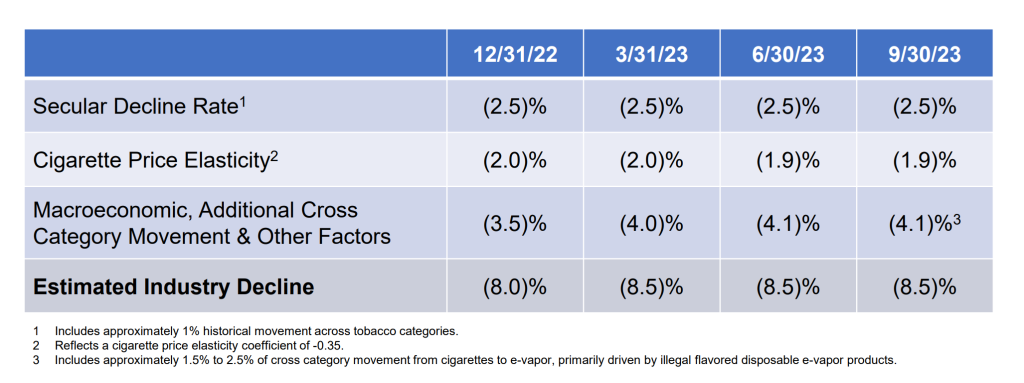
We understand Altria’s intention to signal that “enforcement against illegal e-cigarettes” will slow down the cigarette volume decline and could even lead to volume recovery to cigarettes (- the latter is unlikely). However, informed investors are likely to read this differently: “The Almighty Marlboro is losing adult smokers to Elf Bar!” Shocker! This is extremely damaging to the Marlboro’s brand equity (superior taste/flavor proposition) – the ultimate asset Altria owns.

After spending ~$16Bn, Altria has 2% share in the e-vapor category in traditional retail. It is unclear to what extent Altria can build up NJOY’s share; but, we know – for fact – that money-printing Marlboro brand has 42.3% share in US cigarette market. Even if the illegal e-cigarettes are removed from the market, the US FDA will eventually clear the PMTA review backlog and, over time, more scientifically-substantiated (tobacco flavored) e-cigarettes & heated tobacco products will be available to the US smokers. If “lower consumer stickiness to the Marlboro brand (flavor)” and “increased cross-category movements” are incorporated into Altria’s financial model, Altria’s market value will be fundamentally damaged.
Altria Management achieved the headlines they wished for; every major news outlet reported that flavored disposable e-cigarettes are eating into cigarette volumes. Nevertheless, what they wished for could turn out to be not in their best interest in the long-run.
October 2023: Altria’s sweeping litigation
Altria’s NJOY filed litigation against 34 foreign and domestic manufacturers, distributors and online retailers of disposable e-vapor products that violate California’s flavor ban law and are unlawful under federal law (subject to FDA action)16. Altria states that these companies illegally compete against companies that comply with state and federal laws. The suit seeks a nation-wide injunction against the import, marketing and sale of these products and significant compensatory and punitive damages. The litigation, filed in the US District Court of California, is brought under four claims: unfair competition, false advertising, false advertising in violation of the Lanham Act and violation of the Prevent All Cigarette Trafficking Act of 2009. Named defendants in the suit manufacture and distribute disposable e-vapor products which include brands such as Breeze, Elf Bar, EB, EB Create, Esco Bar, Flum, Juice Box, Lava Plus, Loon, Lost Mary, Mr. Fog and Puff Bar.
Altria notes that the defendants has not received pre-market authorization from the FDA and, in many instances, have not even filed PMTA. Despite a ban on the sale of flavored tobacco products that went into effect in December 2022, flavored vapor products make up more than 97% of the California market according to a recent study commissioned by Altria.
October 2023: Cannabis vaping benefiting from lack of “legality”
Cannabis vaping is reported to reach the same market size as the nicotine vaping in the US17 – as the legal e-cigarette category face the US FDA restrictions and cannabis vapes benefit from the lack of federal-level legality & regulation. US e-cigarette market is (under-)estimated at US$6Bn (after 15 years of existence) whereas a recent report claims that cannabis vapes already generate $6.8Bn in sales – about a quarter of the entire US cannabis market. With only state-by-state cannabis legalization and no federal regulator involved, the growth trajectory for cannabis vapes looks better than nicotine vapes (- another “JUUL Moment” brewing). 64% of the cannabis sales in the US is still illicit – despite the illicit share being down from 86% in 2017.
Smoore (CCEL), Ispire and Advanced Vapor Devices are named as the main suppliers for cannabis vaping devices – a segment claimed to be worth $700Mn.
October 2023: Inflow of unauthorized e-cigarettes
The US authorities are struggling to restrain the inflow of unauthorized e-cigarettes, mainly through major shipping hubs like Los Angeles and Houston. Chinese disposable e-cigarette, Elf Bar, is defying the US import ban by deploying a simple tactic: name change18. In May, US FDA directed customs officials to seize incoming shipments of Elf Bar and EBDesign: Elf Bar quickly re-branded itself as EBCreate and changed the product owner from Shenzhen-based, iMiracle Technology, to Hong Kong-based, Nevera HK Limited. The AP reported in June that the number of unique e-cigarettes in the US has tripled to over 9,000 since 2020, a surge driven almost entirely by Chinese-manufactured disposables. Elf Bar generated US sales of over $270Mn last year, according to the Nielsen data (note: this is an under-estimation).
Recall: In Feb 2023, BAT submitted a citizen petition asking the US FDA to adopt a new enforcement policy against illegal vapes.
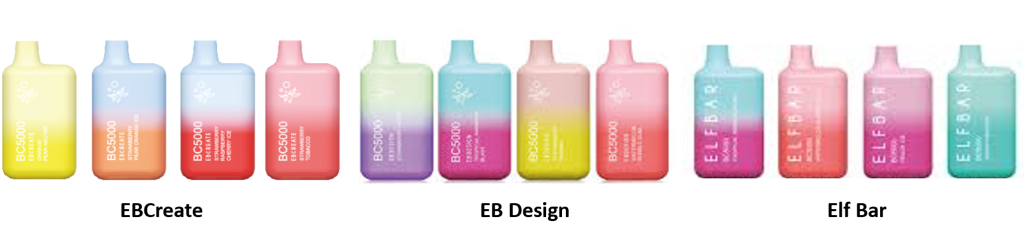
Background
The World Health Organization (WHO) defines “illicit tobacco trade” as “any practice or conduct prohibited by law and which relates to production, shipment, receipt, possession, distribution, sale or purchase including any practice or conduct intended to facilitate such activity”.
The most common form of illicit tobacco trade for cigarettes are:
– Contraband: genuine cigarettes that have been bought in a low-tax country and which exceed legal border limits or are acquired without taxes for export purposes, to be then illegally re-sold in a market with higher prices
– Counterfeit: cigarettes manufactured without authorization of the rightful owners and with intent to deceive consumers and to avoid paying duty
However, the situation is different for the RRPs. Like the category itself, the illicit trade in RRPs (heated tobacco, e-cigarettes and modern oral tobacco) are also in a nascent stage.
– E-cigarettes: As the category is largely un-taxed (i.e. no excise tax), prices vary little from one market to another. Thereby, contraband is not a relevant issue. Moreover, as there are no strong brands or technologically superior products (- with underlying technology being shared by the manufacturers), counterfeit is not a relevant issue either. Illicit trade activities most commonly observed for the category include: e-cigarette sales in countries/channels where the category is banned and selling e-cigarettes that don’t comply with the legal specifications in terms of nicotine content and/or flavors. The current situation of illicit trade in modern oral tobacco is similar to that of e-cigarettes.
– Heated tobacco: This category can be seen as the extension of traditional tobacco for which both contraband and counterfeit could be relevant. However, the emergence of sizable consumer group and well-known brands are the two prerequisites for the illicit product. PMI’s TEREA/HEETS (used with IQOS) is probably reaching a tipping point in this regards. There are already some reported cases of contraband heated tobacco sticks. However, considering the technology involved in the IQOS product, PMI is better positioned to fight the illicit trade when compared to the conventional cigarettes.
References:
- https://www.reuters.com/business/fiserv-service-station-operators-including-bp-warn-us-stores-illegal-vapes-2026-07-03 ↩︎
- https://www.reuters.com/world/shopify-bar-vapes-us-authorities-crack-down-illegal-industry-2026-06-23 ↩︎
- https://www.wsj.com/politics/policy/white-house-pushes-for-flavored-vapes-blocked-by-fda-head-2f8f0138 ↩︎
- https://www.reuters.com/business/healthcare-pharmaceuticals/vape-makers-turn-made-america-credentials-amid-trumps-tariffs-crackdown-2026-04-07 ↩︎
- https://www.nytimes.com/2026/03/09/health/fda-e-cigarettes-flavors.html ↩︎
- https://www.dea.gov/press-releases/2025/09/22/operation-vape-trail-cracks-down-illegal-substances-vape-shops ↩︎
- https://www.reuters.com/business/healthcare-pharmaceuticals/usps-blocks-shipping-illicit-vapes-boost-big-tobacco-2025-08-11 ↩︎
- https://www.publichealthlawcenter.org/resources/state-e-cigarette-registry-bill-map ↩︎
- https://www.washingtonexaminer.com/news/white-house/3406586/trump-administration-taking-action-combat-trump-chinese-vapes-attack ↩︎
- https://www.reuters.com/business/retail-consumer/illegal-us-vape-sales-worth-least-24-billion-2024-data-shows-2025-02-24 ↩︎
- https://ag.ny.gov/press-release/2025/attorney-general-james-sues-nations-largest-vape-distributors-fueling-youth ↩︎
- https://www.fda.gov/tobacco-products/ctp-newsroom/fda-announces-proposed-rule-require-submission-tracking-numbers-imports-e-cigarette-products ↩︎
- Justice Department and FDA Announce Federal Multi-Agency Task Force to Curb the Distribution and Sale of Illegal E-Cigarettes | FDA ↩︎
- https://www.fda.gov/news-events/press-announcements/joint-federal-operation-results-seizure-more-18-million-illegal-e-cigarettes ↩︎
- U.S. lawmakers are trying to ban Elf Bar and other e-cigarettes from China, again | Fortune ↩︎
- https://investor.altria.com/press-releases/news-details/2023/NJOY-Brings-Sweeping-Litigation-Against-Illicit-Disposable-Vapor-Manufacturers ↩︎
- FDA Vape Ban? Nicotine Devices Hit Trouble While Pot Vape Grows – Bloomberg ↩︎
- https://thehill.com/homenews/ap/ap-business/ap-elf-bar-finds-an-easy-way-around-us-vape-import-ban-a-name-change/ ↩︎

